
A Quiet Meditation on Love, Distance, and Time, Where Two Lives Move Like Shadows Across a Candlelit Floor
When Emmylou Harris and Rodney Crowell released Spanish Dancer in 2013 as part of their collaborative album Old Yellow Moon, the song arrived not as a commercial statement but as a deeply personal reflection. The album itself debuted at No. 1 on Billboard’s Top Folk Albums chart and reached No. 29 on the Billboard 200, an impressive achievement for a work rooted in restraint, maturity, and emotional subtlety rather than radio ambition. Spanish Dancer was never issued as a chart-focused single, and it did not enter major singles rankings, which in many ways suits its spirit. This is a song meant to be lived with, not measured.
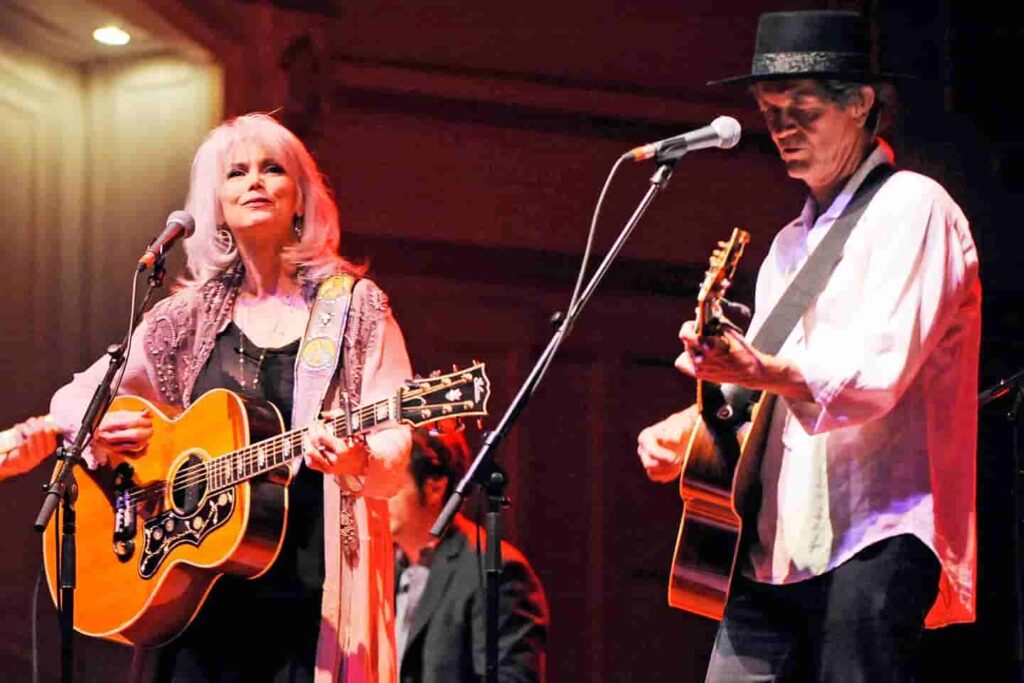
By the time Harris and Crowell performed Spanish Dancer live at Laeiszhalle in Hamburg on May 31, 2013, the song had already taken on added resonance. These were not young artists presenting a new romance. They were two veterans of American music, bound by decades of shared history, separation, reconciliation, and artistic kinship. Their performance that night carried the weight of lived experience, something no chart statistic could ever quantify.
Spanish Dancer was written by Rodney Crowell, a songwriter long admired for his ability to compress emotional complexity into deceptively simple lines. The song’s narrative unfolds quietly. There is no dramatic climax, no declaration, no resolution. Instead, Crowell paints an image of a woman moving through space like memory itself, graceful, distant, and slightly out of reach. The dancer becomes a symbol rather than a character. She is love remembered, love admired from afar, love that never quite settles into permanence.
The lyrics speak of observation rather than possession. This is love seen across a room, across years, across choices already made. In Crowell’s writing, the dancer’s movement mirrors the passage of time. Beautiful, fleeting, and impossible to hold still. There is a profound acceptance embedded in the song. Not resignation, but understanding. Some loves are meant to be witnessed, not claimed.
Emmylou Harris delivers the song with a voice that feels weathered in the most human way. By 2013, her singing had shed any remaining polish of youth, replaced by a tone that carried honesty and fragility. She does not embellish the melody. She trusts it. Every phrase feels considered, as though she is walking carefully through old memories. Her harmony with Crowell is not romantic in the traditional sense. It is companionable, intimate, and deeply respectful.
What makes Spanish Dancer especially meaningful is the context of Old Yellow Moon itself. Harris and Crowell had once been married, divorced, and then spent decades apart before reuniting creatively. This history is never explicitly referenced, yet it quietly informs every note. The album, and this song in particular, feels like a conversation resumed after many years of silence. Not to reopen wounds, but to acknowledge them with grace.
Musically, the arrangement is understated. Acoustic guitar, gentle rhythm, and spacious production leave room for reflection. There is a deliberate avoidance of excess. Each instrument knows when to step back. This restraint allows the song’s emotional core to breathe. Silence becomes as important as sound.
For listeners who have lived long enough to recognize the difference between passion and endurance, Spanish Dancer resonates deeply. It speaks to the loves that shaped us without defining us, to the people who passed through our lives and left an imprint that time never erased. The song does not ask the listener to mourn. It invites remembrance.
The live performance in Hamburg captures this essence perfectly. There is a stillness in the hall, a sense that the audience understands they are witnessing something rare. Two artists standing together, not to relive the past, but to honor it quietly.
In the end, Spanish Dancer is not about dancing at all. It is about movement through life. About watching someone you once loved continue on their path, and finding peace in that vision. It is a song for those who have learned that not all stories need an ending to be complete.