
A Song About Choosing the Wind Over the Shore and Accepting the Risk of Becoming Who You Truly Are
When “The Cape” appears in the catalog of Guy Clark, it stands not as a commercial triumph but as a philosophical centerpiece. First released on the 1995 album Dublin Blues, the song did not enter the Billboard singles charts upon its debut. That absence, however, is entirely consistent with Clark’s career. He was never an artist measured by chart momentum or radio saturation. His legacy was built quietly, line by line, among listeners who valued wisdom over volume and truth over trend.
Dublin Blues, released in 1995, is often regarded as one of Guy Clark’s finest late career statements. It arrived after years of personal struggle, creative doubt, and physical pain. Within that context, “The Cape” functions as a kind of moral compass. While other songs on the album look backward at memory, regret, and friendship, this one looks forward and upward, asking a deceptively simple question: what happens when we finally decide to leap.
The song’s narrative is spare and deliberate. A young boy climbs onto the roof of his house wearing a cape, believing he can fly. His father watches, conflicted but silent. The boy jumps, falls, and breaks his leg. Years later, the man reflects that the boy did not lose his belief in flight. He only learned that timing matters. The brilliance of “The Cape” lies in its restraint. Clark never explains the metaphor outright. He trusts the listener to recognize themselves in the boy, in the father, or in the moment between fear and faith.
This song has often been described as autobiographical in spirit, though not in literal detail. Guy Clark spent much of his life resisting safer paths. He turned down commercial songwriting formulas, declined to soften his edges, and remained committed to craft even when recognition came slowly. “The Cape” captures that philosophy without bitterness. It does not condemn caution, nor does it glorify reckless ambition. Instead, it honors the courage to try, to fall, and to try again with deeper understanding.
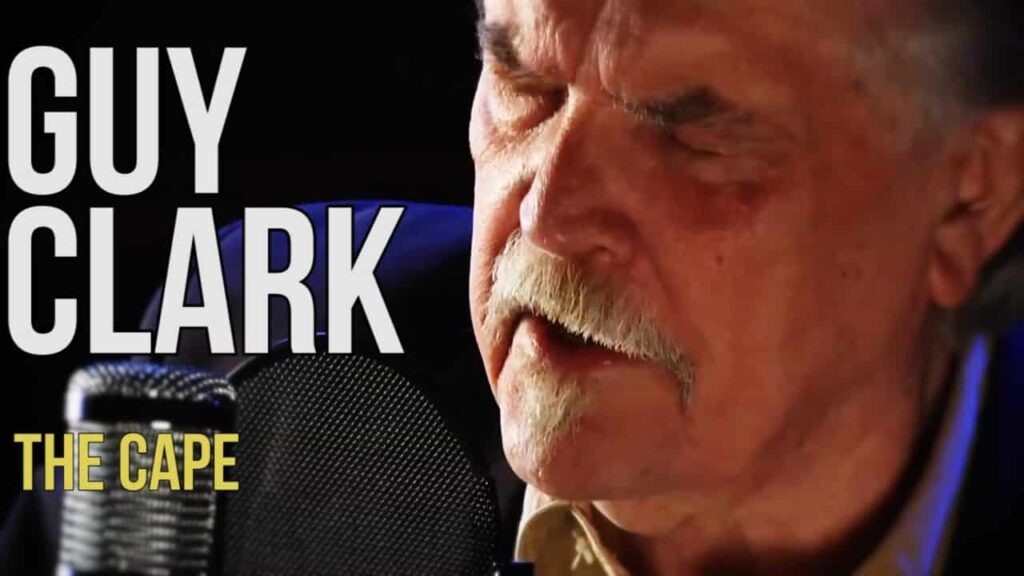
The version recorded live at Marathon Recorders in Nashville during the Music Fog Marathon at the 2011 Americana Music Festival offers a particularly revealing interpretation. By that time, Clark was in his seventies, visibly frail, his voice weathered by illness and age. Yet the performance carries extraordinary weight. The years between the boy on the roof and the man at the microphone collapse into a single moment. When Clark sings the final lines, there is no performance left, only testimony. The audience listens in near silence, aware that they are not hearing a song so much as a summation of a life spent choosing the wind.
Musically, “The Cape” is understated. Its melody moves gently, almost conversationally, supported by acoustic instrumentation that never intrudes on the story. This simplicity is intentional. Clark understood that a song like this could not be improved by embellishment. Every extra note would only distract from the gravity of the words.
Over time, “The Cape” has become one of Guy Clark’s most quoted and cherished songs, frequently covered by artists across the Americana and folk spectrum. Its enduring appeal lies in its honesty. It speaks to aging without despair, to ambition without illusion, and to wisdom earned through lived experience rather than instruction.
For listeners who have known both the fear of jumping and the ache of landing, “The Cape” does not offer comfort in the traditional sense. Instead, it offers recognition. It reminds us that failure is not the opposite of flight. Sometimes it is simply the first lesson.