
A Closed Door in New Orleans, Where Pride Speaks Louder Than Love
When “I Hear You Knocking” first appeared in 1955, it carried with it the unmistakable sound of New Orleans rhythm and blues, a city where music breathed through open windows, late-night clubs, and front porches after the heat of the day had settled. Written by Dave Bartholomew, one of the most important architects of New Orleans R&B, the song was first recorded by Smiley Lewis, whose weary, half-spoken vocal style gave the lyric its quiet authority. Released on Imperial Records, Lewis’s version climbed to No. 2 on the Billboard R&B Singles chart in 1955, becoming the biggest hit of his career and securing the song’s place in American music history.
At its core, “I Hear You Knocking” tells a deceptively simple story. A former lover returns, knocking at the door, hoping to be let back into a life they once abandoned. The response is firm and final. The door remains closed. In an era when rhythm and blues often explored heartbreak through longing and regret, this song stood apart by offering something rarer: emotional resolve. There is pain beneath the surface, but there is also dignity. The narrator has learned the cost of love and refuses to pay it twice.
The power of the song owes much to Dave Bartholomew, who not only wrote it but also helped shape the New Orleans sound through his work as a bandleader, arranger, and producer. His partnership with Fats Domino defined an era, blending rolling piano lines, relaxed backbeats, and horn arrangements that felt conversational rather than aggressive. Although Smiley Lewis was the first to bring the song to life, it was inevitable that Fats Domino would one day place his own unmistakable stamp on it.
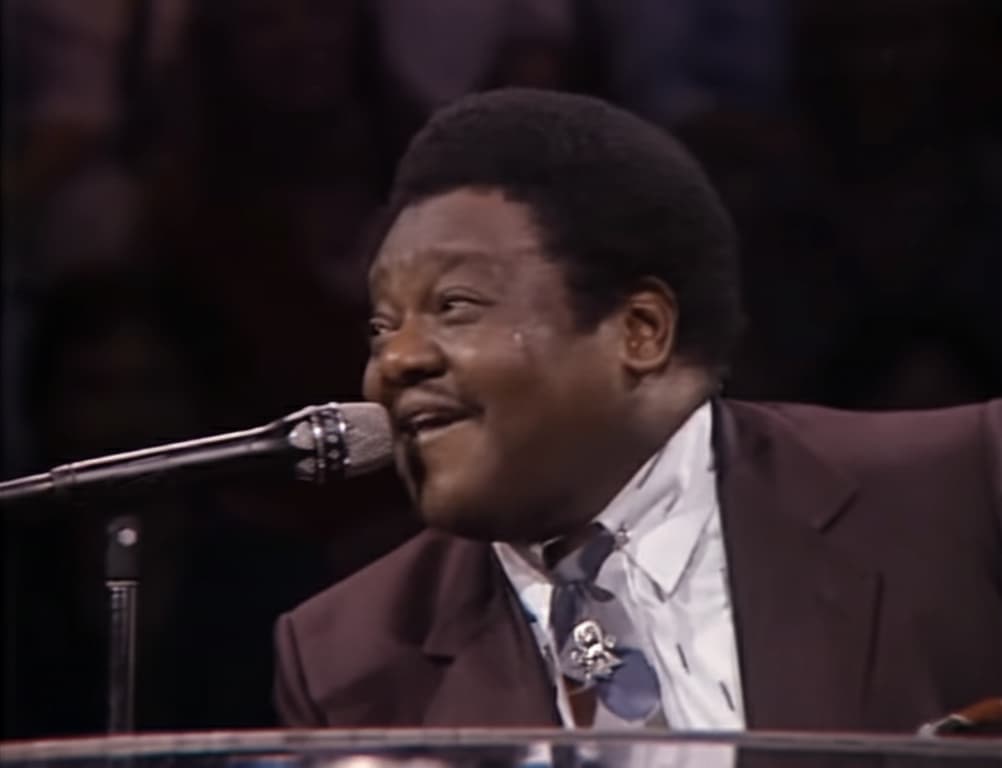
Fats Domino recorded “I Hear You Knocking” in 1961 for his album Let’s Dance with Domino. By that point, Domino was already a global star, known for hits such as “Blueberry Hill”, “Ain’t That a Shame”, and “Walking to New Orleans.” His version of “I Hear You Knocking” was not released as a major single and did not chart, but its significance lies elsewhere. Domino transformed the song from a tense confrontation into something warmer and more reflective. His gentle piano, relaxed tempo, and reassuring vocal delivery soften the sting of rejection without weakening its message. The door is still closed, but there is no bitterness in the voice explaining why.
This contrast highlights one of Fats Domino’s greatest strengths as an artist. Even when singing about disappointment or emotional boundaries, he conveyed humanity and grace. His interpretation feels less like an argument and more like a quiet conversation at the end of a long road. It reflects the maturity of a man who has seen enough of life to know that not every knock deserves an answer.
The enduring appeal of “I Hear You Knocking” is proven by its long life beyond the 1950s and 1960s. In 1970, Welsh singer and guitarist Dave Edmunds recorded a stripped-down rock version that reached No. 1 on the UK Singles Chart for six consecutive weeks, bringing the song to a new generation and a new musical language. Yet even in that louder, sharper arrangement, the essence of the song remained unchanged. Pride, memory, and self-respect stood at its center.
For listeners who grew up with rhythm and blues, “I Hear You Knocking” resonates as more than a hit record. It reflects a time when songs were built on lived experience rather than spectacle. Whether delivered through Smiley Lewis’s world-weary voice or Fats Domino’s comforting warmth, the song speaks to moments when looking back is tempting but moving forward is necessary.
In the end, “I Hear You Knocking” is not about rejection alone. It is about knowing oneself, recognizing the cost of reopening old wounds, and having the quiet strength to keep the door closed. That message, carried on the gentle rhythms of New Orleans, continues to echo long after the knocking has stopped.