
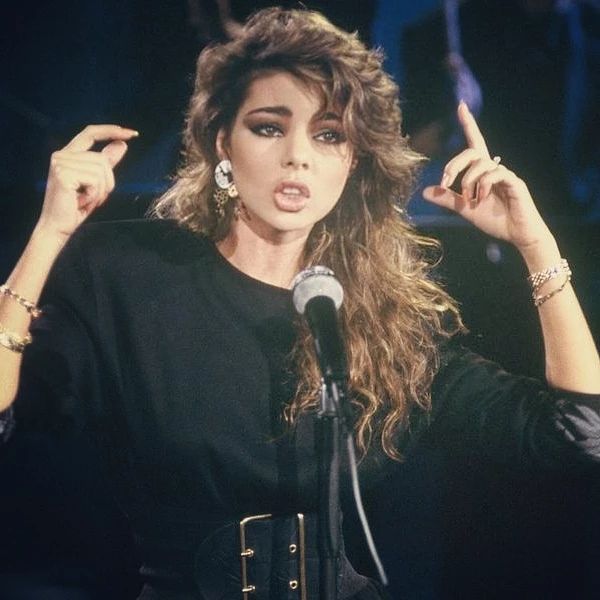
A crystalline anthem of forbidden longing and the fierce preservation of self, echoing through the neon-dusted memories of the mid-eighties.
In the grand tapestry of European pop music, few threads shimmer with as much mysterious elegance as the voice of Sandra. When the needle dropped on “(I’ll Never Be) Maria Magdalena” in the summer of 1985, it didn’t just climb the charts; it captured the collective heartbeat of a continent. Reaching Number 1 in over 20 countries—including Germany, Switzerland, Sweden, and Norway—and breaking into the top echelons of the UK Singles Chart at Number 87 (and later becoming a global club phenomenon), this track was the definitive breakthrough for an artist who would become the “Euro-pop Queen.”
The Genesis of a Global Phenomenon
The story of “Maria Magdalena” is one of serendipity and artistic chemistry. Before the world knew her as a solo powerhouse, Sandra Ann Lauer had tasted success with the girl group Arabesque. However, it was her partnership—both professional and later personal—with the visionary producer Michael Cretu that changed everything. Cretu, who would later achieve worldwide acclaim with Enigma, understood that Sandra possessed a unique vocal timbre: a mixture of youthful innocence and a sophisticated, worldly melancholy.
Recorded at the Data-Alpha-Studio in Munich, the song was the lead single from her debut studio album, The Long Play. The creative team, including songwriters Hubert Kemmler, Markus Löhr, and Michael Cretu, crafted a sound that was light-years ahead of its time. The driving bassline, the ethereal synthesizers, and the iconic male backing vocals (provided by Hubert Kah) created a sonic landscape that felt both futuristic and deeply rooted in the romantic traditions of old Europe.
The Weight of the Name: Meaning and Symbolism
For those who listen closely beneath the infectious beat, the song carries a weight of profound introspection. The title itself invokes the biblical figure of Mary Magdalene, a woman whose legacy has been shrouded in layers of myth, judgment, and misunderstanding for two millennia. By declaring “(I’ll Never Be) Maria Magdalena,” the narrator is asserting a fierce independence.
The lyrics speak to a lover who demands a saintly devotion or a specific, perhaps subservient, role. It is a refusal to be cast in a mold that doesn’t fit—a declaration that while she can love deeply, she will not surrender her identity to satisfy a partner’s idealized or “holy” expectations. It captures that moment in life when we realize that to truly love another, we must first refuse to lose ourselves. There is a palpable sense of “the night” in this song—the “promised land” mentioned in the lyrics represents a space of freedom where two people can exist without the baggage of traditional roles.
A Journey Through Time
To look back at the 1980s through the lens of this song is to remember a time of vibrant change. Sandra’s image—the big hair, the expressive eyes, and the effortless chic—became a symbol of a generation that was moving away from the starkness of the late seventies into a world of color and sound. For many, this song is tied to memories of Mediterranean summers, the hum of a cassette player in a first car, or the dimly lit dance floors of a youth that felt like it would never end.
The brilliance of “(I’ll Never Be) Maria Magdalena” lies in its duality. It is a song you can dance to with abandon, yet it is also a song that invites you to sit by a window on a rainy evening and reflect on the loves you didn’t let define you. It remains a masterpiece of the Euro-disco genre precisely because it treats pop music as a serious vessel for human emotion. Sandra didn’t just give us a hit; she gave us an atmospheric companion for our own journeys of self-discovery.