
“Pretty Boy Blue” – A Gentle Pop Ballad Where Innocence, Longing, and the Fragility of Young Love Quietly Meet
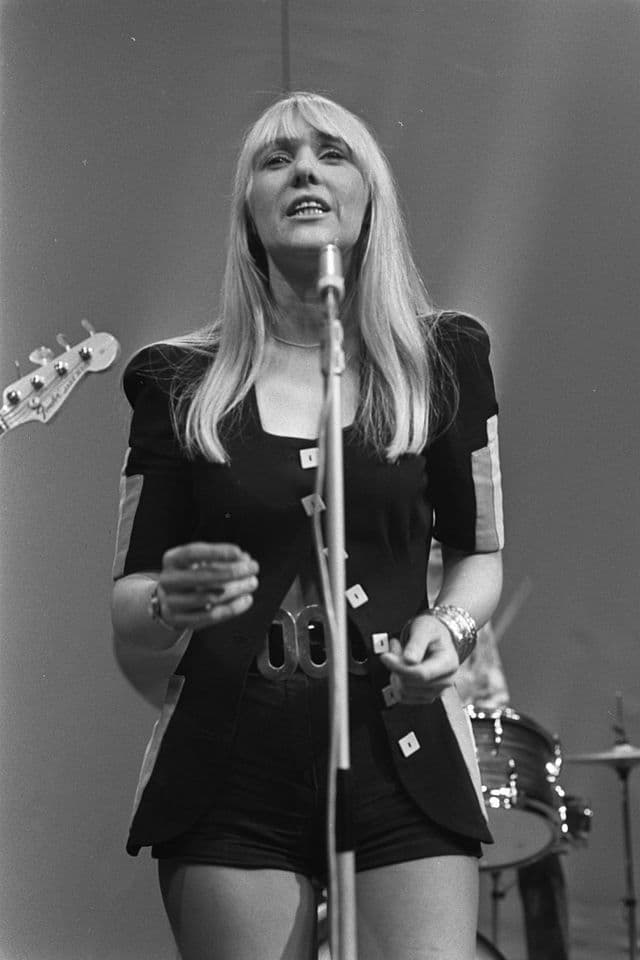
Among the many European pop records of the early 1970s, “Pretty Boy Blue” remains one of the most tender and emotionally resonant performances associated with Sally Carr, the distinctive voice of the Scottish pop group Middle of the Road. Released as a single in 1973, during the group’s remarkably successful run across continental Europe, the song offered listeners something different from the bright, sing-along pop that had first made the band famous. While earlier hits like “Chirpy Chirpy Cheep Cheep,” “Tweedle Dee, Tweedle Dum,” and “Soley Soley” thrived on cheerful hooks and rhythmic energy, “Pretty Boy Blue” revealed another side of the band: softer, reflective, and emotionally intimate.
When the single appeared, Middle of the Road were already well established in the European charts. Their earlier records had dominated radio across Germany, Switzerland, the Netherlands, and Scandinavia. “Pretty Boy Blue” continued that success, reaching the Top 20 on the UK Singles Chart (peaking around No. 12) and performing strongly across several continental European markets, particularly Germany, Switzerland, and Norway, where the group had built an especially loyal audience. Although it was not as explosive commercially as the band’s earliest hits, the song became one of the most beloved recordings in their catalogue, remembered particularly for the emotional warmth of Sally Carr’s vocal performance.
At the heart of “Pretty Boy Blue” lies a delicate storytelling style that was common in early-1970s European pop ballads. The lyrics portray a young man — the “pretty boy” of the title — who carries both charm and sadness within him. There is an underlying sense that beauty and youth can hide a fragile emotional world. Rather than presenting a simple love story, the song suggests a deeper emotional portrait: a boy admired by many, yet perhaps misunderstood or lonely beneath the surface.
This theme resonated strongly with listeners of the time. The early 1970s were an era when pop music frequently explored the bittersweet edges of romance — the moment when innocence begins to fade and life becomes more complicated. In “Pretty Boy Blue,” the narrative voice seems to observe the boy with both affection and quiet concern. The tone is gentle rather than dramatic, almost like a soft memory being recalled years later.
Musically, the arrangement reflects that reflective mood. The production relies on lush orchestral touches, restrained rhythm, and melodic phrasing that allows the vocal to breathe naturally. Unlike the energetic stomp of the band’s earlier hits, this recording moves at a slower, almost lullaby-like pace. It is the kind of arrangement that invites the listener to lean in rather than clap along.
And then there is Sally Carr herself. Her voice carries the entire emotional weight of the song. Carr possessed a remarkably clear tone — bright yet warm — and in “Pretty Boy Blue” she uses it with remarkable subtlety. She does not over-dramatize the lyric. Instead, she sings with a quiet sincerity that makes the story feel personal, almost conversational. It is precisely this restraint that gives the performance its lasting emotional power.
Behind the scenes, Middle of the Road were working within the highly productive European pop industry of the early 1970s, recording frequently and touring extensively across the continent. The group’s success was particularly strong in Germany, where television appearances and radio play helped maintain their popularity long after their British chart dominance had cooled. Songs like “Pretty Boy Blue” demonstrated that the band could evolve beyond novelty pop and embrace more reflective material without losing their melodic identity.
Over the decades, the song has taken on an almost nostalgic glow. For many listeners who first encountered it on European radio in the early 1970s, “Pretty Boy Blue” feels like a quiet snapshot of that era — a time when pop songs were often simple, melodic, and deeply sincere. Its gentle melody and reflective lyric evoke the feeling of a memory revisited after many years: a face once admired, a story half-understood, a moment of youth preserved in music.
Today, when revisiting the catalogue of Middle of the Road, the song stands out not because it was the biggest hit, but because it reveals the emotional heart behind the group’s polished pop sound. “Pretty Boy Blue” reminds us that sometimes the most enduring songs are not the loudest or the most triumphant. Instead, they are the quiet ones — the songs that linger softly in the mind long after the music fades.