
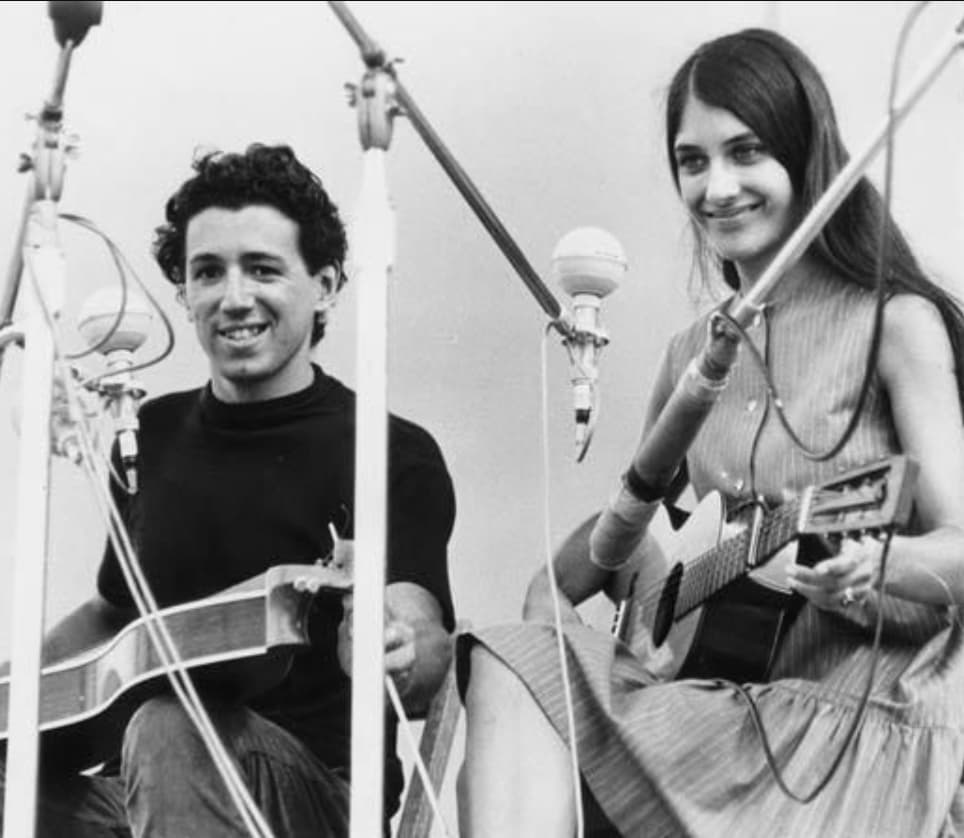
A Gentle Farewell to Sorrow — A Song That Carries Pain Lightly, Yet Deeply
When speaking of the quiet, reflective corners of 1960s folk music, one cannot overlook “Pack Up Your Sorrows” by Richard & Mimi Fariña—a song that feels less like a performance and more like a shared moment between kindred spirits. Released in 1965 on the album Celebrations for a Grey Day, the track did not storm the mainstream charts, yet it found a lasting home within the folk community, where emotional truth mattered far more than commercial ranking. In many ways, its legacy surpasses numbers; it became a song people carried with them rather than one they merely heard.
The album itself reached modest success, peaking at No. 32 on the Billboard 200, a respectable position for a folk record in a decade increasingly dominated by electrified sounds. But Richard Fariña and Mimi Fariña were never chasing chart positions. Their music belonged to a more intimate space—coffeehouses, small gatherings, and the quiet hours when reflection feels unavoidable.
What makes “Pack Up Your Sorrows” endure is its delicate balance between melancholy and comfort. The song gently suggests that while sorrow is inevitable, it need not define us. With its soft melody and tender harmonies, it offers a kind of emotional companionship. Rather than denying pain, it acknowledges it—and then quietly encourages us to carry on. The refrain feels almost like a whispered reassurance: that burdens can be folded away, even if only for a little while.
Behind the song lies the unique partnership of its creators. Richard Fariña, a novelist and musician with a restless creative spirit, brought a poetic sensitivity shaped by his literary ambitions. His marriage to Mimi Fariña, the younger sister of Joan Baez, formed one of the most intriguing duos of the folk revival. Mimi’s voice—clear, warm, and unassuming—gave Richard’s introspective writing a human softness that made even the heaviest themes feel approachable.
There is also an unspoken poignancy when listening to the song today. Richard Fariña’s life was tragically cut short in 1966, just a day after his 29th birthday. Knowing this, “Pack Up Your Sorrows” takes on an almost prophetic quality, as though it carries a quiet awareness of life’s fragility. It is not a song of grand statements, but of small, meaningful gestures—of choosing resilience in the face of uncertainty.
Musically, the arrangement is deceptively simple: acoustic guitar, subtle instrumentation, and harmonies that feel effortlessly natural. Yet within that simplicity lies a depth that many more elaborate productions fail to achieve. It reflects the ethos of the folk movement—honesty over spectacle, sincerity over perfection.
Over the years, the song has been covered by various artists, most notably Judy Collins, whose interpretation helped introduce it to a wider audience. Still, there is something uniquely intimate about the original recording. It feels as though Richard and Mimi are sitting just across from you, sharing a quiet conversation about life’s burdens and the small courage it takes to set them aside.
In the end, “Pack Up Your Sorrows” is not just a song—it is a gentle philosophy. It reminds us that while life may be filled with moments of weight and weariness, there is always a choice, however small, to move forward. And sometimes, that choice begins with something as simple as packing away our sorrows, if only for the length of a song.