
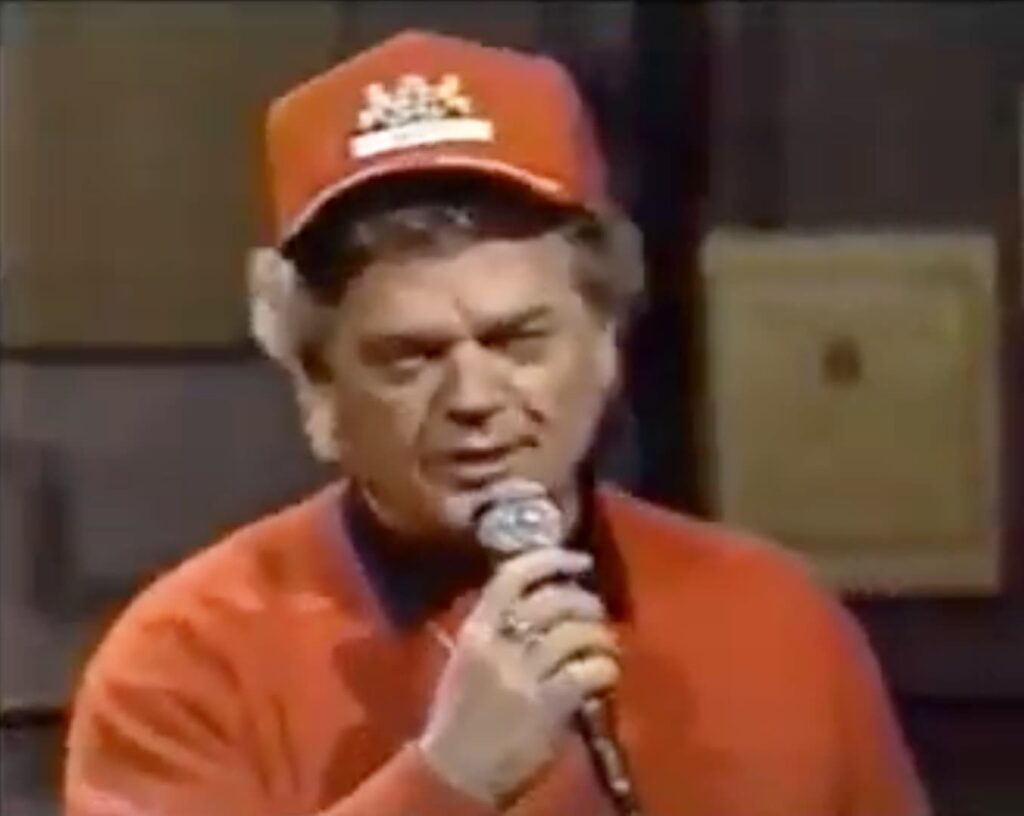
A Country Legend Walks Into Late Night, Bringing Charm, Humor, and a Song That Still Burns Bright
When Conway Twitty appeared on the Late Show with David Letterman, it was more than just another television performance. It was a rare glimpse of an artist who had already built an extraordinary legacy, stepping into a different kind of spotlight. By that time, Twitty had amassed an unmatched record of 53 number-one hits, a statistic that spoke not only to success, but to endurance.
Promoting his album A House on Old Lonesome Road, he performed “Play Ruby Play”, delivering it with the same smooth authority that defined his career. From the first lines, his voice carried that unmistakable blend of warmth and control. Effortless on the surface, yet deeply precise underneath. The song itself, with its vivid storytelling and rhythmic drive, allowed Twitty to move between narrative and melody with ease.
But what made this appearance truly memorable was not just the performance. It was the conversation that followed. Sitting across from Letterman, Conway Twitty revealed a different side of himself. Relaxed, humorous, and grounded. He spoke about his involvement in minor league baseball, including the Nashville Sounds, offering a glimpse into a life beyond the stage. There was no sense of distance or ego, only a man comfortable with both his fame and his roots.
Perhaps the most revealing moment came when he shared the story behind his name. Born Harold Jenkins, he explained how “Conway Twitty” was pieced together from a map. A practical decision, shaped by the realities of the music industry at the time. It was a reminder that even legends are built step by step, often with small, calculated choices.
The mention of Twitty City, his home and fan destination near Nashville, added another layer. It showed how deeply connected he remained to his audience, creating a space where music and personal history could meet.
Looking back, this appearance captures something essential about Conway Twitty. Not just the voice that defined countless songs, but the man behind it.
And as the show fades out, what lingers is not only the echo of “Play Ruby Play”, but the quiet realization that true legends do not need to prove anything. They simply show up, and the story speaks for itself.
 Oldies Songs