
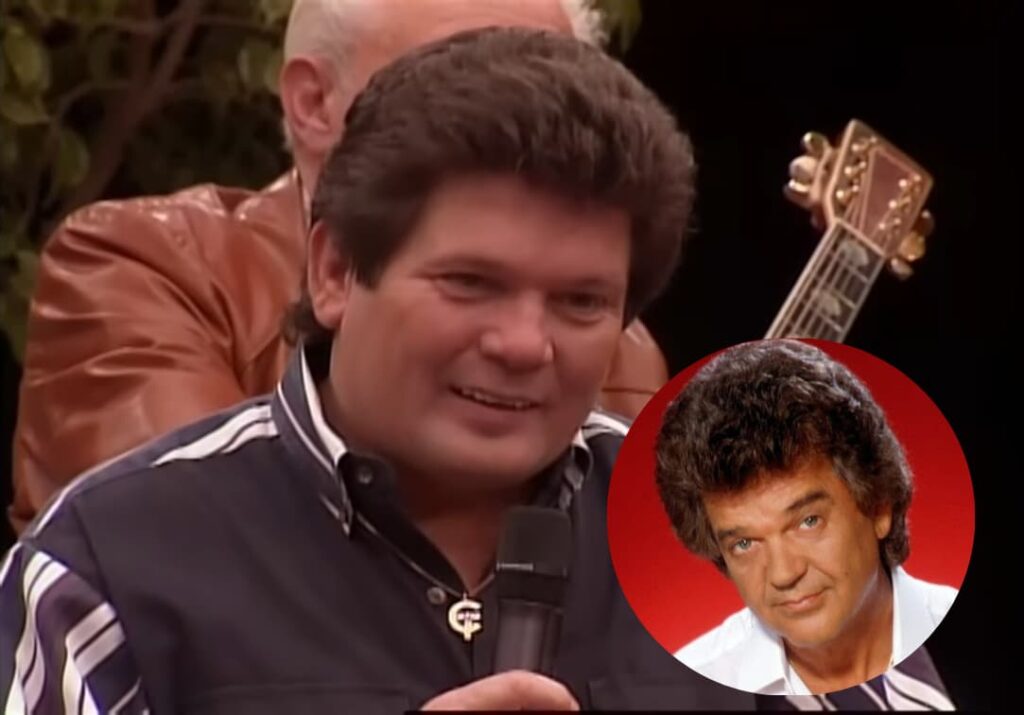
A Son Carries His Father’s Voice Into a Song That Still Blushes With Time
When Michael Twitty steps forward to sing “You’ve Never Been This Far Before”, he is not simply revisiting one of his father’s most talked-about songs. He is stepping into a memory, one that still lives in every note, every pause, and even in the small details he carries with him, like the signature necklace once worn by Conway Twitty. In that moment, the performance becomes something more than music. It becomes inheritance.
Originally released in 1973, “You’ve Never Been This Far Before” was one of Conway Twitty’s most daring recordings. At a time when country music often wrapped intimacy in suggestion, this song spoke more directly. It was tender, but undeniably bold. The lyrics unfold slowly, almost cautiously, capturing a moment suspended between anticipation and vulnerability. It is not just about physical closeness. It is about crossing an emotional line, one that cannot be undone.
Hearing Michael Twitty perform it decades later adds a different kind of depth. His voice carries echoes of his father, but it is not imitation. There is a personal weight in his delivery, shaped by memory and respect rather than performance alone. When he sings those familiar lines, you can feel the connection, not just to the song, but to the man who first gave it life.
What makes this performance especially moving is the story he shares beforehand. The necklace he wears, a replica of his father’s original piece, becomes a quiet symbol of continuity. It rests close to his heart, just as the music does. These small details remind us that songs are not isolated creations. They are part of lives, of families, of histories that continue long after the original voice has faded.
Musically, the song remains as intimate as ever. The slow tempo, the gentle phrasing, the careful build of emotion all serve to draw the listener inward. There is no rush, no excess. Just a steady unfolding of feeling, much like the moment it describes.
Listening now, “You’ve Never Been This Far Before” still carries the same quiet intensity it did in 1973. But through Michael Twitty, it gains something new. A sense of reflection, of legacy, of a son not just remembering, but keeping something alive.
And in that space between past and present, the song finds its second life. Not as a relic, but as a living memory, still capable of making the heart pause, just for a moment, and listen.