
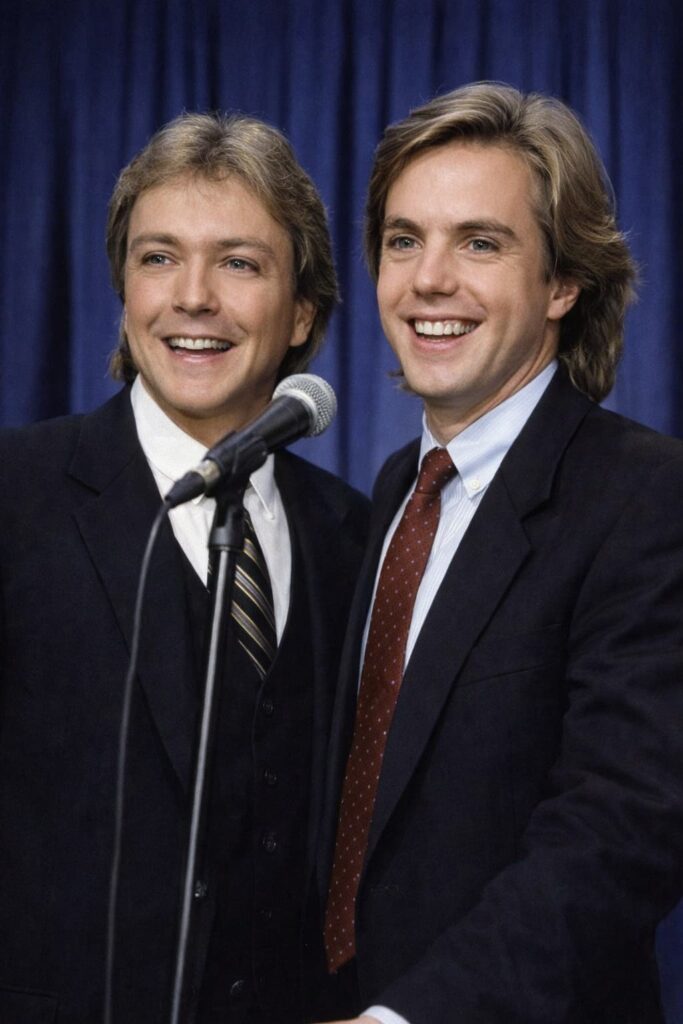
A tender reunion of two voices, where family, memory, and quiet regret intertwine in a song that feels both intimate and timeless.
When “Tell Me It’s Not True” was performed by David Cassidy and Shaun Cassidy in a 1993 television recording, it was not a chart-driven release, nor a single designed to dominate the airwaves. As such, it did not enter the major charts like the Billboard Hot 100 or the UK Singles Chart. Yet, to measure its significance by chart position alone would be to miss the quiet gravity of what this performance truly represents. It belongs instead to a different category of musical moments—those that linger in the heart rather than the rankings.
The song itself originates from the stage musical Blood Brothers, written by Willy Russell. Within that story, “Tell Me It’s Not True” serves as a devastating closing number, a lament filled with disbelief and sorrow, where characters confront the irreversible consequences of fate. It is, at its core, a plea against reality—a fragile hope that tragedy might somehow be undone. When interpreted by the Cassidy brothers, this already poignant composition takes on an additional, deeply personal resonance.
By 1993, both David Cassidy and Shaun Cassidy had long stepped beyond their teenage idol years. David Cassidy, once the face of The Partridge Family, had experienced both meteoric fame and the sobering complexities that followed. Shaun Cassidy, similarly, had enjoyed immense success in the late 1970s with hits like “Da Doo Ron Ron,” before transitioning into a respected career behind the scenes in television production. This particular performance, therefore, feels less like a showcase and more like a conversation—two artists reflecting, perhaps unconsciously, on the passage of time.
There is something strikingly intimate about hearing siblings share a song built on grief and denial. Their voices—distinct yet unmistakably connected—carry a natural blend that no studio arrangement could replicate. “Tell Me It’s Not True” in their hands becomes more than a theatrical piece; it transforms into a quiet meditation on loss, on the fragility of life, and on the bonds that endure through it all. The emotional weight is not forced. It arrives gently, almost hesitantly, as though the song itself is aware of how delicate its message must be.
One cannot help but sense, beneath the surface, echoes of their own lives—the pressures of early fame, the shifting landscapes of public attention, and the enduring importance of family ties. The Cassidy name once filled concert halls with youthful excitement; here, it fills a more reflective space, one shaped by experience and maturity. The performance invites the listener not to relive the past with longing, but to sit quietly with it, to acknowledge both its brightness and its shadows.
Musically, the arrangement remains understated, allowing the lyrical content to take precedence. The melody unfolds slowly, almost reluctantly, mirroring the emotional resistance embedded in the song’s central line—tell me it’s not true. It is a universal sentiment, one that transcends the specific narrative of Blood Brothers and speaks to anyone who has ever faced an unwelcome truth.
In the end, this 1993 recording stands as a gentle reminder that not all meaningful musical moments are captured by statistics or accolades. Some exist simply as shared expressions—fleeting yet profound. For those who listen closely, David and Shaun Cassidy’s rendition of “Tell Me It’s Not True” offers a quiet, enduring kind of beauty: one that does not demand attention, but rewards it deeply.