
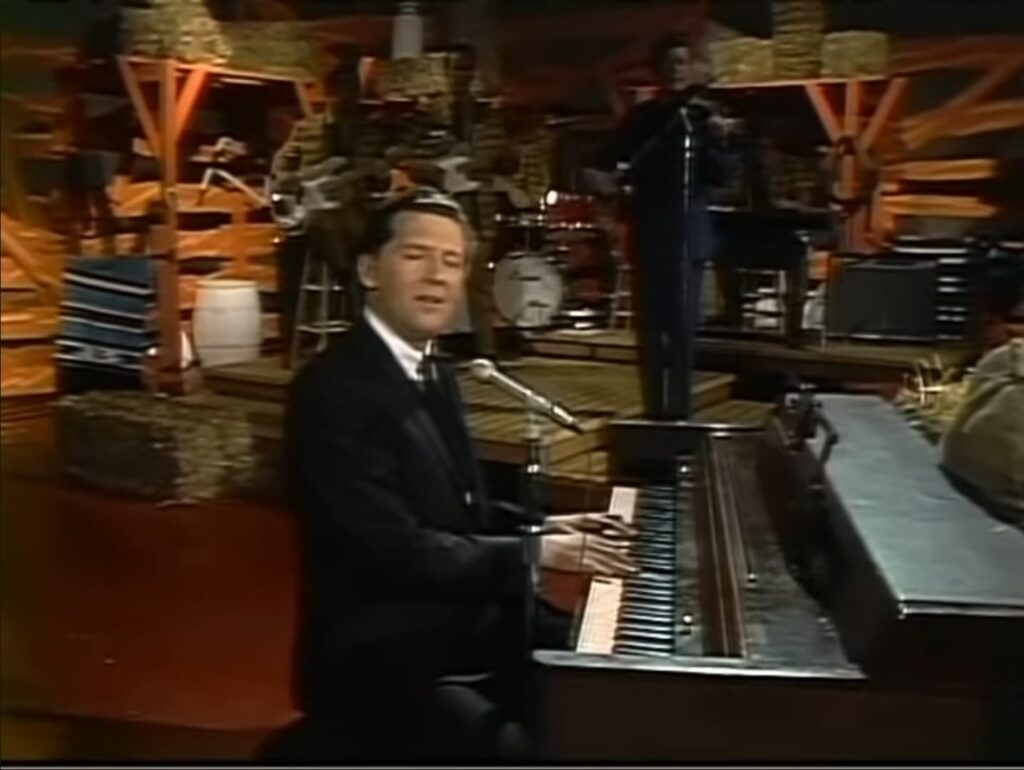
When the Night Ends, Love Has Nowhere Left to Hide
In 1968, “Another Place, Another Time” became the song that quietly rebuilt Jerry Lee Lewis. Released as the title track of his album Another Place, Another Time, it climbed to No. 4 on the Billboard country chart and marked a decisive turning point in his career. After years of controversy had pushed him to the margins, this was not just a hit. It was a reintroduction. A shift from the untamed energy of rock and roll toward the grounded honesty of country music.
From the opening image, the song places us in a closing barroom. Lights dimming, chairs stacked, the jukebox fading. It is a setting familiar to country music, but here it feels especially intimate. The night is ending, and with it, a fleeting closeness that cannot survive beyond those walls.
What makes “Another Place, Another Time” so affecting is its sense of quiet resignation. There is no dramatic goodbye, no confrontation. Just two people who understand that whatever they share belongs only to this moment. The line “we’ll meet again another place, another time” carries both hope and impossibility. It is a promise that sounds comforting, even as it quietly admits it may never be fulfilled.
Vocally, Jerry Lee Lewis strips everything back. The fire that once defined him is still there, but it burns lower now, controlled and deliberate. His phrasing lingers just enough to let the loneliness settle in. Each word feels considered, as though he is not just telling the story, but living inside it.
The arrangement follows that same philosophy. Rooted in honky-tonk tradition, it leans on subtle piano lines and restrained instrumentation. Nothing distracts from the emotional core. The space between notes becomes as important as the notes themselves, echoing the emptiness waiting beyond the song’s final moment.
There is also a deeper layer beneath the narrative. For Jerry Lee Lewis, this was more than a character’s story. It mirrored a personal crossroads. A man once defined by excess now finding his voice in restraint. A performer learning that sometimes the most powerful expression comes not from intensity, but from honesty.
Listening today, “Another Place, Another Time” carries a kind of timeless solitude. We all recognize that moment when something meaningful must end, not because it has failed, but because it cannot continue.
And as the lights go out and the room empties, what remains is not just loneliness. It is the memory of what was, and the quiet hope, however fragile, that somewhere, somehow, it might exist again.