
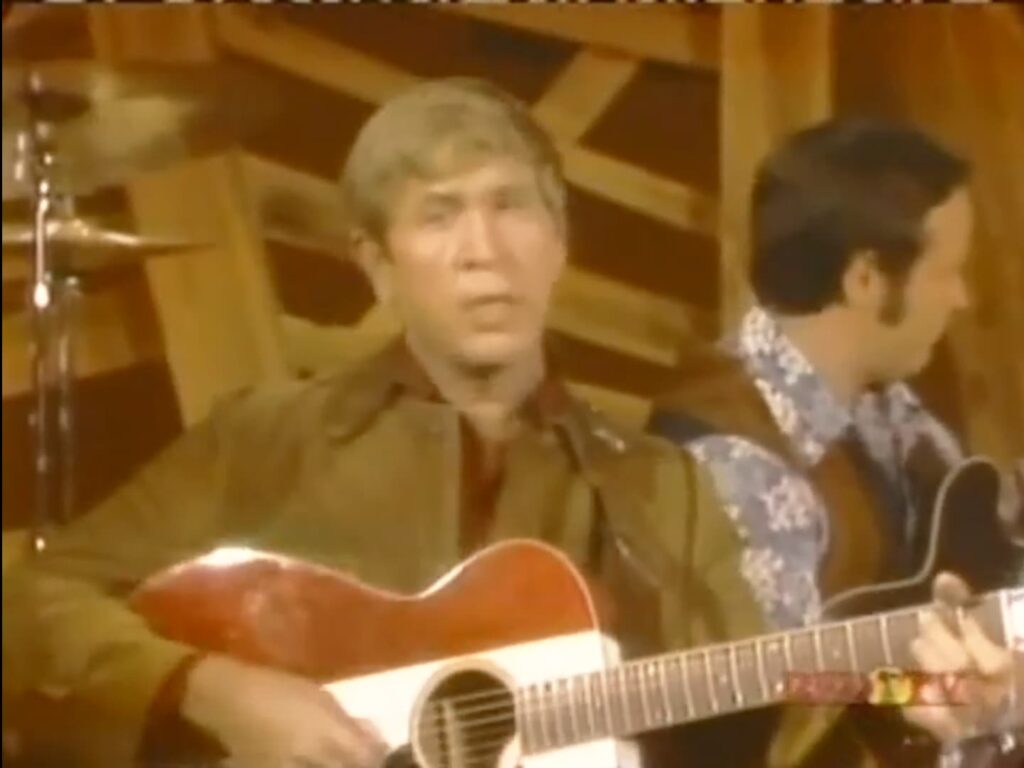
A Country Music Rebel’s Love Letter to Small-Town America and His Rejection of the Big City Dream
Long before country music embraced urban lifestyles and crossover success, Buck Owens recorded a song that proudly stood against the idea that bigger was better. With “I Wouldn’t Live In New York City,” Owens delivered one of the most memorable cultural statements of his career, turning a simple country tune into a humorous but pointed defense of small-town values.
Released during an era when New York symbolized ambition, wealth, and opportunity, the song takes the opposite view. From its opening lines, Owens paints the city as a crowded “concrete jungle” where people are packed together, rushing endlessly through their daily lives while chasing dreams that always seem just out of reach. His observations are delivered with a smile, but beneath the humor lies a deeper commentary about modern life and the growing distance between traditional rural America and the nation’s largest cities.
What makes the song so enduring is Buck Owens’ ability to transform social criticism into entertainment. Rather than sounding angry or bitter, he approaches the subject with the easygoing confidence that made him one of country music’s most beloved personalities. When he sings, “I wouldn’t live in New York City if they gave me the whole dang town,” the line feels less like an attack and more like a declaration of personal identity. He knows exactly where he belongs, and it is not among skyscrapers, traffic, and crowded sidewalks.
The song also reflects the cultural divide that was increasingly visible across America during the late twentieth century. For many listeners, especially those living in rural communities, Owens gave voice to feelings they rarely heard expressed in popular music. His description of a place where people hurry everywhere yet seem to have nowhere to go captured a frustration that resonated far beyond country music audiences.
Listening today, some of the lyrics are surprisingly sharp. Owens jokes that even the biblical cities of Sodom and Gomorrah seem tame by comparison to what he found in New York. The line was intentionally provocative, drawing laughter from audiences while reinforcing the song’s larger theme that success and happiness are not always found in the places society celebrates most.
Yet the most memorable moment may be the song’s reflection on anonymity. Owens sings about a city where nobody notices your existence until you become a statistic. Beneath the comedy is a surprisingly thoughtful observation about loneliness in large urban environments. It is a sentiment that remains relevant decades later.
The performance itself highlights everything that made Buck Owens a country music giant. His delivery is relaxed, conversational, and filled with charisma. He never oversings the lyric. Instead, he allows the song’s humor and honesty to do the work. That approach became a hallmark of the Bakersfield Sound, the influential California country style Owens helped create and popularize throughout the 1960s and 1970s.
Today, “I Wouldn’t Live In New York City” serves as more than just a novelty hit or a playful jab at urban life. It stands as a snapshot of an era when country music proudly celebrated the values of ordinary people, open spaces, and community roots. Whether listeners agree with Buck Owens’ opinion or not, the song remains a reminder that country music has always been at its most powerful when it speaks honestly about where people come from and why those places continue to matter.
More than forty years later, the laughter still lands, the message still resonates, and Buck Owens’ unmistakable voice continues to remind listeners that sometimes the richest life is the one that cannot be measured by the size of a city.