
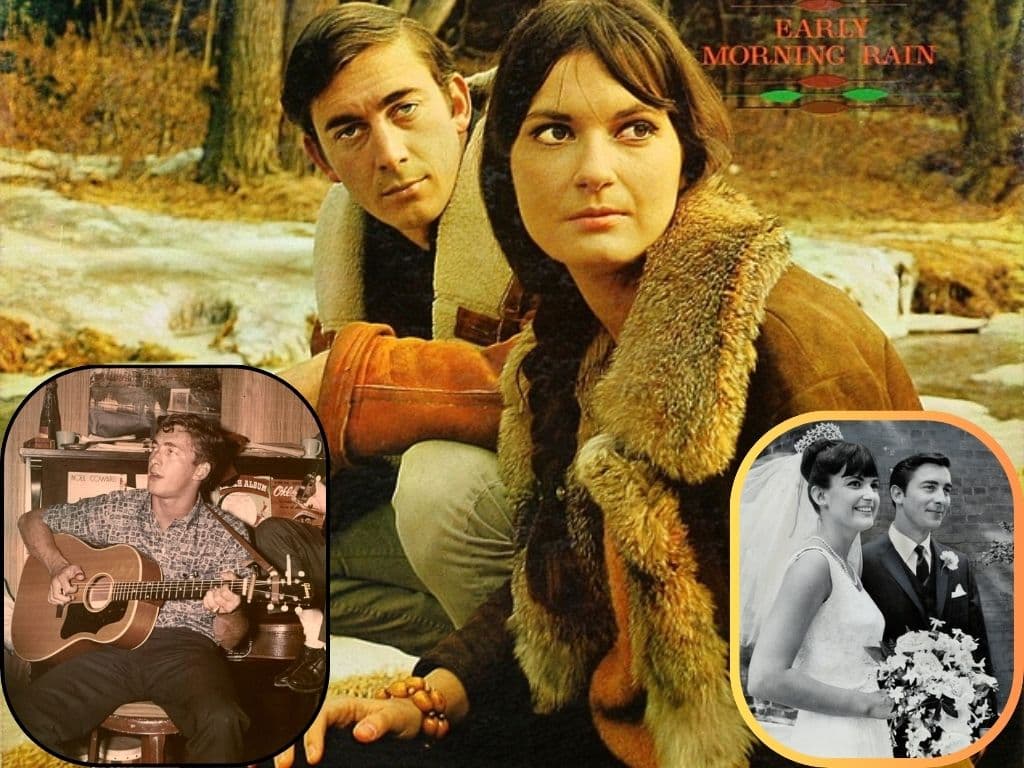
There are songs that belong to a moment, and there are songs that seem to exist outside of time. Early Morning Rain belongs firmly in the second category. Written by Gordon Lightfoot in the early 1960s, it is a song born from restlessness, distance, and quiet longing. But when performed decades later by Ian & Sylvia alongside Lightfoot himself in 1986, it becomes something even more profound: a conversation between past and present, between origin and legacy.
The Birth of a Folk Standard
Before it became a staple of the folk canon, Early Morning Rain was simply a personal reflection. Gordon Lightfoot reportedly drew inspiration from watching planes take off at Los Angeles International Airport while he was broke and homesick. That image alone tells you everything about the emotional core of the song: not dramatic heartbreak, but a quiet ache. The kind that lingers in the chest when you are far from where you belong.
Unlike many songs of its era, Early Morning Rain does not rely on elaborate storytelling. Its power lies in restraint. The imagery is sparse but evocative. The pacing is slow, almost meditative. It mirrors the stillness of early morning, when the world has not yet fully awakened, and thoughts feel heavier than usual.
This minimalism is precisely why the song endured. It left space for interpretation. It allowed different voices, different generations, to inhabit it without losing its essence.
Ian & Sylvia: Voices That Carry the Wind
By the time the 1986 live performance took place, Ian Tyson and Sylvia Tyson had already cemented their place in folk history. As Ian Tyson and Sylvia Tyson, they were more than interpreters of songs. They were storytellers who understood the emotional architecture behind every lyric.
Their version of Early Morning Rain does not attempt to outshine Lightfoot’s original. Instead, it expands it. Ian’s voice carries a rugged, weathered quality, grounding the song in experience. Sylvia’s harmonies, soft yet precise, add a layer of tenderness that transforms the track into something almost intimate.
Together, they do what great folk musicians always do: they disappear into the song, allowing it to speak rather than forcing it to perform.
The 1986 Performance: A Reunion of Meaning
What makes the 1986 live version so compelling is not just the performance itself, but the context. Having Gordon Lightfoot present alongside Ian & Sylvia turns the moment into a kind of musical homecoming.
This is no longer just a song being sung. It is a song being revisited by the very people who helped carry it into the world.
Lightfoot’s presence adds a quiet authority. His voice, deeper and more seasoned than in his early recordings, brings a new dimension to the lyrics. Where the original felt like a young man’s longing, this version feels like reflection. The distance is no longer just physical. It is temporal. It is the distance between who we were and who we have become.
The interplay between the three performers creates a subtle tension. Not conflict, but contrast. Youth versus age. Movement versus stillness. Departure versus memory. And yet, everything remains cohesive, held together by the song’s unwavering emotional core.
Why Early Morning Rain Still Resonates
There is a reason why Early Morning Rain has been covered by countless artists across genres. It speaks to something universal. Not love in its dramatic sense, but in its quieter, more persistent form. The kind tied to place, to identity, to belonging.
In the 1986 performance, that universality becomes even clearer. The song no longer belongs solely to Lightfoot. It belongs to anyone who has ever felt out of place, anyone who has ever watched something leave and wished they were on it.
The arrangement remains simple. Acoustic guitar. Gentle harmonies. No unnecessary embellishments. This simplicity is not a limitation. It is a deliberate choice. It ensures that nothing distracts from the emotional weight of the song.
And that weight is carried not just by the lyrics, but by the voices themselves. Voices that have aged. Voices that have lived. Voices that understand what the song is really about.
A Song That Refuses to Fade
In a music industry often driven by trends, Early Morning Rain stands as a reminder of what endures. It does not rely on production techniques or cultural moments. It relies on honesty.
The 1986 live performance captures this perfectly. It is not polished in the modern sense. It does not need to be. Its imperfections are part of its authenticity. Every slight variation in tone, every subtle shift in tempo, adds to the feeling that this is not just a performance, but a moment being lived in real time.
And perhaps that is why it continues to resonate. Because it does not try to be timeless. It simply is.
Closing Reflection
When Ian & Sylvia and Gordon Lightfoot come together in that 1986 performance, they are not just revisiting a song. They are revisiting a feeling. A memory. A piece of themselves.
Early Morning Rain began as a solitary observation at an airport. But over time, it became something much larger. A shared experience. A quiet anthem for anyone who has ever felt the pull of somewhere else.
And in that live performance, you can hear it clearly. Not just in the notes, but in the spaces between them.
That is where the song truly lives.
 Oldies Songs