
A Song That Smells of Whiskey, Southern Heat, and Shared Voices — Where “Dixie Chicken” Became a Living Memory
When Little Feat released “Dixie Chicken” in 1973, it did not arrive as a conventional hit single destined to dominate the radio charts. Instead, it emerged as something more enduring: a song that seeped slowly into the bloodstream of American roots music. The track appeared on Dixie Chicken, the band’s third studio album, released in January 1973. While the album peaked modestly at No. 46 on the Billboard 200, its cultural impact far exceeded its chart position. Over time, “Dixie Chicken” became Little Feat’s signature song an anthem passed hand to hand, stage to stage, long after the charts had moved on.
Written primarily by Lowell George, with contributions from Fred Martin and Martin Kibbee, “Dixie Chicken” is a masterclass in narrative songwriting. It unfolds like a half-remembered confession overheard late at night: a man, stranded in New Orleans, undone by a woman whose charm is equal parts danger and desire. There is no moral lesson spelled out, no redemption neatly offered. Instead, the song lingers in ambiguity, carried by George’s weary vocal and that unmistakable New Orleans–inflected groove funky, loose, and faintly intoxicated.
Musically, the track is built on a rolling piano figure, swampy rhythm guitar, and a rhythm section that swings rather than pushes. It borrows freely from rhythm and blues, country storytelling, and Crescent City funk, yet it never feels like pastiche. This was Little Feat at their creative peak: a band capable of sounding casual while executing something extraordinarily precise. “Dixie Chicken” does not rush. It saunters, confident that the listener will follow.
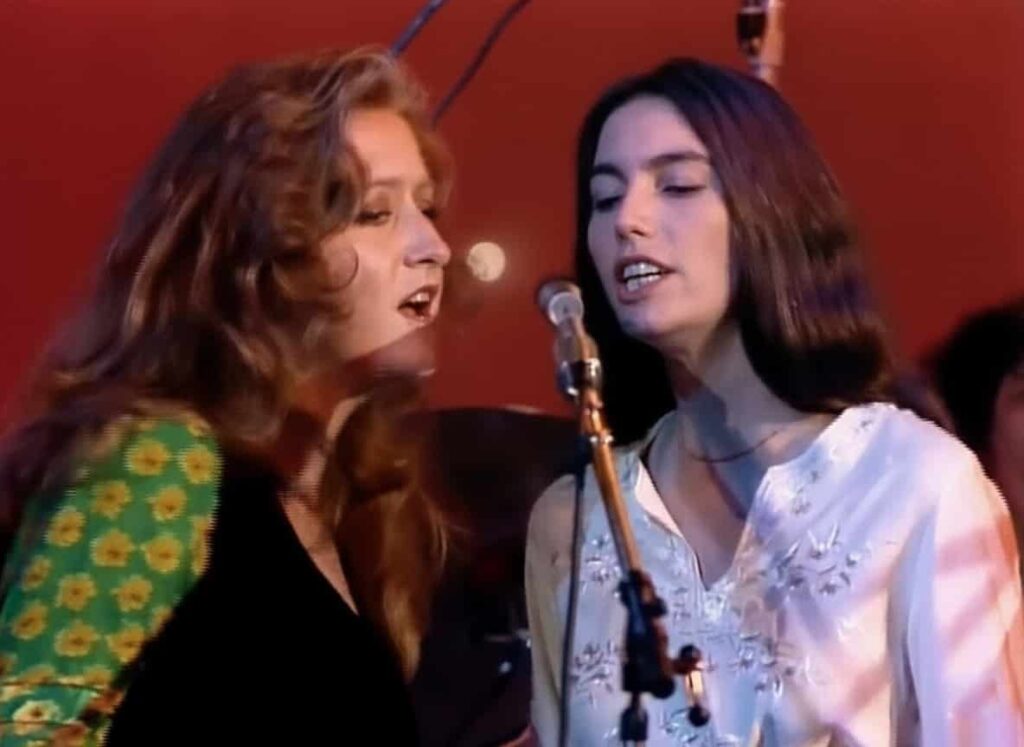
The song’s afterlife may be even more remarkable than its initial release. By the mid-to-late 1970s, “Dixie Chicken” had become a staple of live performances, often stretching well beyond its studio length. It was during this period that one of its most beloved moments occurred. In 1977, Bonnie Raitt and Emmylou Harris joined Little Feat for a live performance of “Dixie Chicken” on the television program The Midnight Special.
This collaboration did not rewrite the song it illuminated it. Bonnie Raitt, with her sly phrasing and blues-soaked authority, and Emmylou Harris, with her clear, aching harmonies, added new dimensions without disturbing the song’s core. Their voices blended effortlessly into the chorus, turning it into a communal experience rather than a solitary confession. It felt less like a guest appearance and more like a gathering of kindred spirits who understood the song’s emotional geography instinctively.
That performance has endured because it captured a fleeting moment when American roots music still lived comfortably in the mainstream when late-night television could showcase musicians simply standing together, singing, and letting the song do the work. There were no visual distractions, no gimmicks. Just voices, groove, and shared understanding.
Lyrically, “Dixie Chicken” endures because it trusts the listener. It does not explain itself or tidy up its emotions. The woman at its center remains elusive; the narrator remains slightly lost. New Orleans itself becomes a character humid, seductive, and morally blurred. The song understands that some memories are powerful precisely because they are unresolved.
Over the decades, “Dixie Chicken” has been covered, quoted, and revered, yet it remains inseparable from Little Feat and from Lowell George’s singular vision. The 1977 performance with Emmylou Harris and Bonnie Raitt stands as a testament to the song’s flexibility and depth a reminder that great songs do not age so much as they gather voices.
In the end, “Dixie Chicken” is not about charts, singles, or commercial success. It is about atmosphere, memory, and the way certain songs seem to follow listeners through life, changing slightly each time they are heard. Like a familiar street in an old city, it never looks quite the same but it always feels like home.
 Oldies Songs