
A Quiet Knock on the Door of Time, Where Compassion Speaks Softer Than Fame
When Brandi Carlile sings “Hello In There”, she is not merely covering a song — she is reopening a room many listeners thought had been quietly locked away. The song, written by John Prine, first appeared on his self-titled debut album John Prine in 1971, an album that peaked at No. 154 on the Billboard 200 at the time of its release. The single itself was never a chart hit, never a radio staple in the conventional sense. Yet over the decades, “Hello In There” has become one of the most enduring and quietly devastating songs in American songwriting — a work whose power has only deepened with age.
That quiet arrival tells us something essential. John Prine did not enter popular music through spectacle or trend. He arrived as a listener first, a careful observer of lives passing just beyond the margins of attention. “Hello In There” was inspired by the elderly residents Prine encountered while working as a mailman in suburban Chicago. He noticed how time had slowly stripped them of friends, partners, routines — and eventually, of being seen at all. From that simple human observation came a song that does not lecture, does not sentimentalize, and never begs for sympathy. It merely asks us to notice.
Musically, the song is spare to the point of fragility. A gentle acoustic guitar, unadorned phrasing, and Prine’s plainspoken voice form a setting where every word matters. The melody moves carefully, as if aware that even beauty must tread lightly around lives marked by loss. This restraint is precisely why the song endures. It refuses to age into cliché. It ages into truth.
At its heart, “Hello In There” is about the erosion of identity that comes with time. The couple at the center of the song were once young, reckless, full of noise and promise. Prine reminds us that they “had an apartment in the city” and “were crazy.” Then life happened — children, accidents, deaths, departures. What remains is not bitterness, but a quiet astonishment at how quickly the world moved on without them. The song’s most devastating line is not its sadness, but its plea: a simple greeting, a recognition of existence. To say “hello” is to affirm that someone is still here.
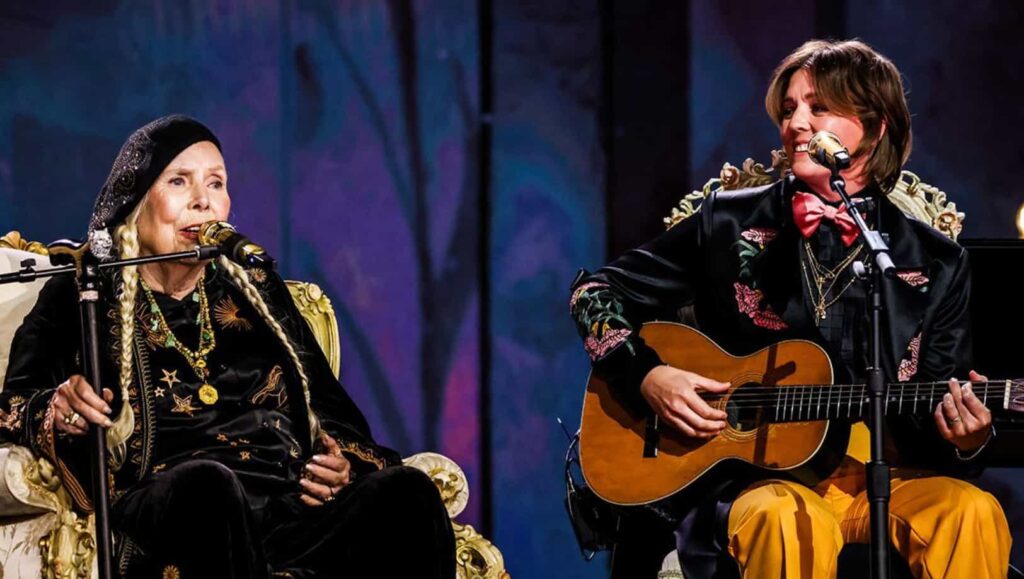
This is why Brandi Carlile has returned to this song repeatedly, most notably in live performances and tribute concerts honoring John Prine, including the widely remembered memorial performances following his passing in 2020. Carlile’s connection to Prine was not casual admiration; it was rooted in shared values — clarity of language, moral empathy, and the belief that songs can be small and still matter immensely. When Carlile sings “Hello In There,” her voice carries both strength and restraint, honoring Prine’s original intent rather than reshaping it. She sings not above the song, but inside it.
Carlile’s interpretation subtly shifts the emotional lens. Where Prine sounds like a quiet witness, Carlile sounds like a compassionate visitor — someone who has come back, knowing what time does, and choosing not to look away. Her phrasing lingers, her dynamics breathe, and the silences feel intentional. In her hands, the song becomes not only a portrait of aging, but a reminder of shared responsibility: the responsibility to listen, to remember, and to acknowledge lives that did not vanish simply because they grew quiet.
Over the years, “Hello In There” has been covered by numerous artists, but it resists reinterpretation. It does not belong to fashion or era. It belongs to the long human story of being overlooked. That is why it feels even more urgent now than it did in 1971. Time has not softened the song; it has sharpened it.
In paying tribute to John Prine, Brandi Carlile is also paying tribute to a way of seeing the world — one where dignity does not fade with age, and where a song does not need charts or accolades to matter. “Hello In There” remains a quiet masterpiece, standing patiently at the edge of our attention, waiting for us to notice that someone is still knocking.
 Oldies Songs