
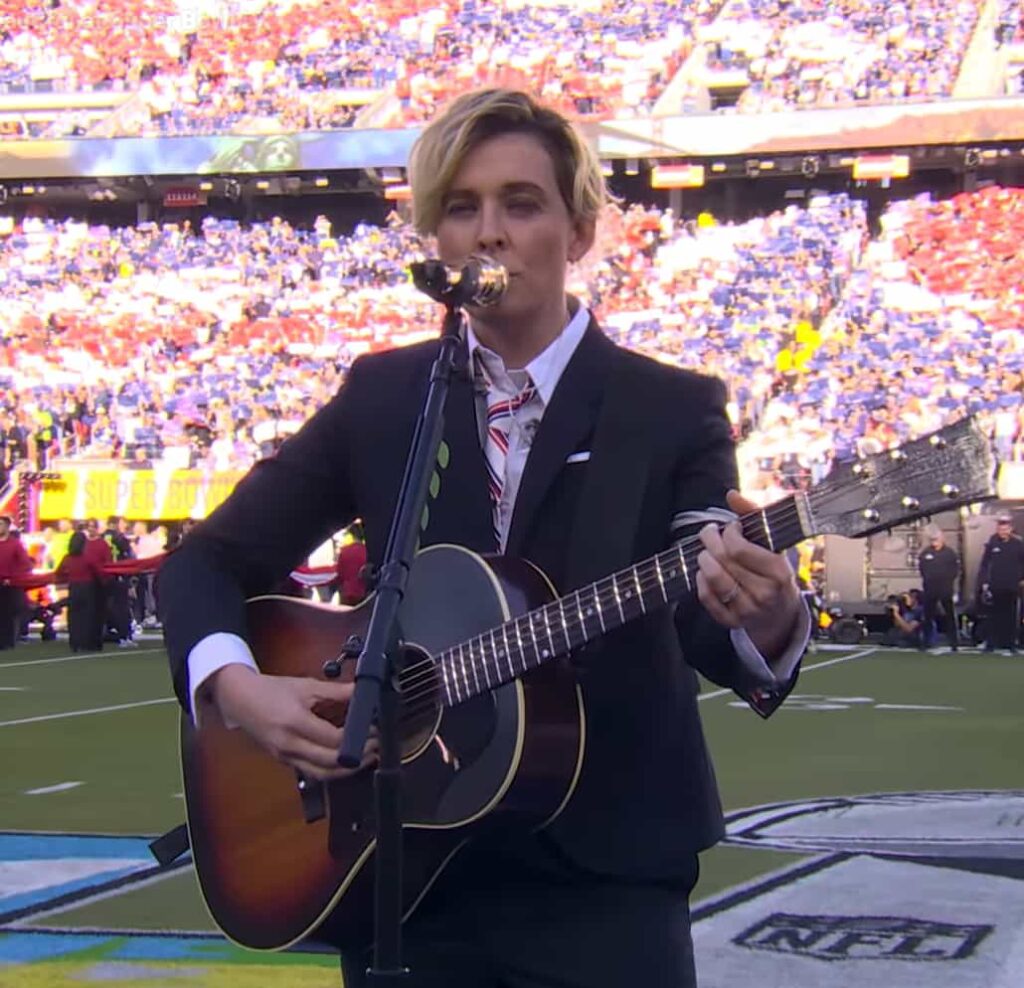
A Reverent Ode, A Nation’s Reflection: Brandi Carlile Sings “America the Beautiful” at Super Bowl LX
In a moment that felt both intimate and vast, Brandi Carlile’s rendition of “America the Beautiful” at Super Bowl LX wasn’t just a performance — it was a pilgrimage of voice and sentiment, carried on the shoulders of a singer‑songwriter whose life’s work has always been about truth, connection, and the human heart.
On February 8, 2026, at Levi’s Stadium in Santa Clara, California, before tens of millions of football fans worldwide and an emotionally charged crowd assembled for one of the most‑watched broadcasts of the year, Carlile took the stage during the pregame show to sing a song that has become a quiet, enduring emblem of America’s hopes and contradictions: “America the Beautiful.”
This was not a chart‑topping single from Carlile’s discography in the traditional sense — “America the Beautiful” is not a pop hit that climbs the Billboard charts — but rather an enduring patriotic standard, a song rooted in a rich tapestry of American musical tradition and poetry. Originally penned as a poem “Pike’s Peak” by Katharine Lee Bates in 1893, and later set to music by Samuel A. Ward, “America the Beautiful” has, for over a century, served as a hymn of wonder at the land’s beauty and a plea for its conscience and character. Its verses have been sung, arranged, reinterpreted, and sometimes contested, as artists and audiences alike confront what it means to love a nation in celebration and in critique.
What made Carlile’s moment at Super Bowl LX especially resonant was not a position in any chart — there was no ranking on the pop singles list to mark — but the sheer scale and weight of the stage itself. Here was a woman with 11 Grammy Awards to her name, a voice etched with both grit and tenderness, asked to sing one of this country’s most beloved songs at one of its most watched cultural events. Her presence carried with it decades of folk‑rock tradition, earnest songwriting, and a life lived in music that has always honored the sparse, the honest, and the heartfelt.
Wrapped in a moment that was both solemn and celebratory, Carlile’s voice threaded through the familiar, rolling lines of “America the Beautiful,” accompanied by the evocative backdrop of acoustic resonance and the subtle, expressive strings of SistaStrings — a violin and cello duo who have accompanied her on her recent tour. The performance was signed in American Sign Language by Julian Ortiz, underscoring a spirit of inclusion and shared experience that rippled far beyond the stadium.
There was no need for fireworks or raucous showmanship; what unfolded was a quiet — yet profound — communion with listeners at home and in the stands. In a time when national identity feels both intensely personal and fiercely debated, Carlile’s approach was a gentle reminder that a song like “America the Beautiful” becomes more than melody and poetic lines: it becomes a mirror held up to our collective hopes. In this performance, older listeners could feel the echo of their own lives — their long unfolding memories, the people who stood beside them during times of joy and challenge, and the quiet, persistent yearning for unity in uncertain days.
In many ways, the significance of this moment lies not in competition or chart success, but in presence — in a voice that has spent years telling stories that matter, now entrusted with a song that belongs to everyone. It was an invitation to remember what it means to see beauty in a wide‑open sky, to listen for harmony in a world too often divided, and to hear a voice that carried more than notes — it carried remembrance, resilience, and a kind of hope that resonates deeply with those who have seen decades of music and life pass by.
And so, when Brandi Carlile sang “America the Beautiful” on that February evening, she wasn’t just performing — she was offering a moment of reflection, a song as a reminder of where we’ve been, and where our voices might yet lead us next.
 Oldies Songs