
A Tender Farewell to Youthful Love and the Innocence We Once Knew
When “Save Your Kisses For Me” by Brotherhood Of Man was released in 1976, few could have predicted that this modest, gently swaying pop tune would become one of the most beloved and commercially successful songs of its decade. Yet history tells a remarkable story: the song won the Eurovision Song Contest 1976, representing the United Kingdom, and went on to top the charts in numerous countries. In Britain, it soared to No. 1 on the UK Singles Chart, where it remained for six weeks. It also reached No. 1 in Germany, France, Ireland, Norway, Belgium, and several other European nations, eventually becoming one of the best-selling Eurovision winners of all time, with sales exceeding six million copies worldwide.
At first listen, “Save Your Kisses For Me” feels light, almost deceptively simple. Its melody is sweet, buoyed by bright harmonies and a gently bouncing rhythm. The lead vocal—soft, tender, and unassuming—invites the listener into a moment that seems almost ordinary: a man saying goodbye in the morning, reminding his beloved to save her kisses for him. But what gives the song its emotional resonance is the final revelation. The farewell is not between lovers—it is a father speaking to his three-year-old daughter. That subtle twist transforms the song from a pleasant pop number into something quietly profound.
Written by Tony Hiller, Lee Sheriden, and Martin Lee, the song was crafted with remarkable economy. Its lyrics are brief, its arrangement uncluttered, yet its impact lingers long after the final note. The structure mirrors the innocence it portrays—uncomplicated, sincere, and free of irony. In an era when glam rock still shimmered and disco was beginning to pulse across dance floors, Brotherhood Of Man chose restraint. They leaned into melody and harmony rather than spectacle. And perhaps that is why the song has endured.
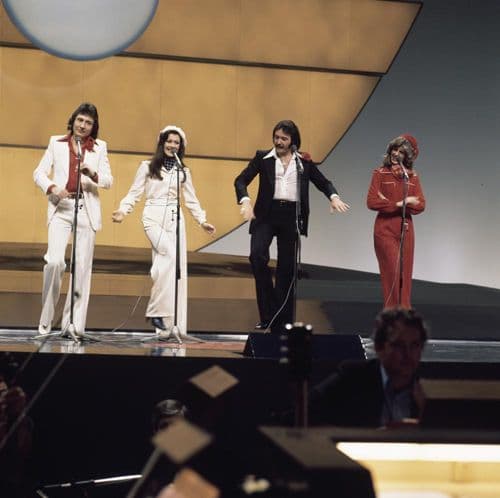
The Eurovision performance itself remains iconic. Dressed in coordinated white outfits with subtle red accents, the quartet—Martin Lee, Sandra Stevens, Lee Sheriden, and Nicky Stevens—delivered a performance that felt both polished and warm. Their synchronized movements were modest by today’s standards, but in 1976, it was a masterclass in presentation: charming, accessible, and emotionally direct. The visual simplicity allowed the song’s sentiment to shine.
Beyond its chart success, the cultural meaning of “Save Your Kisses For Me” lies in its evocation of everyday tenderness. It speaks to the quiet rituals of family life—the morning goodbye, the innocent embrace, the unspoken promise of return. These are moments that often pass unnoticed until time has gently carried them away. The song captures that fleeting tenderness and preserves it in melody.
Musically, the arrangement leans on crisp acoustic guitar, light percussion, and layered harmonies reminiscent of earlier vocal groups. There is a faint echo of 1960s pop craftsmanship, yet the production feels distinctly mid-1970s—clean, radio-friendly, and designed for broad appeal. Unlike many Eurovision winners that fade into nostalgic curiosity, this track retained commercial strength long after the contest spotlight dimmed.
It is also worth noting that “Save Your Kisses For Me” became the best-selling UK Eurovision entry in history. In the broader sweep of British pop music, that is no small achievement. The mid-1970s were a competitive era, filled with stylistic shifts and bold personalities. For such a gentle, family-centered song to rise above the noise speaks volumes about its emotional authenticity.
Perhaps the song’s enduring charm lies in its universality. Everyone, at some point, has experienced that tender morning farewell—whether as parent or child. The lyrics do not dramatize love; they honor its quiet constancy. In a world that often celebrates grand gestures, Brotherhood Of Man reminded listeners that love’s truest form is often found in small, repeated acts of care.
Nearly half a century later, when the opening chords of “Save Your Kisses For Me” begin to play, they carry with them more than nostalgia. They carry echoes of simpler mornings, of childhood laughter drifting down hallways, of promises made in the soft light of dawn. And in that gentle refrain—“Save your kisses for me”—there is a timeless reassurance: that love, in its purest form, is always waiting to welcome us home.