
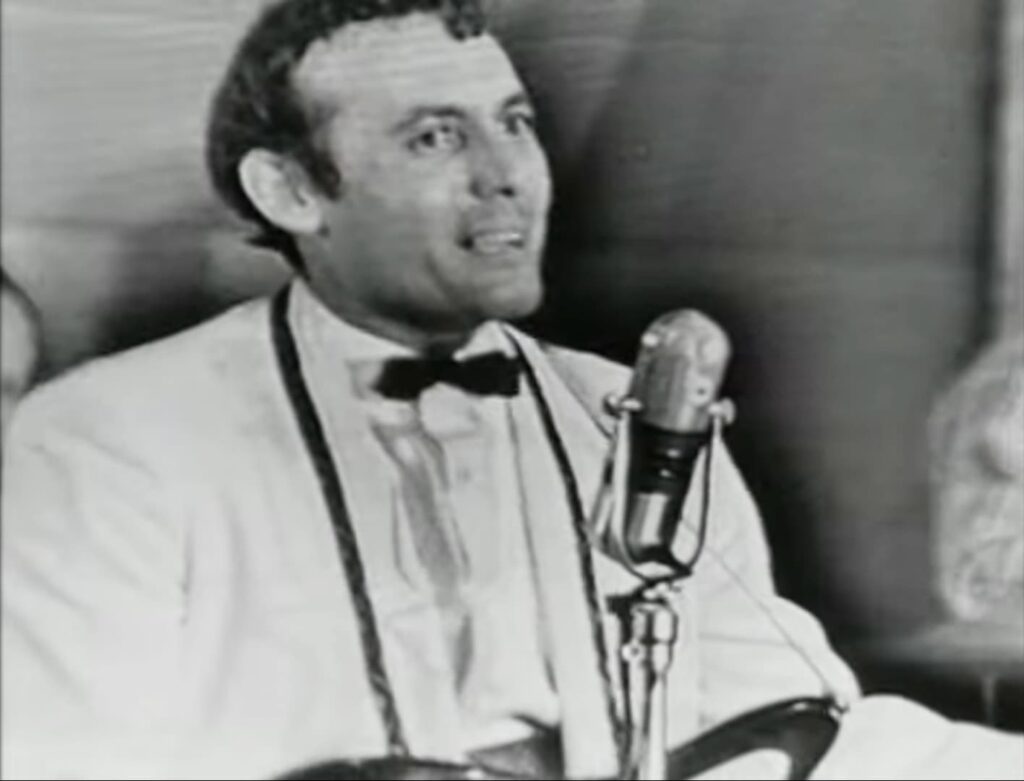
A Rhythm That Took Hold of a Generation, Turning Everyday Life into Pure Motion
When Carl Perkins recorded “Boppin’ The Blues” in the mid-1950s, he captured something more than a song. He captured a moment when music itself felt contagious. A rhythm that moved from jukebox to jukebox, from small-town dance floors to a rapidly changing America.
Following the success of “Blue Suede Shoes,” this track reinforced Perkins’ place at the center of the emerging rockabilly sound. Built on a driving beat, sharp guitar lines, and an infectious sense of momentum, the song feels alive from the very first line. It does not ease in. It jumps straight into motion.
Lyrically, the song is simple, almost playful. Friends “boppin’ the blues,” a doctor prescribing jukebox music instead of medicine, even a grandfather throwing down his crutches when the rhythm takes over. These images are not meant to be taken literally. They reflect something deeper. The idea that music had become a force strong enough to override routine, age, even physical limits.
What makes “Boppin’ The Blues” stand out is its sense of freedom. There is no weight of heartbreak or reflection here. Instead, it celebrates movement. The urge to dance, to let go, to be carried by sound rather than thought. In that way, it represents a shift in popular music. From listening to feeling.
Carl Perkins’ vocal delivery adds to that energy. Relaxed, slightly raw, and completely natural, it never feels forced. He is not performing at the listener. He is part of the same moment, caught in the same rhythm.
Instrumentally, the track is tight and efficient. The guitar drives everything forward, supported by a rhythm section that never slows down. It creates a sense of continuity, as if the song could go on indefinitely, just like the feeling it describes.
Looking back, “Boppin’ The Blues” may not carry the same cultural weight as some of Perkins’ biggest hits, but it reveals something essential about his artistry. His ability to translate a cultural shift into something immediate and accessible.
And as the refrain repeats, one idea becomes clear.
This was never just about music.
It was about a feeling that spread from one person to another, until suddenly, everyone was moving to the same beat.