
A Tender Rockabilly Vow Wrapped in Rhythm and Youthful Devotion
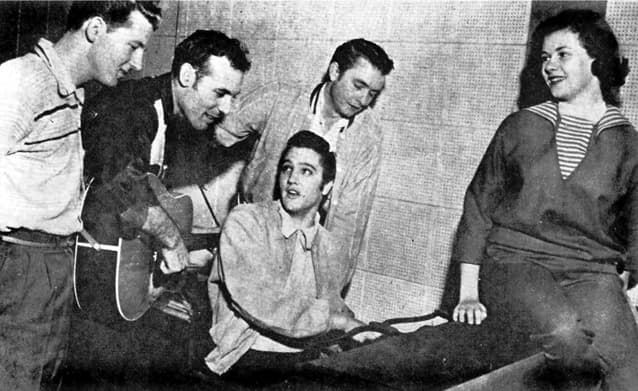
Released in 1957 on Sun Records as Sun 261, “Your True Love” by Carl Perkins stands as one of the most heartfelt statements ever pressed onto seven inches of spinning vinyl. The single climbed to No. 13 on the Billboard Country and Western chart and reached No. 67 on the Billboard pop chart, a respectable crossover achievement in an era when musical boundaries were sharply drawn. Recorded on December 4, 1956 at the legendary Sun Studio in Memphis, the track carries with it an added layer of history. That same day, fate gathered Perkins alongside Elvis Presley, Johnny Cash, and Jerry Lee Lewis for what would later be immortalized as the Million Dollar Quartet session. On “Your True Love,” it was Jerry Lee Lewis whose piano added a bright, rolling undercurrent beneath Perkins’ steady guitar.
By late 1956, Perkins had already tasted both triumph and hardship. “Blue Suede Shoes” had made him a pioneer of rockabilly, yet a devastating car accident earlier that year stalled his momentum at a critical moment. In “Your True Love,” there is no trace of bitterness. Instead, there is gratitude, humility, and a simplicity that feels almost disarming. The song unfolds like a promise spoken across a kitchen table rather than shouted from a stage. Its melody swings gently, driven by Perkins’ crisp guitar tone and Lewis’ buoyant piano flourishes, but the heart of the recording lies in its sincerity.
Lyrically, “Your True Love” is not complicated. It is a pledge of loyalty, of steadfast affection in a world that often feels uncertain. In the mid 1950s, rock and roll was frequently cast as rebellious and unruly. Yet here was Perkins offering something stable and reassuring. The emotional weight rests in his voice, slightly nasal, unmistakably Southern, yet warm and unguarded. There is a sense that he believes every word he sings.
Listening now, decades removed from its chart run, “Your True Love” feels less like a commercial release and more like a snapshot of American youth finding its voice. The recording captures that fleeting moment when rockabilly was still raw but already capable of tenderness. It reminds us that behind the swagger of the era stood young men with open hearts, singing about devotion in a language both new and timeless.