
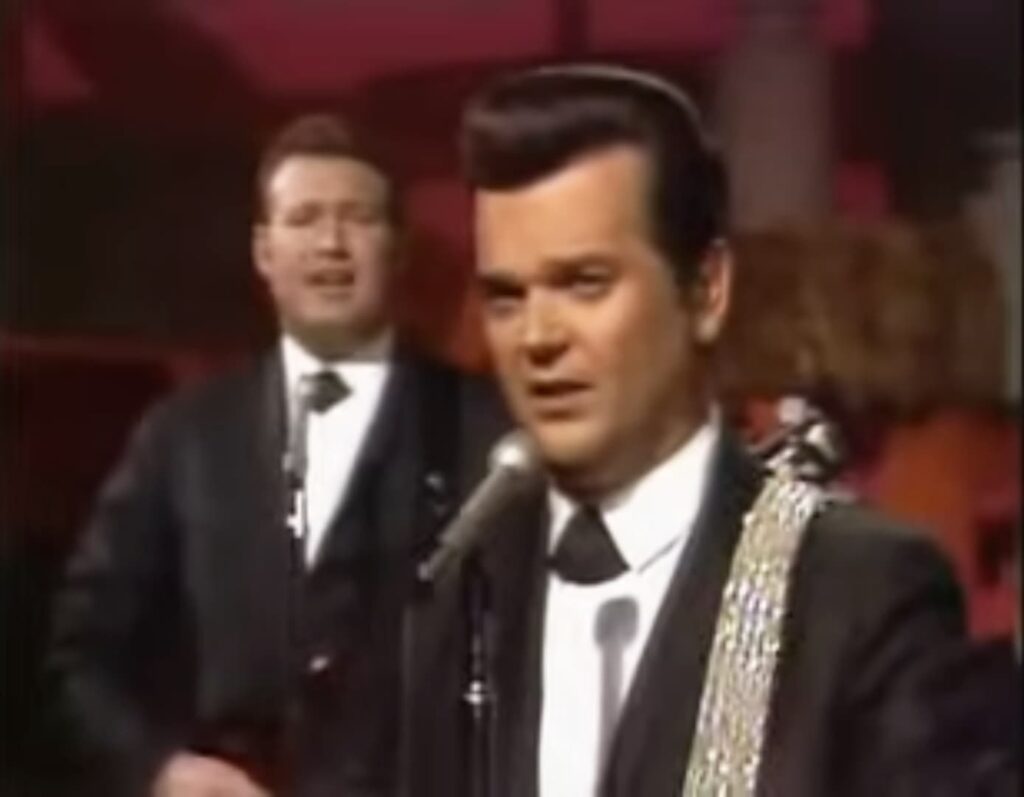
A Love That Refuses to Fade, Where Yesterday’s Memories Still Outshine Tomorrow’s Promises
Released in April 1969, Conway Twitty’s “I Love You More Today” quickly rose to No. 1 on the Billboard Hot Country Singles chart, marking his second chart-topping hit and solidifying his place among country music’s most emotionally direct storytellers. Serving as the title track of the album “I Love You More Today”, the song spent a full 15 weeks on the charts, resonating deeply with listeners through its simple yet piercing message of enduring love.
Written by L. E. White, the song unfolds not as a celebration of love fulfilled, but as a quiet, aching reflection on love that lingers even after it has slipped away. At its core lies a striking emotional contrast. While another man may hold her in the present, the narrator clings to something he believes time cannot replace: a deeper, longer, and more meaningful past.
When Conway Twitty delivers the opening lines, there is an immediacy that draws the listener in. His voice, smooth yet weighted with feeling, does not plead or accuse. Instead, it states a truth that feels both confident and fragile. The central idea, that he loves her more today than anyone else ever could from this moment forward, becomes less a claim and more a quiet conviction.
What gives “I Love You More Today” its lasting power is its perspective. Rather than focusing on loss alone, it reflects on shared memories. Moments already lived, tears once wiped away, laughter once held close. These details are not grand, but they are intimate, and that intimacy gives the song its emotional depth.
By 1969, Conway Twitty was transitioning fully into country music after earlier success in rock and roll, and songs like this helped define his signature style. A style rooted in storytelling, emotional clarity, and a willingness to explore the complexities of love without embellishment.
The melody moves gently, never overwhelming the lyric, allowing each line to settle naturally. There is no urgency in the arrangement, only a steady unfolding that mirrors the narrator’s quiet certainty.
Looking back, “I Love You More Today” remains one of Conway Twitty’s most poignant recordings. It is a reminder that love is not always measured by who holds it now, but by who lived it most deeply, and who continues to carry it long after everything else has changed.