
“Shenandoah” — A Timeless American Lament Reimagined as a Quiet Prayer
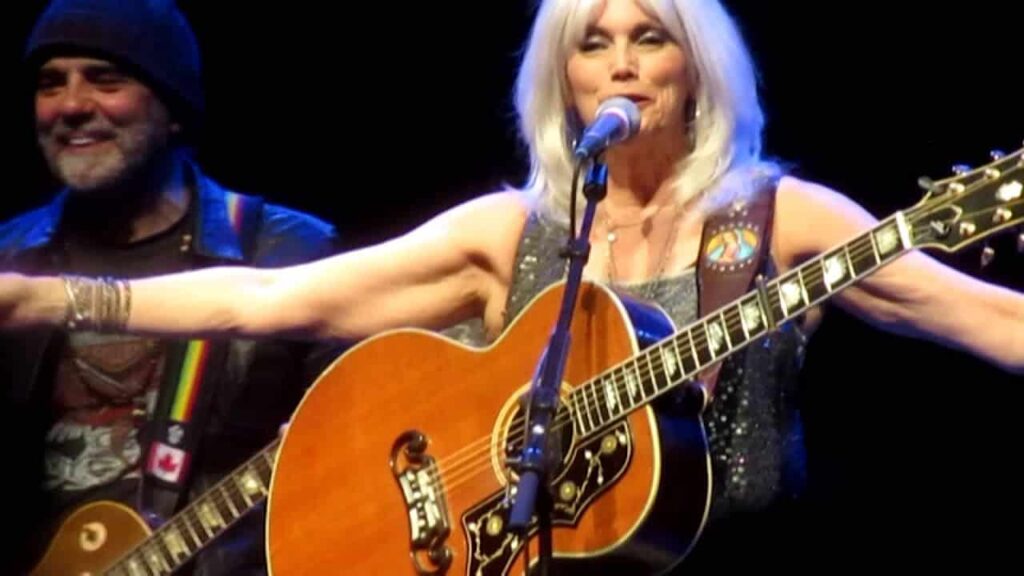
When Emmylou Harris and Daniel Lanois stepped onto the small, hushed stage of Sessions at West 54th Street in 1997, they were not there to chase radio play or chart positions. Their rendition of “Shenandoah” was never released as a commercial single, never entered the Billboard charts, and was never designed to compete in the marketplace. And yet, in many ways, it stands as one of the most spiritually resonant performances either artist ever shared on camera. That absence of chart ambition is itself meaningful, because “Shenandoah” does not belong to the machinery of pop success. It belongs to memory, to distance, and to longing.
“Shenandoah” is a traditional American folk song whose origins trace back to the early 19th century. Scholars continue to debate its precise beginnings, but it is commonly associated with riverboatmen on the Missouri River and with the legend of the Native American chief Shenandoah. Over generations, the song evolved into a floating hymn of yearning — sometimes interpreted as a man longing for a lost love, sometimes as an exile aching for home, and sometimes as a quiet farewell to a fading world. Because it predates the modern recording era, “Shenandoah” has no original chart debut in the conventional sense. Its power has always lived outside numbers.
By 1997, Emmylou Harris was deep into a period of artistic rebirth. Her landmark album Wrecking Ball (1995), produced by Daniel Lanois, had reintroduced her voice in a radically spare, atmospheric setting. The album itself reached No. 85 on the Billboard 200 and earned critical acclaim, including a Grammy Award for Best Contemporary Folk Album. More importantly, it reshaped how her voice was heard — no longer framed by traditional country polish, but by space, shadow, and emotional restraint.
That aesthetic carried directly into their West 54th Street performance of “Shenandoah.” Lanois’ guitar work is minimal, almost hesitant, allowing silence to do as much work as sound. Emmylou Harris, by then in her fifties, sings not with youthful clarity but with lived-in grace. Her voice floats rather than projects, fragile yet steady, as though the song itself might dissolve if handled too firmly.
The emotional meaning of this version lies in what it refuses to dramatize. There is no swelling climax, no virtuosic display. Instead, the performance feels like a conversation with time. Each line — “Oh Shenandoah, I long to see you” — is delivered as a statement of fact rather than a plea. Longing here is not urgent; it is permanent. It is the kind of longing that settles into a person after decades, becoming part of their inner weather.
For listeners who have carried music through long lives, this performance resonates deeply. “Shenandoah”, in the hands of Emmylou Harris and Daniel Lanois, becomes less a song about a place or a person and more a meditation on everything that recedes with age — youth, certainty, old landscapes, familiar voices. It speaks to the understanding that some distances cannot be crossed again, only remembered.
Sessions at West 54th Street was known for its intimacy, and this performance exemplifies why. There is no barrier between artist and audience, no spectacle to distract from the emotional core. The camera lingers, the room breathes, and the song unfolds at its own unhurried pace.
In the end, this “Shenandoah” does not ask to be applauded. It asks to be sat with. It reminds us that the most enduring music is not always the music that climbed the charts, but the music that quietly accompanies us as the years pass — still beautiful, still unresolved, and still calling from across the river.
 Oldies Songs