
A Circle Unbroken: When Three Voices Turned “Gold Watch And Chain” Into a Testament of Loyalty and Loss
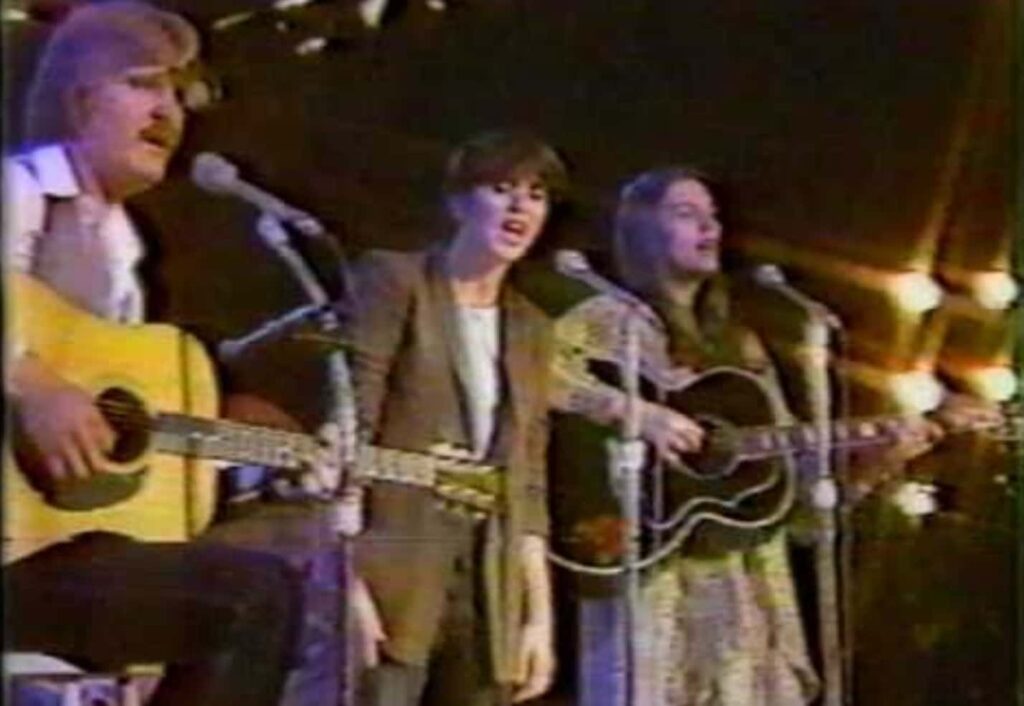
In 1979, during a remarkable live collaboration, Emmylou Harris, Ricky Skaggs, and Linda Ronstadt stood together to perform “Gold Watch And Chain,” breathing new life into a traditional song that had traveled through generations of American roots music. The performance, now preserved in widely shared footage, remains one of the most cherished moments of late 1970s country and bluegrass television. For many listeners, it was more than a song. It was a reunion of traditions, a meeting of voices that carried the past forward with quiet conviction.
“Gold Watch And Chain” is an old-time standard often associated with the Carter Family repertoire, a ballad of devotion marked by a simple promise: the gift of a gold watch and chain as proof of faithful love. By the time Harris, Skaggs, and Ronstadt approached it in 1979, the song already carried decades of emotional weight. Their interpretation honored that lineage while adding a luminous polish that defined the progressive country movement of the era.
The setting was intimate and unadorned. No elaborate staging, no theatrical spectacle. Just three artists standing close, trading verses and harmonies with a reverence that felt almost sacred. Harris, already celebrated for her crystalline tone and commitment to traditional material, anchored the performance with poise. Skaggs, still early in what would become a defining career in bluegrass revival, brought instrumental authority and youthful fire. Ronstadt, whose voice had conquered both rock and country charts, softened her power into something restrained and tender.
What made the performance unforgettable was not volume or virtuosity, though both were present. It was the balance. Each voice entered like a thread in a carefully woven tapestry. Harris carried the melody with steady grace. Ronstadt’s harmony floated above like a second light source. Skaggs grounded the arrangement, reminding listeners of the Appalachian roots from which the song first grew.
By 1979, country music was navigating a crossroads. The outlaw movement had reshaped Nashville. Pop influences were increasingly visible. Yet here stood three artists who refused to abandon the older vocabulary of American song. In their hands, “Gold Watch And Chain” was not nostalgia for its own sake. It was preservation. It was proof that the quiet stories of devotion and heartbreak still mattered.
The lyric itself is deceptively simple. A promise of a gift. A pledge of loyalty. A subtle warning that love, once broken, leaves a permanent mark. In lesser hands, such straightforward writing might feel quaint. In theirs, it felt eternal. Each line carried the weight of lived experience. The performance did not rush. It allowed space between phrases, as though honoring every generation that had sung those words before.
For audiences who discovered the clip years later, often through late night television rebroadcasts or eventually online archives, the performance became a portal. It transported them back to a time when harmony singing occupied the center of the stage. Before digital perfection, before visual spectacle overshadowed sound, there were evenings like this. Three musicians, one microphone, and the shared understanding that the song was larger than any individual career.
The collaboration also symbolized a rare intersection. Harris was emerging as a guardian of traditional country. Ronstadt had already bridged rock stardom with country credibility. Skaggs would soon become a torchbearer for bluegrass revival. Seeing them united in 1979 now feels almost prophetic. It hinted at the Americana movement that would flourish decades later, where genre boundaries softened and authenticity regained currency.
Listeners who return to that performance often speak of its warmth. There is an ease in their smiles, a mutual respect that transcends the cameras. Nothing feels forced. The harmonies lock not through rehearsal alone but through shared musical language. It is the sound of artists who listen to one another.
Nearly half a century later, the footage endures. Not because it was flashy. Not because it was historic in the way award shows or chart milestones are historic. It endures because it captures a truth about American roots music. Songs survive when artists treat them as living things. In that 1979 performance, “Gold Watch And Chain” was not revived. It was simply allowed to breathe again.
For those who were there, or who found it years afterward, the memory lingers like the ticking of the promised watch itself. Steady. Patient. Unbroken
 Oldies Songs