
A Wild Spark of Early Rock ’n’ Roll Where Rebellion, Rhythm, and Youth Collide
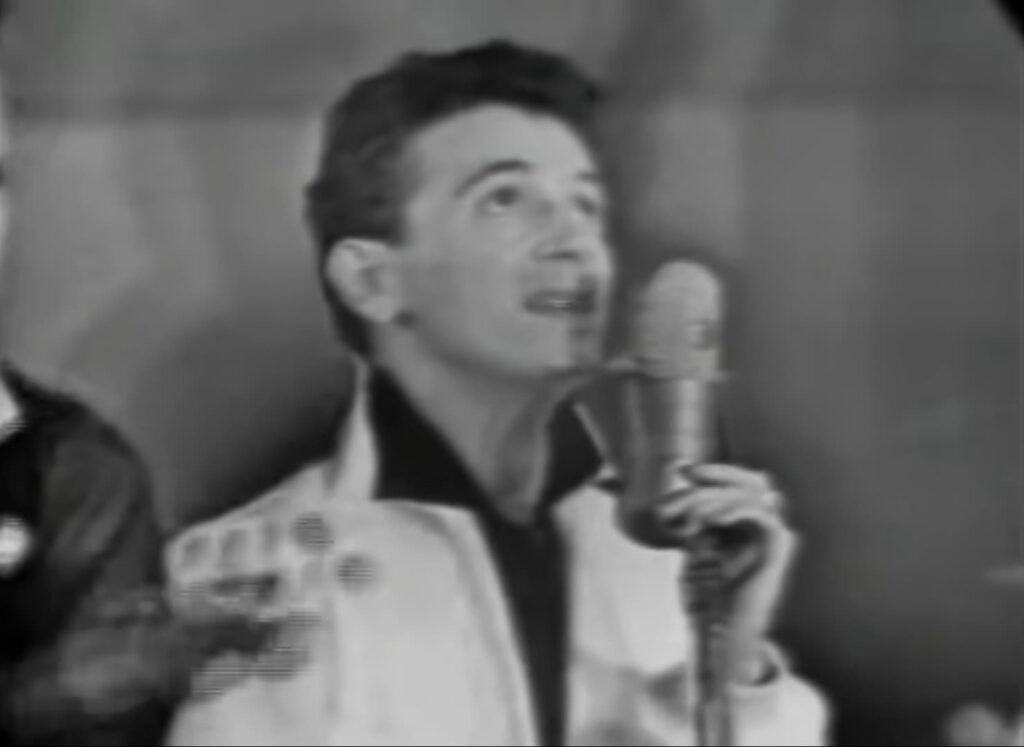
In 1958, on the modest but electric stage of Town Hall Party, Gene Vincent delivered a performance of “Be-Bop-A-Lula” that captured the raw pulse of early rock ’n’ roll at its most unfiltered. Originally released in 1956 and quickly becoming a breakout hit, the song had already cemented Vincent’s place among the pioneers of the genre. Yet this televised appearance offered something different, something more intimate and immediate, bringing the restless energy of the era directly into living rooms.
Backed by his band, the Blue Caps, Vincent stepped forward with a presence that felt both restrained and dangerous. Dressed sharply but carrying a quiet edge, he did not need exaggerated movement. His voice did the work. From the first “be-bop-a-lula, she’s my baby,” there was a looseness, a swagger that felt new at the time. It was not polished in the traditional sense, but that imperfection became its power.
What made this performance unforgettable was its sense of control within chaos. The rhythm rolled forward with a steady, almost hypnotic groove, while Vincent’s vocal phrasing bent around the beat, stretching and pulling in a way that felt instinctive rather than rehearsed. It was rock ’n’ roll in its formative years, still discovering its own language.
The audience response, though more reserved than later generations might expect, carried a quiet fascination. There was a sense that something was changing, that this sound, this attitude, was beginning to redefine popular music. Vincent stood at that crossroads, bridging the smooth crooners of the past with the rebellious voices that would soon dominate the charts.
Looking back, this Town Hall Party appearance remains more than just a performance. It is a snapshot of a cultural shift in motion. “Be-Bop-A-Lula” was never just a song about a girl. It was a declaration of style, attitude, and identity. And in that moment in 1958, Gene Vincent did not just sing it. He embodied it, leaving behind a performance that still echoes with the spirit of rock ’n’ roll’s earliest days.