
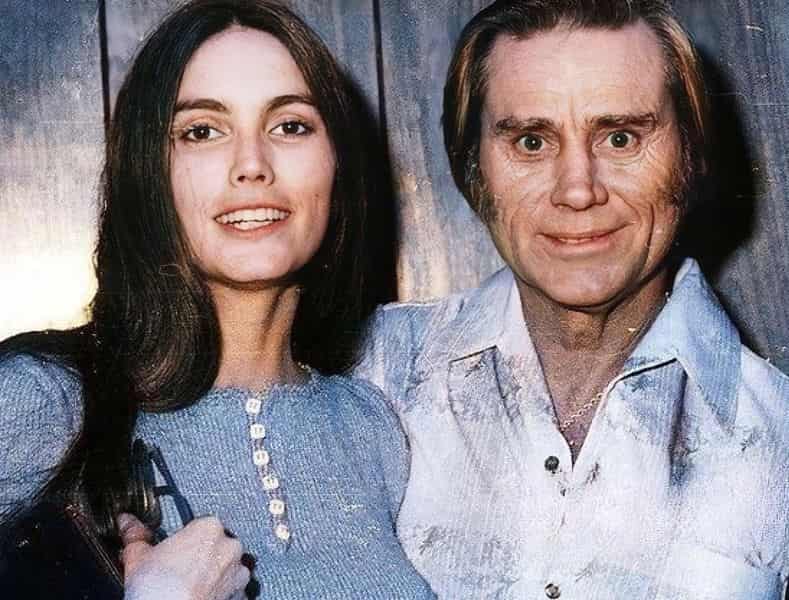
Here We Are — A Quiet Testament to Love’s Endurance and Life’s Winding Roads
When George Jones and Emmylou Harris first recorded “Here We Are” together in 1979 for Jones’s duet-centric album My Very Special Guests, they captured a moment that was never designed to be a blockbuster hit on the charts, but instead a deep, resonant conversation between two voices steeped in country music’s most profound emotional language. The song itself was not released as a major charting single and did not register on the Billboard country singles charts in the way Jones’s bigger hits did. Instead, its place in the album’s tapestry and among fans’ memories has given it a lasting significance far beyond any numerical ranking. My Very Special Guests itself reached a modest position on the country albums chart, reflecting an eclectic project rather than a chart-driven release.
Written by the talented Rodney Crowell in his early twenties, and brought to life by the venerable Jones and the luminous Harris, Here We Are stands apart from many of the more overtly dramatic country classics of the era precisely because of its simplicity and profound humility. Jones’s weathered baritone, already known for its unmatched capacity to convey heartache with a single phrase, offsets Harris’s clear, heartfelt tone, creating an audible dialogue between two souls who have lived long enough to know both love’s promise and its burdens.
Thematically, Here We Are tells the story of two people who have spent too many nights chasing elusive dreams, running from the realities that define a long relationship, and finally arriving at a space where the turbulence of youth has given way to acceptance. The refrain “We’ve both grown tired of running after rainbows / Here we are, darlin’, here we are” is not just romantic; it is philosophical. It speaks to a generation who remembers the long drives home from dancing under summer skies, the hush of early mornings beside someone you’ve loved for years, and the hard-won knowledge that love’s survival is itself a kind of victory.
Rodney Crowell’s own reflections on the song later revisited in his 2013 recording with Emmylou Harris on their Old Yellow Moon album reveal that his intentions went beyond the immediate context of youthful infatuation. By the time Crowell returned to Here We Are decades later, he viewed it less as an attempt to impress a love interest and more as a meditation on aging, friendship, and the peace of mutual understanding. Harris herself has described the song’s content as sweet and laden with affection between souls who have traversed their own individual histories yet still find that quiet place in each other’s presence.
Placed amid the tracks of My Very Special Guests, Here We Are complements the album’s larger celebration of camaraderie among artists. Jones’s decision to share the microphone with so many peers from Waylon Jennings and Willie Nelson to Linda Ronstadt was a bold departure from the solo-artist model that dominated country music. Harris’s appearance here is emblematic of her own journey, having begun in the orbit of Gram Parsons’s pioneering country-rock fusion before ascending as a singular voice of emotional clarity.
For listeners today who first encountered this song on vinyl or cassette, there might be an unmistakable sense of nostalgia an echo of a night when the radio crackled under a summer sky, or the quiet of an old porch swing at dusk. The simplicity of the instrumentation and the unvarnished harmonies serve not just as musical support, but as a kind of emotional architecture: it is here that the heart’s subtle contours can be heard most clearly. There are no grand gestures, no sweeping metaphors of eternal devotion. Instead, there is presence two voices acknowledging shared pasts and choosing, in the present, to stand together, unguarded.
In a musical catalog filled with declarations of heartbreak and longing, Here We Are lives as a gentle affirmation: love may not always burn bright, but it endures in the stillness after the storms. In that quiet affirmation, there is a resonance that lingers long after the final note has faded, speaking directly to anyone who has ever found themselves, at last, here, with someone who has walked beside them through life’s winding roads.