
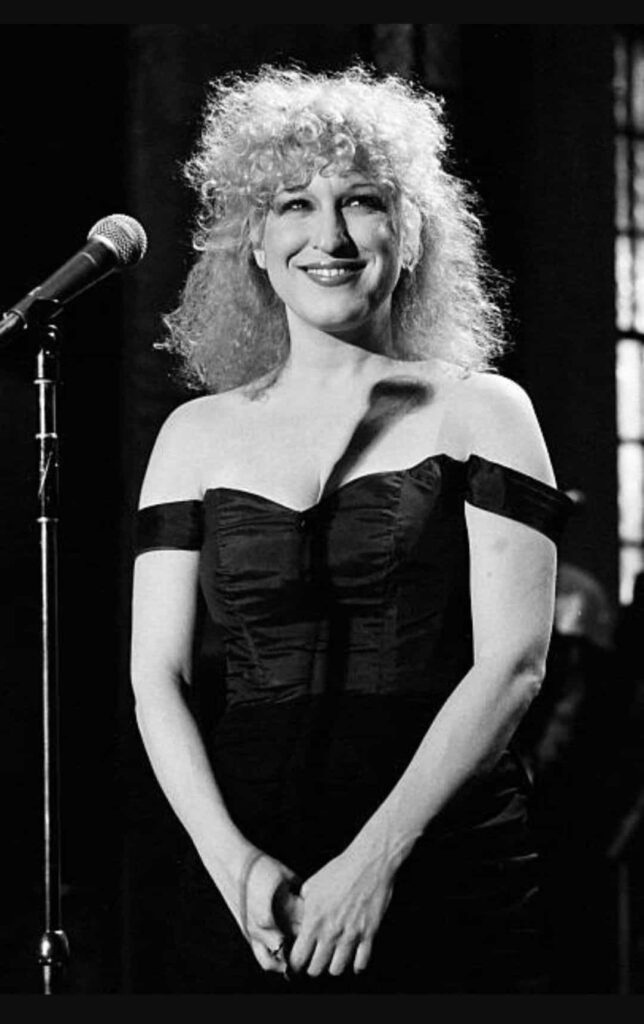
A Tender Conversation Across Generations, Where Loneliness Whispers and Compassion Answers
When “Hello in There” was released by Bette Midler in 1973, it did not storm the charts in the conventional sense. It was never crafted as a radio-dominating single, nor did it climb high on the Billboard Hot 100. Instead, it lived quietly within the grooves of her debut album, The Divine Miss M, an album that reached No. 9 on the Billboard 200 and introduced the world to a singular voice—bold, theatrical, and yet capable of astonishing intimacy. The song itself had first appeared two years earlier on John Prine’s self-titled 1971 debut album, but in Midler’s hands, it took on a new emotional hue—less rustic, more torch-like, yet equally devastating.
From the very first line, “Hello in there” is not merely a greeting. It is a plea.
Written by John Prine, one of America’s most perceptive and compassionate songwriters, the song explores the quiet erosion of connection that often accompanies aging. Prine was in his early twenties when he wrote it—an almost astonishing fact, considering the depth of empathy embedded in the lyrics. The story goes that Prine drew inspiration from elderly patrons he observed while working as a mailman in Illinois. He noticed how often they seemed invisible, how rarely anyone stopped to truly see them. That observation blossomed into one of the most humane ballads ever written.
When Bette Midler chose to record “Hello in There”, she was at the beginning of her ascent, fresh from her celebrated performances at New York’s Continental Baths. Known for her brassy humor and flamboyant stage presence, Midler surprised many by delivering this song with such restraint. Her interpretation strips away excess and leaves only ache. Where Prine’s version feels like a front-porch reflection, Midler’s feels like a dimly lit theater confession—each word suspended in the air, trembling.
The song unfolds as a portrait of an elderly couple who have outlived friends, siblings, and even children. “You know that old trees just grow stronger / And old rivers grow wilder every day,” Prine wrote—lines that resist sentimentality while acknowledging resilience. Yet beneath that strength lies isolation. The refrain—“So if you’re walking down the street sometime / And spot some hollow ancient eyes / Please don’t just pass them by and stare / As if you didn’t care, say ‘Hello in there’”—remains one of the most quietly powerful appeals in popular music.
Midler’s phrasing lingers on those final words. She does not rush them. She lets the silence around them speak. And that is perhaps why her version resonates so deeply. She understands that this is not merely a song about growing old. It is about being forgotten while still alive. It is about rooms filled with memories but empty of visitors. It is about the dignity of acknowledgment.
Though not a chart hit, “Hello in There” became a cornerstone of Midler’s early performances. It helped define the emotional range that would later make songs like “The Rose” and “Wind Beneath My Wings” cultural touchstones. Critics praised her debut album widely; it would go on to win the Grammy Award for Best New Artist in 1974. Within that celebrated collection, “Hello in There” stood as a quiet moral center.
Over the decades, the song has been performed by numerous artists, but it is the pairing of John Prine’s plainspoken sincerity and Bette Midler’s dramatic tenderness that continues to endure. In concerts, audiences often fall into complete stillness when it begins—a shared recognition passing through the room.
Listening to “Hello in There” today feels like opening an old photo album. The faces inside may have faded slightly, but the emotions remain sharp. The song reminds us that time moves in one direction, but compassion can move in any. It urges us to pause, to look again, to speak gently.
In a world that grows noisier each year, this song remains profoundly simple. A greeting. A recognition. A small act that means everything.
And sometimes, that is enough.