
A quiet confession of a restless heart—“For Lovin’ Me” captures the bittersweet honesty of leaving before love can settle
When “For Lovin’ Me” first emerged in the early 1960s, it did not storm the charts in the manner of pop juggernauts, nor was it crafted for commercial spectacle. Instead, it found its place quietly, almost humbly, within the folk revival that was then reshaping North American music. Written by the incomparable Gordon Lightfoot and recorded by Ian & Sylvia for their 1964 album “Four Strong Winds”, the song became one of those understated classics—respected, revisited, and deeply felt rather than loudly celebrated. While it did not chart as a major single upon release, its enduring presence has arguably outlasted many of its more commercially successful contemporaries.
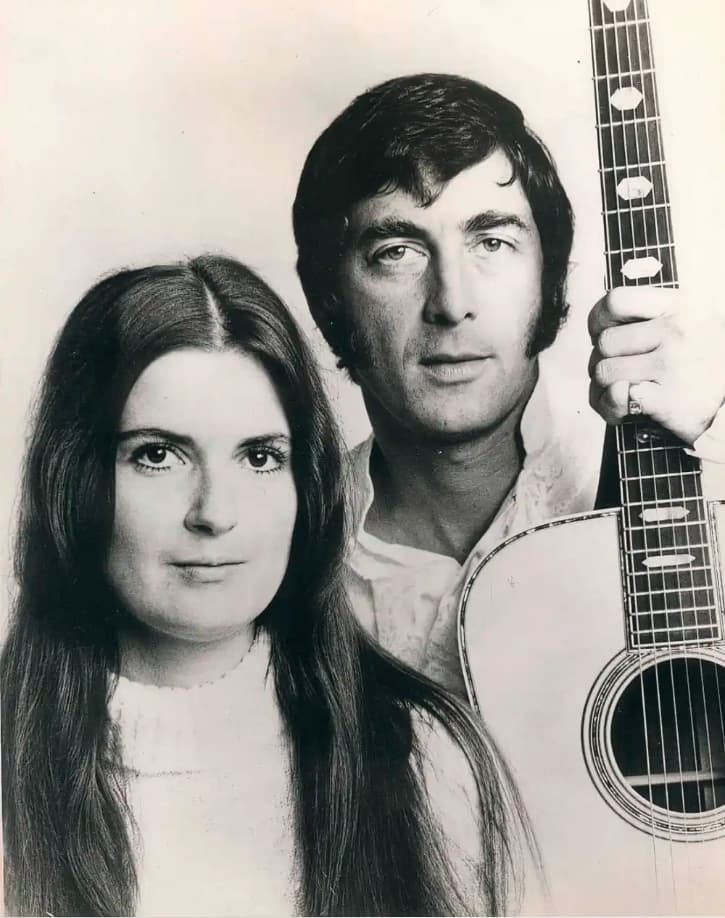
The importance of “For Lovin’ Me” lies not in chart statistics, but in its emotional precision and its place within a defining musical movement. The early 1960s folk scene, particularly in Canada and the United States, was fertile ground for introspection and storytelling. Ian Tyson and Sylvia Tyson, performing as Ian & Sylvia, were among the leading voices of that era, bridging traditional folk sensibilities with a more personal, modern lyricism. Their interpretation of Lightfoot’s composition carried a delicate balance—restrained, almost conversational, yet laden with quiet emotional weight.
At its core, the song tells a story that feels disarmingly simple: a man admits, almost apologetically, that he is leaving—not out of anger, nor betrayal, but because of an inherent restlessness. The line “That’s what you get for lovin’ me” lands with a peculiar mixture of regret and resignation. There is no villain here, no dramatic rupture. Instead, there is the uncomfortable truth that some people are simply not made to stay. In this sense, Gordon Lightfoot crafted a character that feels achingly real—someone who understands the pain they cause, yet cannot change their nature.
What makes Ian & Sylvia’s version particularly compelling is its emotional restraint. Rather than dramatizing the departure, they allow the lyrics to breathe. Sylvia’s harmonies soften the edges of the narrative, offering a subtle counterbalance to the narrator’s detachment. The arrangement is sparse—acoustic guitar, gentle rhythm—leaving space for the listener to reflect. It is this very sparseness that gives the song its power. There are no grand gestures here, only the quiet echo of something ending before it has fully begun.
Behind the song lies an interesting chapter in Gordon Lightfoot’s early career. At the time of writing, he was still establishing himself as a songwriter, and many of his compositions were first popularized by other artists. Ian & Sylvia were instrumental in bringing his work to a wider audience, and “For Lovin’ Me” stands as one of the earliest examples of his distinctive voice—marked by emotional clarity, narrative simplicity, and a deep understanding of human contradictions.
Over time, the song would be recorded by other artists, including Peter, Paul and Mary, whose version brought it additional exposure. Yet for many listeners, there remains something uniquely intimate about the Ian & Sylvia recording. It feels less like a performance and more like a quiet admission overheard—something personal, almost private.
The meaning of “For Lovin’ Me” continues to resonate because it speaks to a universal experience: the realization that love alone is not always enough to make someone stay. It does not condemn, nor does it seek forgiveness. Instead, it presents a moment of honesty—uncomfortable, but undeniably human. There is a certain dignity in that honesty, a recognition that not all departures are born of cruelty; some are simply the result of who we are.
Listening to the song today, one cannot help but feel a sense of distance—not just from the era in which it was recorded, but from a style of songwriting that valued subtlety over spectacle. It invites the listener to slow down, to sit with the words, and to remember a time when music often spoke in softer tones, yet carried deeper truths.
In the end, “For Lovin’ Me” is less about leaving and more about understanding—the quiet acknowledgment that hearts do not always move in harmony, and that sometimes, the most honest thing one can offer is a gentle goodbye.
 Oldies Songs