
A meditation on movement, fate, and the quiet dignity of staying in motion when life offers no guarantees
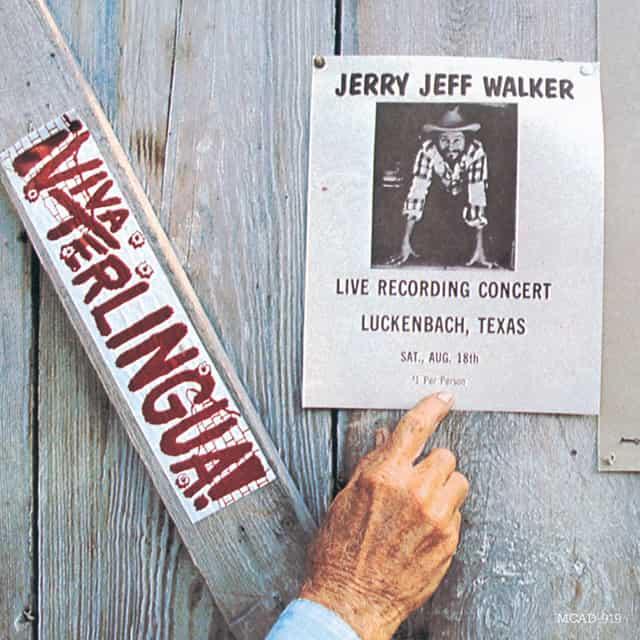
Released in 1973 on Viva Terlingua!, “Wheel” stands as one of Jerry Jeff Walker’s most quietly enduring compositions. It was never designed to conquer radio playlists or dominate the charts under Walker’s own name. In fact, “Wheel” did not enter the Billboard country charts when Jerry Jeff Walker released it, a detail that matters, because it reveals exactly what kind of song this is. It was written for listening rooms, late-night drives, and moments of personal reckoning rather than commercial ambition. Yet its afterlife would prove far more powerful than its initial reception.
Recorded live at the legendary Armadillo World Headquarters in Austin, Viva Terlingua! captured Walker at the height of his creative authority, bridging folk storytelling, outlaw country, and the restless independence of the Texas singer-songwriter movement. “Wheel” arrives on the album not as a showstopper, but as a philosophical pause. Its placement early in the record signals its importance. This is not a song about conquest or nostalgia. It is about motion, acceptance, and survival.
Jerry Jeff Walker wrote “Wheel” during a period when his own life was defined by movement. He had already tasted mainstream success with “Mr. Bojangles”, yet he consistently stepped away from the conventional music industry path. He drifted between towns, scenes, relationships, and musical identities. The song reflects that existence. The wheel keeps turning. You either move with it or get left behind.
Lyrically, “Wheel” avoids dramatic declarations. Instead, it speaks in plain language, the kind that carries weight precisely because it refuses embellishment. The narrator understands that life does not pause for sorrow, regret, or longing. There is no bitterness here, only clarity. The wheel turns. You do not argue with it. You learn to live inside its rhythm.
Musically, the song is understated. Acoustic guitar leads the arrangement, supported by gentle rhythm and restrained ensemble playing. Walker’s voice, slightly weathered even then, delivers the lines with conversational ease. There is no strain, no vocal theatrics. This restraint is essential. “Wheel” works because it sounds like a truth being spoken rather than a performance being delivered.
The song’s deeper meaning emerges in what it does not say. There is no promise of resolution. No final lesson. Instead, it offers a worldview shaped by experience. You may lose people. You may lose direction. But movement itself carries its own dignity. Continuing forward becomes an act of quiet courage.
Ironically, “Wheel” achieved its greatest commercial recognition not through Walker, but through Waylon Jennings. In 1974, Jennings recorded the song for his album The Ramblin’ Man, and his version reached No. 1 on the Billboard Hot Country Singles chart. This chart success introduced the song to a wider audience, many of whom assumed it was a Jennings original. Yet the spirit of the song remained unmistakably Jerry Jeff’s. Waylon’s gravel-edged authority gave it a harder surface, but the philosophical core stayed intact.
That contrast is revealing. Jerry Jeff Walker’s version feels like reflection after the road has already been traveled. Waylon Jennings’ version feels like defiance while still on the move. Both are valid. But Walker’s original carries a vulnerability that time only deepens.
Within Walker’s catalog, “Wheel” has become a defining statement. It represents his belief that songs do not need to shout to endure. They need only to tell the truth clearly. Over decades, the song has remained a favorite among listeners who recognize themselves in its calm acceptance of life’s impermanence.
Today, “Wheel” endures because it does not belong to any single moment. It belongs to anyone who has watched plans dissolve, paths change, and time move forward without permission. It does not ask for optimism. It offers understanding. The wheel turns. And somehow, that is enough.