
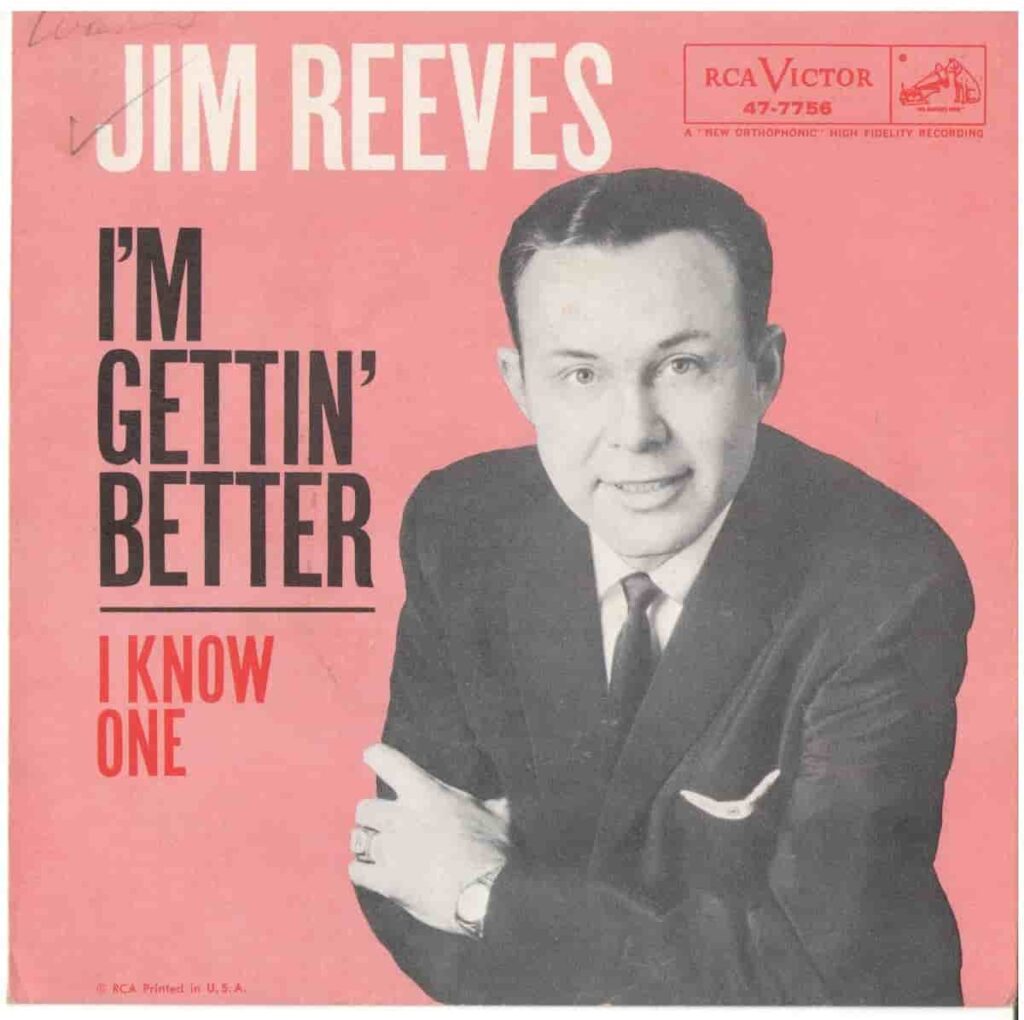
Quiet Recovery After Goodbye, When Healing Moves Slowly and Honestly
Released in 1960, Jim Reeves’s “I’m Gettin’ Better” stands as one of the most quietly affecting records of his early 1960s period, a time when his voice and artistic identity were reaching full maturity. Upon its release, the song climbed to No. 3 on the Billboard Hot C&W Sides chart and crossed over to the Billboard Hot 100 at No. 52, a notable achievement for a country ballad built not on drama or bravado, but on restraint and emotional truth. These chart positions matter, because they show how deeply Reeves’s understated style resonated beyond the country audience, touching listeners who recognized themselves in its gentle honesty.
By 1960, Jim Reeves was already known as “Gentleman Jim,” a title earned through his smooth baritone, impeccable diction, and calm delivery. Unlike many country singers of the era who leaned heavily into heartbreak with raw vocal displays, Reeves specialized in emotional understatement. “I’m Gettin’ Better” fits squarely into that artistic philosophy. It does not tell a story of sudden healing or dramatic recovery. Instead, it captures something far more realistic and far more human, the slow and uneven process of learning how to live after love has ended.
The song opens with a simple image. Walking by the river where goodbyes were once spoken. Remembering kisses without breaking down. On paper, these lines appear almost casual, yet in Reeves’s voice they carry enormous weight. The narrator insists, again and again, that he is getting better. The repetition of that phrase is not reassurance for the listener. It is reassurance for himself. That is where the emotional power of “I’m Gettin’ Better” truly lies. Each repetition sounds less like a declaration and more like a quiet act of self persuasion.
Musically, the arrangement is spare and supportive, allowing Reeves’s voice to remain front and center. The production reflects the early 1960s Nashville Sound, polished but never overwhelming. Soft backing vocals and gentle instrumentation provide a warm frame without intruding on the intimacy of the performance. This balance was one of Reeves’s greatest strengths. He understood that heartbreak, when sung too loudly, can lose its authenticity. His genius was knowing when to hold back.
Lyrically, the song reveals its depth through small moments. A conversation with an old friend. A question asked and answered with just a tear or two. These are not grand scenes, but they feel unmistakably real. The line “I know I’ll never be the same” is particularly telling. It acknowledges that healing does not mean returning to who one once was. It means learning to live differently. That quiet acceptance elevates the song from a simple breakup ballad into a reflection on emotional growth and loss.
The metaphor of standing too close to the flame is another subtle but powerful detail. Love is remembered not as something evil or destructive, but as something that burned brightly and left a mark. Even when the pain fades, the warmth and the scars remain. Reeves delivers these lines without bitterness, which gives the song its lasting dignity.
Within Jim Reeves’s catalog, “I’m Gettin’ Better” may not be his most famous recording, but it is among his most honest. It reflects a period when country music was learning how to speak softly without losing emotional impact. The song’s crossover success on the pop charts confirms that its message transcended genre boundaries.
Today, listening to “I’m Gettin’ Better” feels like opening an old letter written with care and restraint. It does not demand attention. It invites reflection. It understands that healing is rarely dramatic and almost never complete. Sometimes, the most truthful thing a heart can say is not “I am healed,” but simply “I am getting better.” In that quiet admission, Jim Reeves left behind a song that continues to speak with remarkable clarity and grace.