
A Life Turned Into Song, Where “Coal Miner’s Daughter” Carries the Weight of Truth and Memory
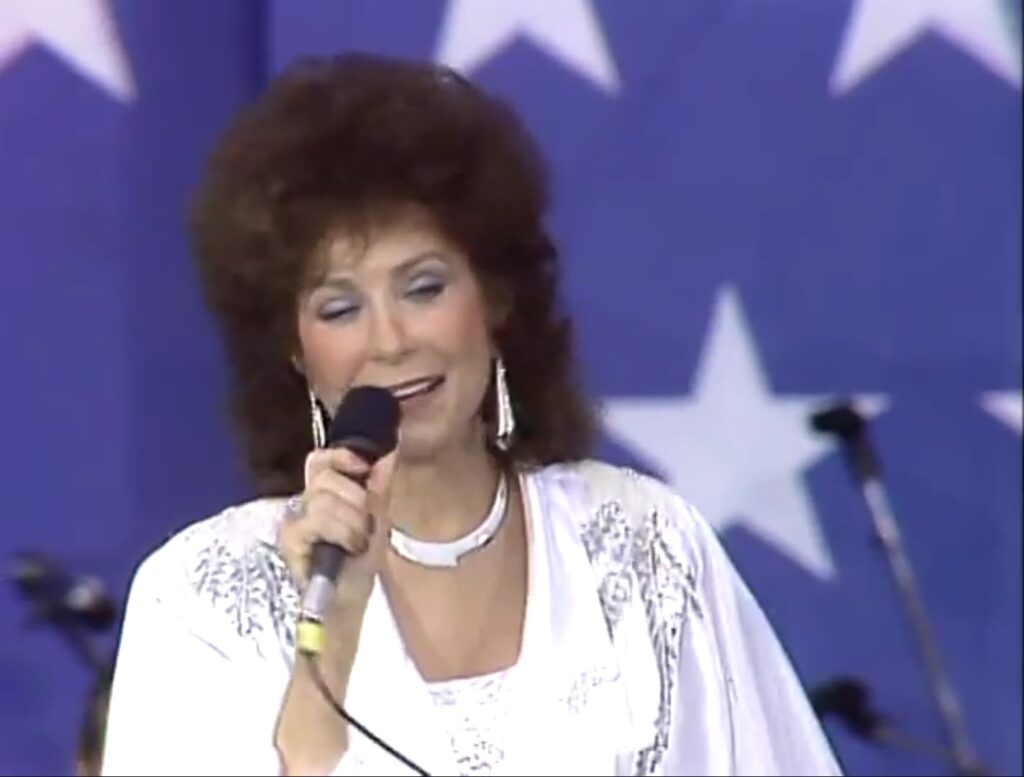
On September 22, 1985, at the Farm Aid concert in Champaign, Illinois, Loretta Lynn stood before the crowd and sang “Coal Miner’s Daughter,” not as a performance, but as a living memory. First released in 1970, the song had already become her signature, reaching No. 1 on the Billboard country chart and later inspiring the 1980 film of the same name. Yet on this stage, years later, it felt even more personal.
Written by Loretta Lynn herself, “Coal Miner’s Daughter” is not built on metaphor or invention. It is a direct reflection of her childhood in rural Kentucky, growing up in a poor mining family, where life was defined by hardship, resilience, and quiet dignity. Lines about her father working long hours in the mines and her mother holding the family together are delivered with a simplicity that makes them all the more powerful.
At Farm Aid, an event closely tied to artists like Willie Nelson and dedicated to the struggles of working families, the song finds a natural home. The audience does not just hear it. They understand it.
Loretta Lynn’s voice in 1985 carries both strength and warmth. There is no need to embellish the story. She tells it plainly, allowing the truth of her experience to carry the emotion. When she sings about being “proud to be a coal miner’s daughter,” it does not feel like nostalgia. It feels like identity.
The arrangement remains faithful to the original, with gentle instrumentation supporting her voice without distraction. The focus stays where it belongs, on the story itself.
What makes this performance especially moving is its authenticity. There is no separation between the singer and the song. Loretta Lynn is not interpreting a character. She is remembering her own life.
The audience responds with deep appreciation, not just for the music, but for the honesty behind it.
Looking back, this rendition of “Coal Miner’s Daughter” at Farm Aid stands as one of Loretta Lynn’s most enduring statements. It is a reminder that the most powerful songs are often the simplest ones, the ones that tell the truth without hesitation, and in doing so, become something far greater than music.
 Oldies Songs