
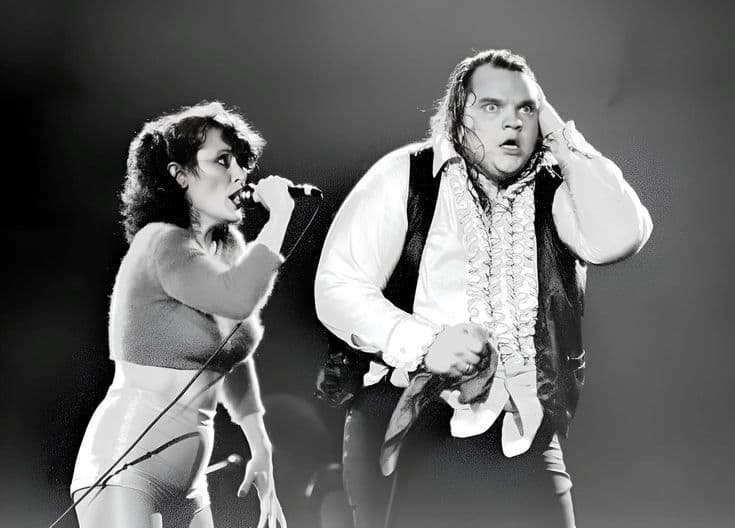
A thunderous hymn of youth, freedom, and reckless love — a song that rides forever between romance and rebellion
When “Bat Out of Hell” first erupted onto the airwaves in 1977, it didn’t arrive politely. It didn’t ask for permission. Instead, it burst through speakers like a motorcycle tearing down a midnight highway, carrying with it the voice of Meat Loaf, the grand, operatic vision of Jim Steinman, and a sound that felt too big, too dramatic, and too emotional for its time — and yet timeless from the very first note.
Released as the title track of the album Bat Out of Hell (1977), the song was part of a debut that would go on to become one of the best-selling albums in music history, eventually moving over 40 million copies worldwide. At the time of its release, however, success was far from guaranteed. The album initially struggled to find radio support in the United States, where its theatrical length, spoken-word sections, and Wagnerian ambition seemed out of step with prevailing radio formats. When “Bat Out of Hell” was issued as a single, it peaked at No. 68 on the Billboard Hot 100 during its later U.S. chart run, while gaining far stronger traction in Europe. In the UK, a 1993 reissue famously climbed to No. 15, introducing the song to a new generation and confirming its enduring power.
Behind the song lies one of the most fascinating creative partnerships in rock history. Jim Steinman, its composer and lyricist, conceived “Bat Out of Hell” as part of a larger, almost mythic narrative — a rock-and-roll opera fueled by teenage longing, fear, lust, and the hunger for escape. Steinman once described the song as a metaphor for being “barely seventeen and barely dressed,” suspended between innocence and experience, racing toward something you don’t fully understand but desperately need. It was never just about speed or rebellion; it was about that moment in life when everything feels urgent, when love feels like life or death, and when standing still feels more dangerous than crashing.
Musically, “Bat Out of Hell” is a masterclass in controlled excess. Clocking in at nearly ten minutes, it unfolds like a short film. The roaring guitars — inspired by the revving motorcycles of Bruce Springsteen’s “Born to Run” era — collide with sweeping piano lines, pounding drums, and sudden quiet passages that feel like catching your breath before the next emotional plunge. Meat Loaf’s voice is the true engine of the song: vulnerable, defiant, terrified, and triumphant all at once. Few singers have ever sounded so willing to risk everything on a single performance.
Lyrically, the song tells the story of a young man speeding away from love, from fear, from the past — or perhaps toward it. Lines about “dying” are less about death than about transformation: the death of youth, the end of illusions, the cost of growing up. The image of being “a bat out of hell” becomes a symbol of desperate motion — the need to move forward at all costs, even when the destination is uncertain. It speaks to anyone who has ever felt trapped by expectations, by small towns, by time itself.
What gives “Bat Out of Hell” its lasting resonance is not just its bombast, but its honesty. Beneath the leather jackets and thunderous crescendos lies a deeply human fear: that love might slip away, that time might run out, that the chance to truly live might pass unnoticed. The song understands that youth is not gentle — it is loud, reckless, and painfully beautiful — and that remembering it later in life comes with both warmth and ache.
Decades on, Meat Loaf and “Bat Out of Hell” remain inseparable, frozen together in a moment of pure, incandescent creation. The song endures not because it belongs to a particular decade, but because it captures something universal: the sound of a heart racing faster than reason, chasing freedom with no guarantee of survival. And for those who listen closely, it still feels like that first ride into the dark — terrifying, glorious, and utterly unforgettable.