
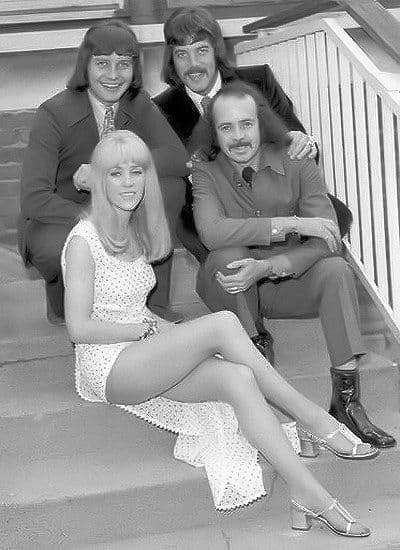
A Joyful Pop Echo from the Early 1970s: When “Tweedle Dee Tweedle Dum” Turned Simple Nonsense into Pure Musical Sunshine
Released in 1971, “Tweedle Dee Tweedle Dum” by Middle Of The Road stands as one of the most delightfully uncomplicated pop records of the early 1970s—an era when a catchy melody and a cheerful rhythm could still conquer international charts. Issued as a single during the group’s remarkable European chart run, the song became a substantial hit across several countries. It climbed to No. 2 on the UK Singles Chart, reached No. 1 in the Netherlands, and also topped charts in Belgium while placing strongly throughout continental Europe. Though it never entered the American Billboard Hot 100—reflecting the often unpredictable divide between European and American pop tastes—it nevertheless became one of the defining songs of Middle Of The Road’s golden period.
The track later appeared on the band’s album Acceleration (1971), which collected several of the group’s major hits and showcased the buoyant, accessible style that had already brought them worldwide attention with “Chirpy Chirpy Cheep Cheep.” Like many of the band’s recordings, “Tweedle Dee Tweedle Dum” was written and produced by the prolific songwriting team Lally Stott and Geoff Stephens, both of whom specialized in crafting infectious pop tunes with broad international appeal.
At first glance, “Tweedle Dee Tweedle Dum” seems almost childlike. The title itself evokes the whimsical characters Tweedledum and Tweedledee from Lewis Carroll’s Through the Looking-Glass, figures known for playful absurdity and circular logic. Yet the song’s charm lies precisely in that simplicity. Built around a bright sing-along chorus and a lively rhythm, it invites listeners into a world where the weight of everyday life momentarily disappears. In the early 1970s—an era filled with social change, political tension, and generational upheaval—songs like this provided a gentle reminder that music could still be carefree and joyous.
The arrangement is unmistakably part of the bubblegum-pop tradition that flourished at the end of the 1960s and into the early 1970s. Light percussion, buoyant bass lines, and a cheerful vocal delivery from Sally Carr, the group’s charismatic lead singer, give the song an irresistible forward motion. Carr’s voice is clear, warm, and slightly playful—perfectly suited to the song’s whimsical spirit. Around her vocals, the band layers harmonies and rhythmic accents that make the track feel almost like a celebration in miniature.
What makes Middle Of The Road particularly fascinating is that they were a Scottish group who found their greatest success not in Britain or the United States, but across mainland Europe. Formed in Glasgow, the band consisted of Sally Carr, Ken Andrew, Eric McCredie, and Ian McCredie. Their early recordings struggled to gain attention in the UK, but once “Chirpy Chirpy Cheep Cheep” exploded across Europe in 1971, the band suddenly became one of the continent’s most beloved pop acts. “Tweedle Dee Tweedle Dum” followed quickly afterward, helping cement their reputation for bright, melodic pop that audiences could instantly embrace.
Behind the scenes, the song also reflects the efficient songwriting industry that powered much of European pop during that time. Producers and composers like Geoff Stephens had an instinct for melodies that could cross language barriers. By using simple, rhythmic syllables—“tweedle dee” and “tweedle dum”—the chorus becomes universally understandable. One does not need translation to enjoy it; the sound itself carries the emotion.
Listening to “Tweedle Dee Tweedle Dum” today can feel like opening a small musical time capsule. The production style, the optimistic melody, and the uncomplicated joy of the chorus immediately transport the listener back to the early 1970s, when transistor radios played such songs on sunny afternoons and jukeboxes spun them in cafés across Europe. There is a certain innocence embedded in the recording—an innocence that modern pop music rarely attempts to recreate.
More than five decades later, the song remains a testament to the power of melody and mood. Not every memorable record needs profound lyrics or grand orchestration. Sometimes all it takes is a bright tune, a lively beat, and a voice like Sally Carr’s delivering a melody that refuses to leave the mind. In that sense, “Tweedle Dee Tweedle Dum” is more than just a cheerful pop hit; it is a reminder of a musical moment when joy itself could climb the charts.
And perhaps that is why the song still brings a quiet smile whenever it returns on an oldies playlist. Within those playful syllables—“tweedle dee, tweedle dum”—lives the spirit of a simpler pop era, where music asked for nothing more than a willing heart and a memory ready to wander back through time.
 Oldies Songs