
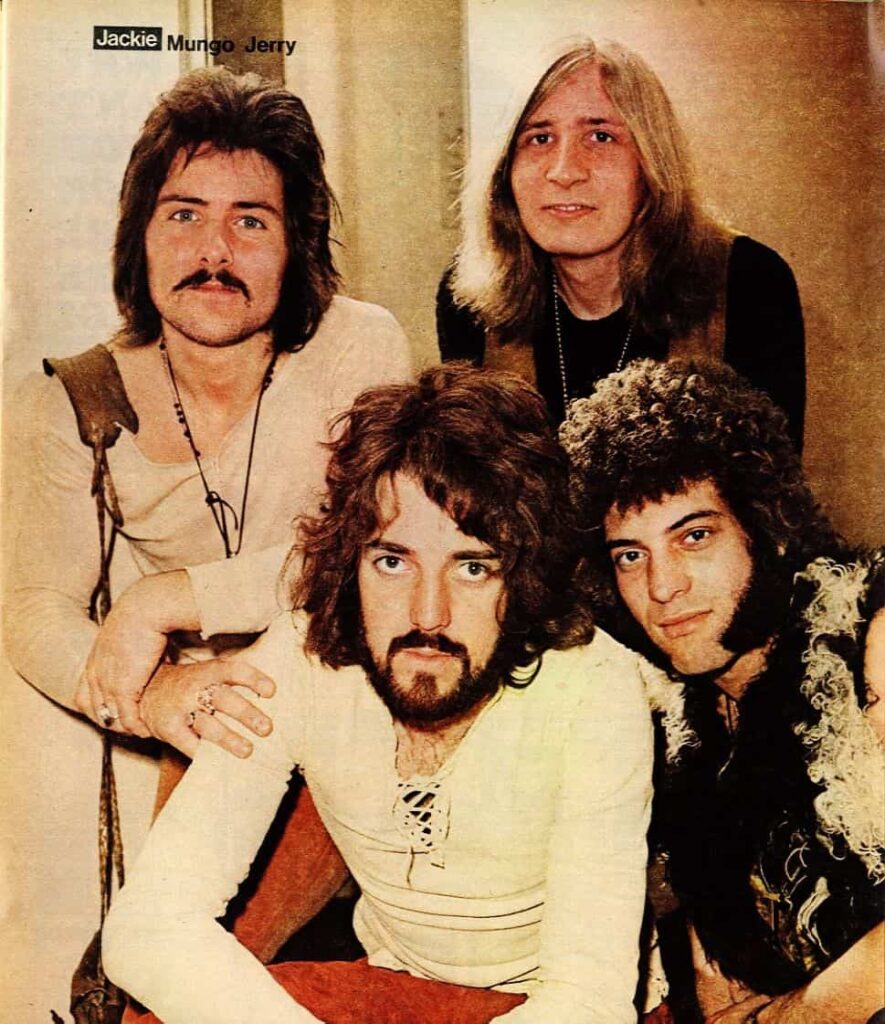
A carefree celebration of youth and freedom, “In the Summertime” captures a fleeting season when life felt lighter, love came easier, and time itself seemed to slow down.
When Mungo Jerry released “In the Summertime” in the summer of 1970, few could have predicted that this deceptively simple song would become one of the most enduring anthems of its era. Yet within weeks, it was everywhere — drifting out of car windows, spilling from radios, and settling into the collective memory of a generation. The song reached No. 1 on the UK Singles Chart, where it remained for seven consecutive weeks, and climbed to No. 3 on the US Billboard Hot 100, while topping charts across Europe, Australia, and beyond. With global sales estimated at over 30 million copies, it stands as one of the best-selling singles of all time — an extraordinary achievement for a band that seemed to arrive almost out of nowhere.
At the center of Mungo Jerry was Ray Dorset, the band’s founder, singer, and principal songwriter. Dorset wrote “In the Summertime” in a remarkably short span of time, reportedly sketching the song years earlier during a break while working in a factory, long before fame entered the picture. That origin story matters, because the song carries the unmistakable honesty of someone dreaming of escape — not from heartbreak or tragedy, but from routine, pressure, and restraint. It is a song born of imagination rather than ambition, and that may be why it feels so unforced even today.
Musically, “In the Summertime” is striking for what it avoids. There is no grand production, no lush orchestration, no studio polish typical of many late-1960s recordings. Instead, the track leans on a jug-band rhythm, acoustic guitar, light percussion, and Dorset’s relaxed, conversational vocal delivery. The sound feels almost improvised, as if the band simply gathered in a circle and let the groove happen. This looseness was radical in its own quiet way, standing in contrast to the increasingly complex rock productions of the time.
Lyrically, the song is a gentle manifesto for living in the present. Lines about driving fast, drinking with friends, and enjoying romance without complications are not calls to rebellion, but invitations to savor a moment. There is a strong sense of seasonal awareness — the understanding that summer, like youth, does not last forever. Beneath the cheerful surface lies a subtle urgency: enjoy this now, because soon it will be gone. That emotional undercurrent is what gives the song its lasting resonance.
The cultural timing of “In the Summertime” was also crucial. Released at the dawn of the 1970s, it arrived as the optimism of the late 1960s was beginning to fade. The world felt more uncertain, more divided, and less innocent. Against that backdrop, Mungo Jerry offered not protest or philosophy, but something arguably just as valuable — relief. The song did not try to change the world; it simply reminded listeners what it felt like to be free within it, if only for three minutes.
Over the decades, “In the Summertime” has never truly disappeared. It has been used in films, commercials, and countless summer playlists, often evoking memories of long drives, open roads, and evenings that seemed to stretch endlessly. Its charm lies in its ability to transport listeners back to a time when joy required very little explanation.
In retrospect, Mungo Jerry may be remembered primarily for this one defining hit, but what a legacy it is. “In the Summertime” remains a song that does not age — not because it belongs to every era, but because it preserves one perfectly. It is a musical postcard from a season we all recognize, whether we lived it in 1970 or only remember how it felt.