
A tender portrait of small-town dreams and quiet heartbreak, where time, love, and memory intertwine beneath the neon glow of a Woolworth counter
When “Love at the Five and Dime” was released in 1986 as part of the album “The Last of the True Believers”, Nanci Griffith offered listeners something far more enduring than a simple country-folk ballad. The song did not achieve major chart success upon its initial release as a single—never breaking into the upper tiers of the Billboard Hot Country Songs chart—but its legacy grew steadily over time, especially after Kathy Mattea recorded her own version in 1986, which reached No. 3 on the same chart. That success helped carry the song into the wider American consciousness, where it remains one of the most quietly devastating narratives ever set to music.
At its core, “Love at the Five and Dime” is a story—simple on the surface, yet layered with emotional complexity. It follows the lives of two young people, Rita and Eddie, whose romance blossoms in the humble setting of a five-and-dime store, a place once familiar to so many small-town Americans. These stores, like Woolworth’s, were more than retail spaces; they were gathering points, places where lives intersected, dreams were shared, and sometimes, hearts were broken. Griffith, known for her literary songwriting style, paints their journey with remarkable restraint and empathy.
What makes this song particularly compelling is its structure. Rather than following a traditional verse-chorus format, Griffith allows the narrative to unfold almost like a short story. The passage of time is marked not by musical shifts but by emotional transitions—Eddie’s departure, Rita’s quiet endurance, and the slow erosion of youthful hope. There is no grand climax, no dramatic resolution. Instead, we are left with a lingering sense of what might have been, a reflection on how ordinary lives carry extraordinary weight.
The collaboration with Kathy Mattea, though not a formal duet in Griffith’s original version, became spiritually significant through Mattea’s interpretation. Her rendition, with its warmer, more polished country production, introduced the song to a broader audience without losing its intimacy. It is often said that Mattea’s version feels like a conversation across time with Griffith’s original—two voices honoring the same fragile truth.
Behind the song lies Griffith’s deep affection for American roots culture. Born in Texas, she grew up surrounded by the kinds of stories she would later immortalize in her music. “The Last of the True Believers” itself is widely regarded as one of her finest works, a record that bridges folk storytelling with country sensibilities. The album may not have dominated the charts, but it secured Griffith’s reputation as a songwriter of rare sensitivity and intelligence.
Perhaps the most poignant aspect of “Love at the Five and Dime” is its quiet commentary on the passage of time. It speaks to a generation that remembers when love was less complicated, yet no less painful. The imagery of the five-and-dime store becomes symbolic—a place frozen in memory, untouched by the relentless march of modern life. For many listeners, the song evokes not just Rita and Eddie’s story, but their own—first loves, missed chances, and the bittersweet realization that life rarely unfolds as planned.
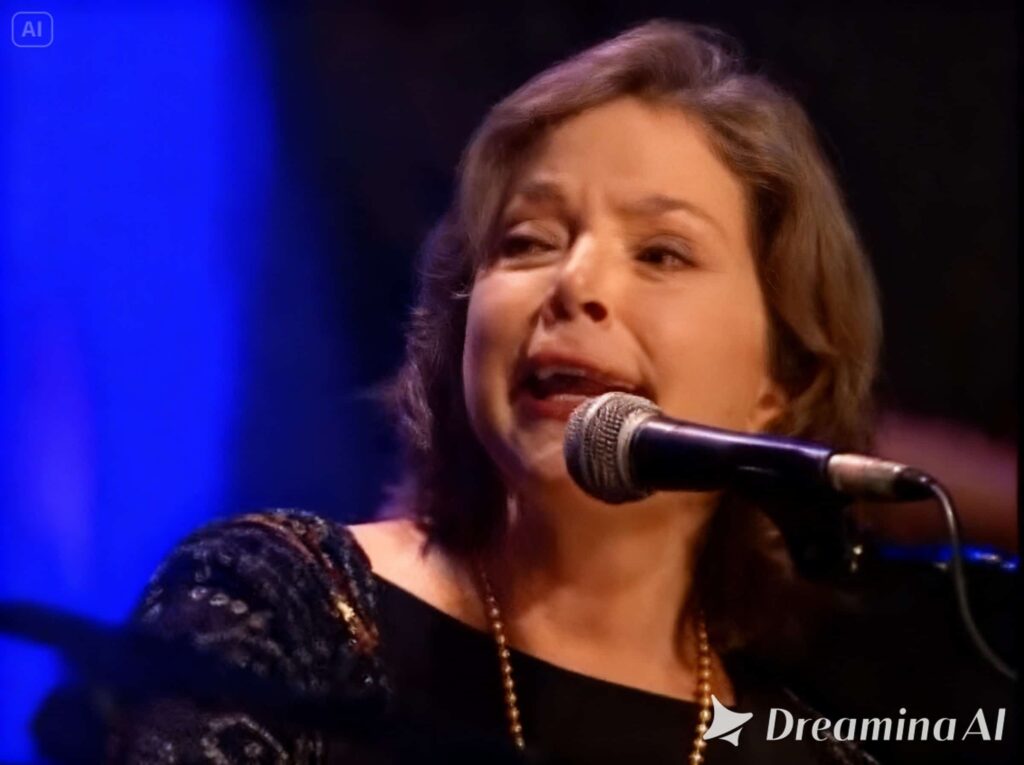
Over the years, the song has been performed in numerous intimate settings, but one of its most cherished live interpretations came during Griffith’s acoustic performances in the late 1980s and early 1990s, where the stripped-down arrangement allowed every word to resonate with even greater clarity. In those moments, the audience was not merely listening—they were remembering.
In the end, “Love at the Five and Dime” endures because it does not try to impress. It simply tells the truth, softly and without adornment. And in doing so, it reminds us that the most profound stories are often the quietest ones—the ones that linger long after the music fades.
 Oldies Songs