
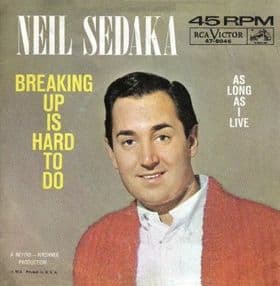
A tender anthem of young heartbreak that quietly became one of pop’s most enduring confessions
When “Breaking Up Is Hard to Do” was released in 1962, it did more than capture teenage sorrow. It secured Neil Sedaka’s place among the defining voices of early 1960s American pop. Issued as a single in the summer of that year, the song soared to No. 1 on the Billboard Hot 100, becoming Sedaka’s first chart-topping hit in the United States. It also reached No. 7 on the UK Singles Chart, affirming his growing international appeal. Written by Neil Sedaka and his longtime collaborator Howard Greenfield, the track appeared on the album “Neil Sedaka Sings His Greatest Hits” in 1962, though it had originally been recorded for Sedaka’s earlier sessions.
At first listen, the song feels buoyant, almost cheerful, with its brisk tempo and bright “doo-be-doo-down-down” refrain. Yet beneath that polished pop exterior lies a fragile admission: the agony of letting go. Sedaka once revealed that the melody was inspired in part by classical phrasing, a reminder of his training at the Juilliard School. That formal discipline gave the composition its balance and clarity, even as the lyrics voiced the helplessness of young love slipping away. Greenfield’s words are disarmingly simple. “Don’t take your love away from me” is not poetry dressed in metaphor. It is a plea, plain and vulnerable.
The early 1960s were an era when pop music was beginning to shift from the innocence of the 1950s into something more emotionally nuanced. In that context, “Breaking Up Is Hard to Do” felt both immediate and timeless. It spoke to the universal fear that the person you love may simply walk away. Sedaka’s smooth tenor, tinged with urgency, carried that fear into living rooms and onto transistor radios across America.
A decade later, in 1975, Sedaka reimagined the song as a slow, aching ballad. That version climbed to No. 8 on the Billboard Hot 100, making him the only artist to record two entirely different arrangements of the same song and take both into the Top 10. The transformation revealed what had always been hidden inside the original. Strip away the upbeat rhythm, and the core of the song is pure lament.
More than sixty years on, “Breaking Up Is Hard to Do” remains a gentle reminder that even the brightest melodies can hold deep sorrow. It stands as a testament to Neil Sedaka’s gift for crafting songs that feel simple on the surface yet carry the weight of real emotion. In its brief two minutes and sixteen seconds, it tells a story that never grows old.
 Oldies Songs