
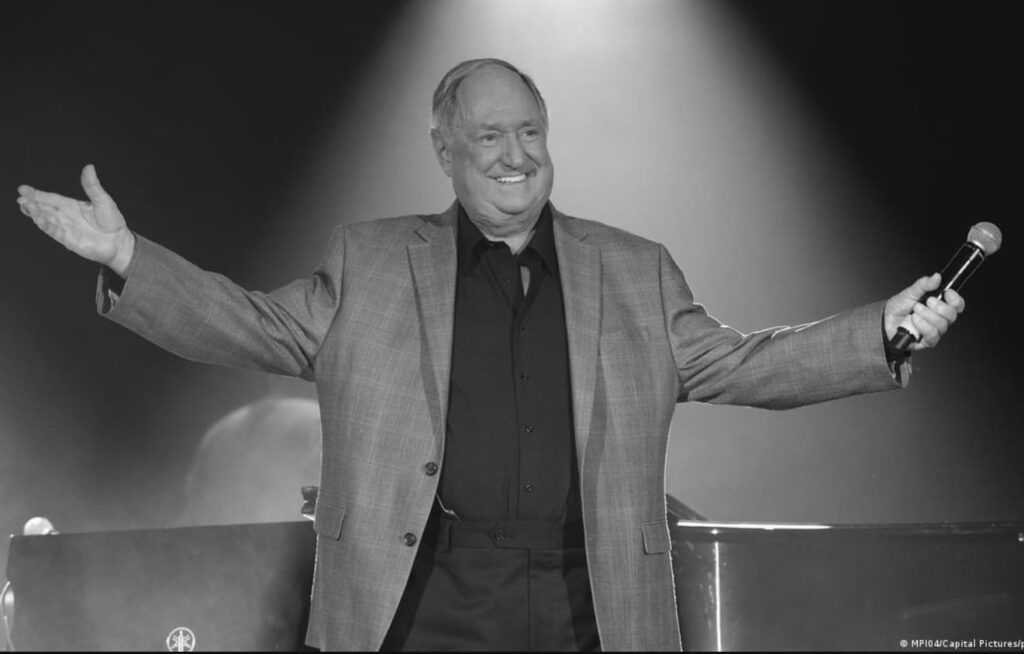
“The Hungry Years” – a wistful reflection on dreams, success, and longing for what once was.
When you speak the title “The Hungry Years”, you’re invoking much more than a simple pop song — you’re awakening an era, a sentiment, and the subtle ache of nostalgia that only time can carve into memory. Though it was never released as a major chart‑topping single in its own right, “The Hungry Years” stands as the emotional centerpiece of Neil Sedaka’s 1975 album The Hungry Years, an album that itself reached #16 on the Billboard 200 charts and stayed on the list an impressive 32 weeks during a period of rediscovery and career renaissance for Sedaka.
In the mid‑1970s, Neil Sedaka was no longer just the bright‑eyed crooner of the late 1950s and early 1960s — the man responsible for effervescent hits like Calendar Girl and Oh! Carol. By 1975, he had lived through a very real creative and professional drought in the United States, a stretch he and many of his contemporaries later referred to as his “hungry years,” a time of striving, of resilience, of believing in the music even when the spotlight dimmed.
To understand the weight of this song, you must imagine where Neil stood in 1975. The British Invasion and changing pop tastes had pushed many early rock‑and‑roll pioneers aside. But instead of fading quietly, Sedaka packed his bags for England and Australia, kept writing songs for others, and nurtured a craft that would soon bloom again. His collaboration with Elton John’s Rocket Record Company — where Elton himself would sing uncredited backing vocals on hits like “Bad Blood” — marked a triumphant resurgence. It was during these years that Sedaka realized success never guarantees fulfillment, a truth that courses through the veins of “The Hungry Years.”
The song itself is an introspective ballad steeped in bittersweet imagery. From its opening lines, it evokes the exhilaration of ascending to great heights — “we made it to the top, we went so high we couldn’t stop” — only to reveal a more sobering truth: sometimes, the climb itself costs us far more than we ever anticipated. It’s a meditation on ambition, youth, love, and the paradox that achieving our dreams can leave us yearning for the hunger that once drove us. The “hungry years” are not just a period of struggle, but a time of shared hopes, imagined futures, and simple joy in each other’s company, long before fame and success complicated everything.
Lyrically and melodically, the song is a tapestry of reminiscence — the kind of track that resonates deeply with listeners who have lived long enough to see both the glory and the emptiness life can offer. Lines like “I miss the hungry years, the once upon a time… we didn’t have a dime” speak directly to hearts that remember not just the thrill of youth, but the value found in struggle and togetherness, not in trophies or trophies’ shine.
Although “The Hungry Years” wasn’t a hit single that dominated the charts like Bad Blood or the ballad remake of Breaking Up Is Hard to Do, it became one of Sedaka’s most requested songs — particularly in live performances — cherished by fans who connected with its emotional core. It also marked the rekindling of his long‑time songwriting partnership with Howard Greenfield, whose lyrical sensibilities perfectly complemented Sedaka’s melodic warmth.
For those who grew up with Sedaka’s music, hearing “The Hungry Years” can feel like stepping back into a sunlit room filled with echoes — laughter, heartbreak, the turning of a record on an old hi‑fi, a memory of someone loved or lost. It’s a song that doesn’t just speak of time passed; it mourns it, embraces it, and invites the listener to join in that gracious, reflective pause that only truly great music can inspire.
In the panorama of Sedaka’s career — from teenage heartthrob to seasoned storyteller — “The Hungry Years” remains a gentle reminder that life’s sweetest melodies are often found in the spaces between ambition and remembrance.