
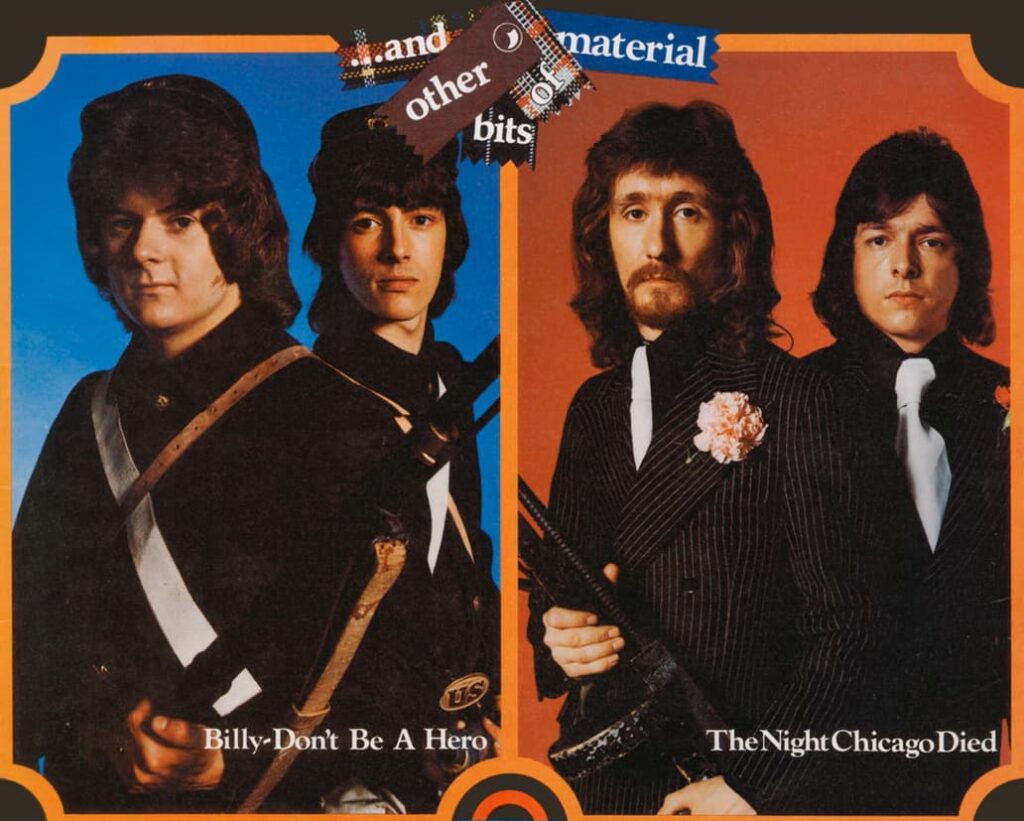
A tender farewell wrapped in melody – a gentle confession of love that lingers long after the last note fades
Released in 1974, “Love Song” by Paper Lace stands as one of the group’s most heartfelt and underappreciated recordings. While the band is most famously associated with the dramatic storytelling of “Billy Don’t Be a Hero” and the nostalgic wartime ballad “The Night Chicago Died,” both major international hits, “Love Song” revealed another side of the Nottingham quartet—a softer, more introspective dimension that often gets overshadowed by their chart-topping successes.
“Love Song” was issued as a single in the United Kingdom in 1974, following the massive success of “Billy Don’t Be a Hero,” which reached No. 1 on the UK Singles Chart and later topped the US Billboard Hot 100 in a different version. However, “Love Song” did not replicate that level of commercial triumph. It did not achieve a significant chart position in either the UK or US markets. Yet commercial ranking, as history often proves, is not always the measure of a song’s emotional worth. Some songs are not built for stadium cheers—they are meant for quiet rooms, late evenings, and memories that refuse to fade.
Musically, “Love Song” is rooted in the soft pop-rock style that characterized much of mid-1970s British radio. The arrangement is restrained: gentle guitar lines, steady percussion, and layered harmonies that were a signature of Paper Lace. Unlike their narrative-driven hits, this track leans into sincerity rather than drama. The melody unfolds with a kind of understated patience, allowing the lyrics to breathe. There is no theatrical crescendo, no sudden twist—just a steady emotional current that carries the listener from beginning to end.
The story behind “Love Song” reflects the transitional moment Paper Lace was experiencing. After the explosive success of their breakthrough singles, the band faced the pressure of proving they were more than a one-hit novelty. With this release, they attempted to demonstrate versatility, stepping away from historical storytelling into personal reflection. It was a bold artistic decision. Instead of capitalizing on the formula that had already guaranteed chart dominance, they offered something intimate—almost vulnerable.
Lyrically, “Love Song” expresses devotion in its purest form. It is not about youthful infatuation or dramatic heartbreak. Rather, it speaks of enduring affection—the kind that grows quietly over time. The song feels less like a declaration shouted from a rooftop and more like a confession whispered across a kitchen table after years of shared life. That subtlety gives it remarkable staying power. It resonates not because it dazzles, but because it feels lived-in.
There is also something unmistakably 1970s about its tone—an era when love songs were allowed to be earnest without irony. In that decade, vulnerability was not hidden behind sarcasm or complex production tricks. Bands like Paper Lace relied on melody, harmony, and heartfelt delivery. Listening to “Love Song” today is like opening a faded photograph album. The edges may be worn, but the images inside remain vivid.
Although the song never climbed the charts the way “The Night Chicago Died” (which reached No. 1 on the US Billboard Hot 100 in 1974) did, it holds an important place within the band’s catalog. It reveals their musicianship beyond commercial hits. It shows that they were not merely storytellers of fictional heroes and distant cities—they were interpreters of everyday emotion.
In retrospect, “Love Song” feels like a quiet statement of identity. It reminds us that sometimes the most meaningful music is not the loudest or most celebrated. Some songs do not dominate radio waves; they settle into the background of life’s most personal moments—weddings, long drives, or evenings spent reflecting on a lifetime of memories.
And perhaps that is the true legacy of “Love Song.” It does not demand attention. It earns affection slowly. Decades later, it still carries that gentle sincerity—a reminder of a time when a simple melody and honest words were more than enough to say everything that needed to be said.