
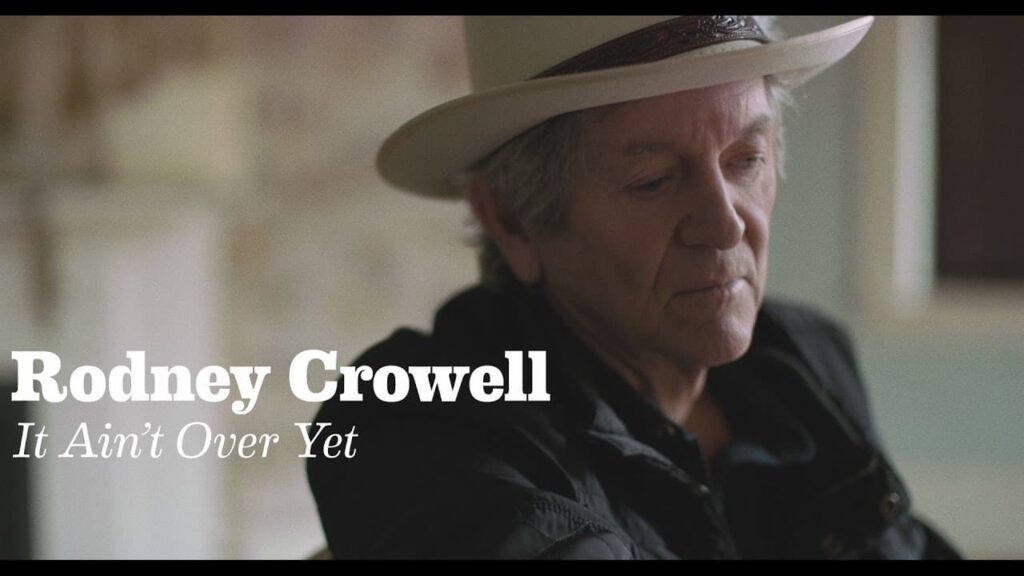
A Quiet Conversation About Endurance, Friendship, and the Grace of Not Giving Up
Released in 2017, “It Ain’t Over Yet” stands as one of the emotional pillars of Rodney Crowell’s acclaimed album Close Ties. While the song itself was not issued as a commercial single and therefore did not register an individual position on the Billboard Hot Country Songs chart, its parent album made a strong and meaningful impact. Close Ties reached No. 15 on the Billboard Top Country Albums chart and climbed to No. 3 on the Americana Folk Albums chart, confirming Crowell’s enduring relevance in a genre increasingly shaped by youth and gloss rather than lived experience.
For listeners who have followed Rodney Crowell since the 1970s, this song feels less like a performance and more like a personal letter left open on the table. By 2017, Crowell was already a Hall of Fame songwriter, a man whose pen had shaped classics for others long before mainstream audiences fully recognized his own voice. With “It Ain’t Over Yet”, he was no longer chasing radio rotation or commercial trends. He was taking stock.
The song gains extraordinary emotional weight from its collaborators. Rosanne Cash, Crowell’s former wife and creative partner during one of the most productive chapters of his career, appears not as a nostalgic novelty but as a living echo of shared history. Her voice, weathered and honest, carries decades of triumph, heartbreak, and reconciliation. Alongside her is John Paul White of The Civil Wars, whose restrained harmonies add a quiet gravity rather than dramatic flourish. Together, the voices do not compete. They converse.
The story behind the song is inseparable from loss. Crowell wrote “It Ain’t Over Yet” during the final months of Guy Clark’s life. Clark, a towering figure in the Texas songwriting tradition, was not merely a colleague but a mentor and a compass. Facing the slow goodbye of a friend, Crowell chose reflection over sentimentality. The result is a song that understands time not as an enemy, but as a teacher that speaks softly to those willing to listen.
Lyrically, the song is built on restraint. There are no grand declarations, no swelling choruses designed to overwhelm. Instead, Crowell leans into the wisdom of survival. The phrase “it ain’t over yet” is not shouted as defiance. It is spoken as reassurance. It acknowledges mistakes, missed chances, and long roads that did not lead where they once promised. Yet it refuses despair. The song accepts age without surrendering purpose.
Musically, Close Ties is rooted in acoustic textures and unhurried tempos, and this track embodies that philosophy fully. The arrangement leaves space for silence, allowing meaning to settle between the notes. This is music for listening rooms, for late evenings, for moments when memory arrives uninvited. It trusts the listener to bring their own history into the song.
For those who came of age during the golden era of singer-songwriters, “It Ain’t Over Yet” resonates deeply. It does not romanticize the past, nor does it deny regret. Instead, it offers something rarer. Permission to keep going. In a culture that often sidelines aging voices, Crowell reminds us that relevance is not measured by novelty, but by truth.
Within Rodney Crowell’s vast catalog, this song occupies a special place. It is neither a career summation nor a farewell. It is a pause. A breath. A moment of clarity shared among friends who have walked long roads together. And perhaps that is why it lingers so powerfully. Because long after the charts fade and the years accumulate, some songs do not need to prove anything at all. They simply stay.