
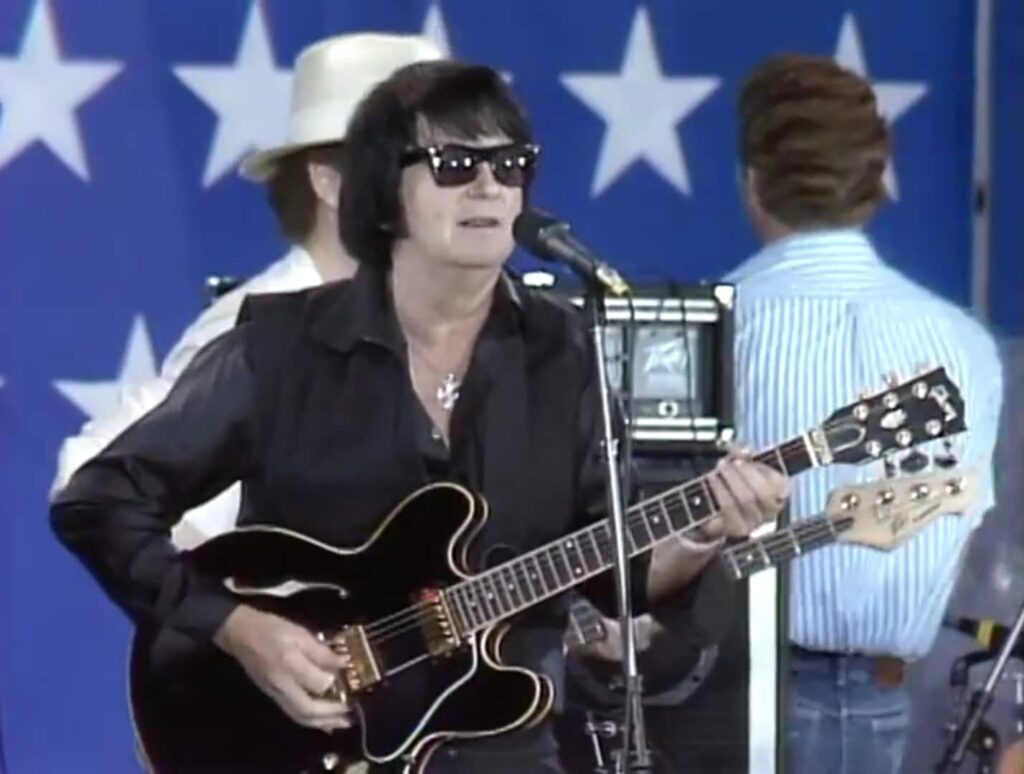
A fiery return to rock and roll roots as “Mean Woman Blues” roared across the Farm Aid stage, reminding the world that Roy Orbison could still command a crowd with pure musical electricity.
On September 22, 1985, the stage at Farm Aid in Champaign became the setting for a moment that blended charity, nostalgia, and raw rock and roll energy. Among the legendary performers who gathered to support struggling American farmers that day was the unmistakable voice of Roy Orbison. When he launched into “Mean Woman Blues”, the crowd witnessed not just a performance, but a powerful reminder of an artist whose voice had defined an era.
By 1985, Orbison was already considered one of the most distinctive voices in popular music. Known worldwide for haunting ballads like “Crying” and “Only the Lonely,” he had built a reputation for emotional intensity and extraordinary vocal control. Yet “Mean Woman Blues”, originally made famous in the 1950s, showed another side of Orbison. The song carried the swagger and rhythm of early rock and roll, giving him the chance to trade melancholy for playful defiance.
At Farm Aid, that shift in tone electrified the audience.
The concert itself was historic. Organized by Willie Nelson, Neil Young, and John Mellencamp, Farm Aid was created to raise awareness and financial support for family farmers across the United States. The lineup included some of the most respected names in American music. Each artist brought their own style and story to the stage, but Orbison’s appearance carried a particular sense of anticipation. For many watching, his voice had been the soundtrack to countless memories from the late 1950s and early 1960s.
When the band kicked into the opening rhythm of Mean Woman Blues, Orbison stood center stage with his trademark dark glasses and calm composure. The song’s driving beat immediately energized the crowd. Instead of the operatic crescendos that defined many of his ballads, this performance leaned into rockabilly grit and rhythmic punch.
What made the moment special was the way Orbison delivered the song with both authority and ease. His voice still carried remarkable strength, rising above the guitars with clarity and confidence. The playful lyrics about a troublesome woman were delivered with a wink in the voice, turning the performance into something both humorous and thrilling.
For longtime listeners, the performance felt like a bridge between decades. The sound of early rock and roll echoed through the stadium, yet Orbison’s voice showed that time had not diminished his artistry. If anything, the years had deepened the character in his singing.
The crowd responded with enthusiastic applause, recognizing the rare combination of musical history and live energy unfolding before them.
Moments like this also hinted at the remarkable comeback that Orbison would experience in the late 1980s. Just a few years after the Farm Aid performance, he would join the legendary supergroup Traveling Wilburys and release new recordings that introduced his voice to another generation. In retrospect, the 1985 performance of “Mean Woman Blues” now feels like part of that quiet resurgence.
Looking back, the Farm Aid stage captured Orbison at a fascinating point in his career. He was no longer the young star who first climbed the charts in the 1950s, yet he remained a commanding performer whose voice could still ignite a crowd.
And for those who witnessed that evening in Champaign, the memory remains vivid. A familiar rhythm, a legendary voice, and a song that proved rock and roll spirit never really fades.