
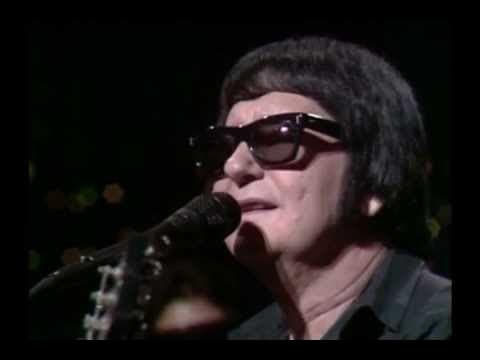
A quiet terror of love reaching its breaking point, where devotion and doubt collide in a single, breathless moment
Few songs capture emotional tension with the precision and restraint of “Running Scared”, the 1961 masterpiece that carried Roy Orbison to the very summit of popular music. Released as a standalone single on Monument Records and written by Roy Orbison with his trusted collaborator Joe Melson, the song reached No. 1 on the Billboard Hot 100 in June 1961, holding the top position for two consecutive weeks. In the United Kingdom, it climbed to No. 9 on the UK Singles Chart, marking Orbison’s growing international stature at a time when rock and roll was rapidly evolving beyond its early swagger into something more emotionally complex.
From the outset, “Running Scared” distinguished itself by what it refused to do. There is no traditional chorus, no rhythmic hook designed for easy repetition. Instead, the song unfolds like a short psychological drama, built on a slow, relentless crescendo that mirrors the narrator’s mounting fear. Orbison sings not as a brash hero, but as a man quietly unraveling. The arrangement remains restrained, almost hesitant, until the final moments, when the music rises abruptly and Orbison’s voice ascends into an aching, operatic climax, punctuated by a sudden upward key change that feels less like triumph than emotional surrender.
The story behind the song is deceptively simple. A man believes he is about to lose the woman he loves to someone stronger, more confident, more assured. He watches from a distance, paralyzed by jealousy and self-doubt, convinced that he is about to be left behind. What makes “Running Scared” remarkable is not the plot itself, but the emotional honesty with which it is told. Orbison and Melson understood that fear can be louder than anger, and more devastating than rage. The song speaks from the fragile space between love and abandonment, where imagination becomes an enemy and silence becomes unbearable.
Musically, Roy Orbison was operating in a category entirely his own. While many of his contemporaries relied on swagger or irony, Orbison leaned into vulnerability. His voice, soaring yet controlled, carried a sense of emotional exposure that was unusual for male singers of the era. On “Running Scared”, his vocal performance is almost architectural, carefully constructed to rise with the narrative. Each line adds weight, each note pushes higher, until the final confession breaks through. When the woman ultimately chooses him, the resolution feels hard-earned, as if survival itself were the victory.
The song was not initially tied to a specific album, a common practice in the early 1960s when singles often stood alone. It was later included on various albums and compilations, becoming an essential part of Roy Orbison’s recorded legacy. Over time, it came to be recognized not just as a chart success, but as a blueprint for emotional storytelling in popular music, influencing generations of singers who sought to express vulnerability without sentimentality.
That emotional clarity was still unmistakable two decades later when Roy Orbison performed “Running Scared” live on Austin City Limits in 1982. By then, his voice carried the weight of years, fame, loss, and reflection. The performance stripped away any lingering notion that the song belonged only to youth. Instead, it revealed how deeply its themes resonate with experience. Fear of loss does not fade with time. If anything, it grows more articulate. Orbison sang not as a man imagining heartbreak, but as one who had lived through it and understood its quiet persistence.
The enduring power of “Running Scared” lies in its refusal to dramatize fear into spectacle. It remains intimate, inward-looking, and profoundly human. For listeners who have known love as something fragile rather than guaranteed, the song feels less like entertainment and more like recognition. In the vast catalog of Roy Orbison, filled with grand emotions and sweeping melodies, “Running Scared” stands apart as a moment of hushed intensity, where the smallest doubt carries the greatest weight, and where a single voice is enough to hold the world still.
 Oldies Songs