
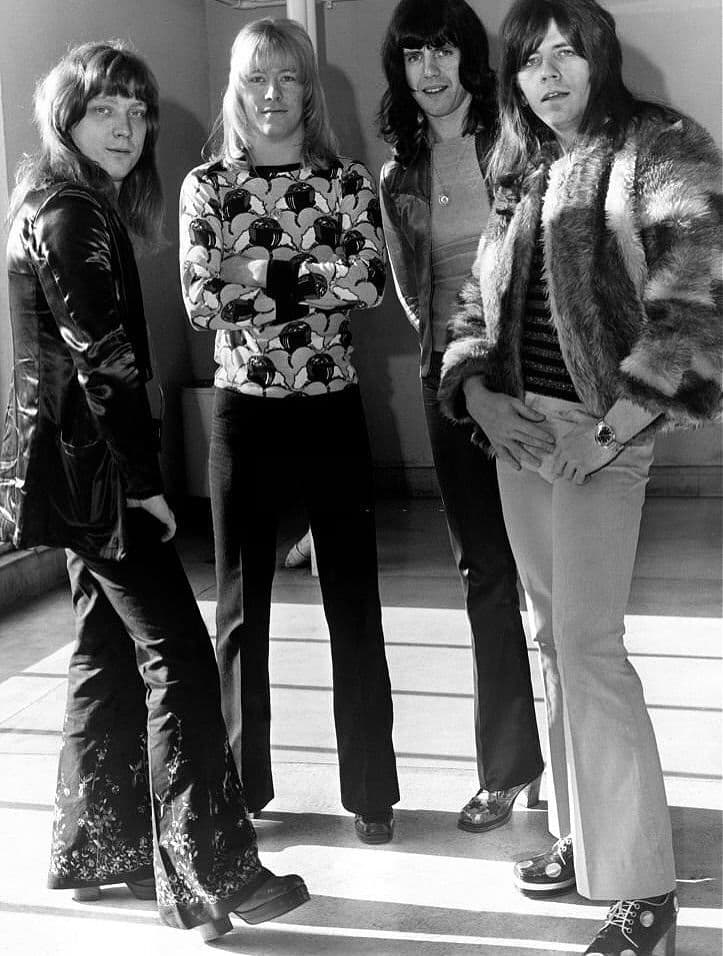
A fierce glam-rock spark that revealed Sweet’s heavier soul beneath the glitter
When “Burn On The Flame” arrived in 1973, it did not storm the summit of the British charts the way some of Sweet’s glittering singles had done. Yet its importance lies not in peak positions, but in revelation. Featured on the album Sweet Fanny Adams (1974 in the UK; late 1973 in some European territories), the song signaled a turning point: a bold declaration that Sweet were far more than a bubblegum glam act crafted by hitmakers. While it was not issued as a major standalone UK single with a notable chart peak like “Block Buster!” (UK No. 1, 1973) or “Hell Raiser” (UK No. 2, 1973), “Burn On The Flame” became a cult favorite—especially in continental Europe and Australia, where it received radio airplay and was sometimes promoted as a single in select markets.
By the time “Burn On The Flame” was circulating, Sweet—fronted by the charismatic Brian Connolly, with Andy Scott, Steve Priest, and Mick Tucker—had already tasted enormous success. Under the songwriting and production guidance of Nicky Chinn and Mike Chapman, they had conquered the charts with infectious, stomping anthems. But beneath the flamboyant costumes and stacked harmonies, there had always been another current running through the band: a harder, darker rock energy that owed more to The Who and Led Zeppelin than to teen-pop formulas.
“Burn On The Flame” is where that hidden fire bursts into full view.
Musically, the track leans heavily into muscular guitar riffs and an almost urgent rhythmic propulsion. Andy Scott’s guitar work crackles with controlled aggression, while Mick Tucker’s drumming carries a precision that feels both disciplined and explosive. The production—still under the Chinn-Chapman umbrella—retains the polished sheen expected of early-’70s glam, but the song’s spine is unmistakably hard rock. There is less of the sing-along chant here and more of a smoldering intensity.
Lyrically, “Burn On The Flame” speaks of passion that refuses to die—of desire and emotional defiance. The title itself suggests endurance through fire, an image that resonates deeply. In the early 1970s, glam rock was often dismissed as style over substance. Yet here, Sweet seemed to be saying: we endure, we burn, we persist. The flame is both love and ambition, both vulnerability and stubborn pride.
There is a subtle poignancy when listening today, knowing what lay ahead. Brian Connolly’s voice—powerful yet tinged with a certain fragility—carries the song with conviction. His upper register soars, but one can already sense the strain that relentless touring and personal struggles would later exacerbate. In retrospect, “Burn On The Flame” feels like a moment frozen in amber: the band at a creative crossroads, still united, still fierce.
The album Sweet Fanny Adams itself marked a shift toward self-composition. Unlike earlier singles written entirely by Chinn and Chapman, the band began asserting more creative control. This evolution would lead to heavier tracks like “Set Me Free”, which charted in the US (Billboard Hot 100 No. 29 in 1975) and further established Sweet as a credible rock act beyond the glam stereotype. In that sense, “Burn On The Flame” stands as an early ember of that transformation.
For many listeners who discovered Sweet through their chart-topping hits, encountering this track felt almost like discovering a secret room behind a familiar door. The glitter was still there—but behind it burned something rawer, more authentic. It is the sound of a band insisting on depth at a time when image often overshadowed artistry.
Listening now, decades removed from the era of platform boots and shimmering jackets, “Burn On The Flame” carries a different weight. It reminds us of a time when rock music balanced melody and muscle, when bands were evolving in real time before our ears. The song does not merely entertain—it endures. Like its title suggests, it continues to glow quietly in the vast catalogue of Sweet, cherished by those who appreciate the deeper cuts as much as the chart-toppers.
In the grand narrative of 1970s rock, “Burn On The Flame” may not have claimed the highest chart position. But sometimes, it is not the brightest explosion that leaves the longest impression. Sometimes, it is the steady flame that burns on.