
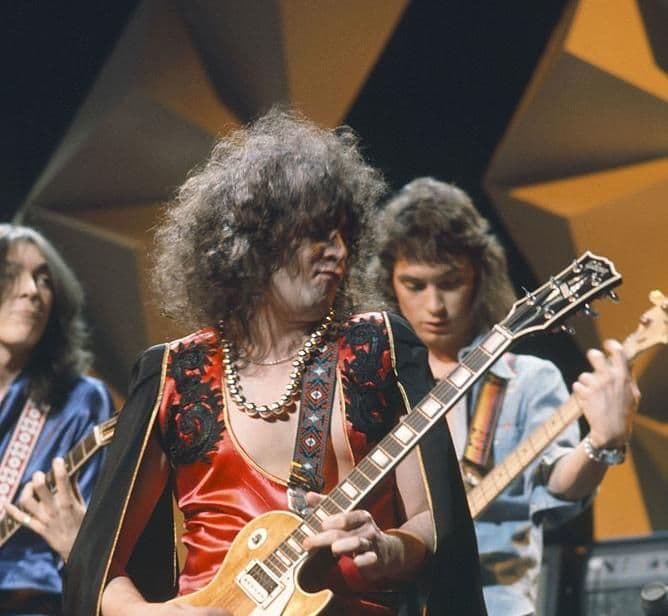
A defiant glam-rock manifesto, “20th Century Boy” captures the moment when pop swagger, myth-making, and raw guitar attitude collided at full force.
When T. Rex released “20th Century Boy” in March 1973, it arrived not as a cautious single but as a bold declaration. By that point, Marc Bolan was already a dominant figure in British popular music, yet this song felt like a line drawn in the sand—a statement of identity at a time when glam rock was beginning to fracture and evolve. Upon its release, “20th Century Boy” climbed quickly to No. 3 on the UK Singles Chart, confirming Bolan’s continuing grip on the public imagination. In Ireland, it reached No. 1, while elsewhere it stood as one of the most instantly recognizable singles of the era. Notably, the track was issued as a standalone single, not tied to a new studio album at the time, which only reinforced its sense of independence and self-assurance.
From its opening seconds, the song announces itself with absolute confidence. The now-iconic guitar riff—thick, dirty, and unashamedly repetitive—locks in with a stomping rhythm that owes as much to early rock ’n’ roll as it does to the glittering excess of the early 1970s. Produced by Tony Visconti, whose collaboration with Bolan helped define the T. Rex sound, the recording is lean but muscular. There is no ornamentation for its own sake; every element serves the attitude. Bolan’s voice, half-sung and half-boasted, floats above the groove with a sly grin you can practically hear.
Lyrically, “20th Century Boy” is less a narrative than a self-portrait. Bolan places himself at the center of a world shaped by electricity, celebrity, and desire. Lines about “friends who stuck together” and the insistence on being “your boy” are delivered not as pleas, but as facts. This is not a song about longing for acceptance—it assumes it. In that sense, the track functions as a glam-rock mission statement: the individual as spectacle, the self as art, the present moment as something to be seized rather than explained.
Yet beneath the bravado lies a quieter tension. By 1973, the cultural landscape was shifting. Glam rock, once shocking and playful, was becoming mainstream, even predictable. “20th Century Boy” sounds like Bolan pushing back against that domestication. The repeated emphasis on the “20th century” feels almost anxious, as if he were anchoring himself firmly in the now, aware that pop fame is fleeting and eras turn quickly. The song’s power comes from that duality—confidence edged with urgency.
Musically, the track bridges generations. Its DNA traces back to Chuck Berry and Eddie Cochran, filtered through fuzz pedals and glitter boots. That lineage is key to understanding why the song has endured. Long after its initial chart run, “20th Century Boy” found new life through films, commercials, and cover versions, introducing Bolan’s voice to listeners far removed from the glam era. Each revival underscores the same truth: the song does not belong to a single moment. It belongs to anyone who recognizes that surge of self-belief when music makes you feel larger than the room you’re standing in.
Although it later appeared on compilations such as Bolan Boogie, “20th Century Boy” remains most powerful when remembered as it first appeared—sudden, loud, and unapologetic. It stands among T. Rex’s finest achievements not because it chased trends, but because it distilled everything Bolan stood for into three relentless minutes. For listeners who lived through that time, it echoes with the sound of transistor radios, chart countdowns, and a world that still believed pop music could reinvent identity. For those discovering it later, it remains a reminder that true style, once captured on tape, never really ages.