
A Playful Anthem of Glam Desire and Defiant Romance
When “Jeepster” by T. Rex burst onto the British charts in late 1971, it did not merely introduce another pop single—it crystallized a moment in cultural history. Released in November 1971 as the second single from the landmark album Electric Warrior, the song soared to No. 2 on the UK Singles Chart, where it remained for four weeks, famously held off the top spot by Benny Hill’s novelty smash “Ernie (The Fastest Milkman in the West).” Yet chart positions only tell part of the story. “Jeepster” was not just a hit; it was a shimmering statement of glam rock identity, wrapped in swagger, flirtation, and poetic eccentricity.
By 1971, Marc Bolan had already begun reshaping the musical landscape. With “Hot Love” and “Get It On,” he had transformed T. Rex from their earlier psychedelic-folk incarnation into something electrified and magnetic. “Jeepster” arrived at the height of that transformation. Produced by Tony Visconti, whose lush yet controlled arrangements gave the track its glistening polish, the song rides on a sensual, mid-tempo groove anchored by warm electric guitar and a subtle rhythmic pulse. It feels intimate, almost conspiratorial, as if whispered from stage to the first row under shimmering lights.
The story behind “Jeepster” reveals both its spontaneity and its significance. According to Bolan, the song was inspired by the American car brand Jeep, though, in true Bolan fashion, the title became less about automobiles and more about metaphor. The lyrics are playful and surreal: “Girl, I’m just a jeepster for your love.” The imagery is whimsical—foxes, tigers, and sleek machines—but beneath the glitter lies a direct, almost childlike declaration of desire. Unlike the heavy-handed romantic ballads of earlier eras, Bolan’s approach is teasing, mischievous, confident without arrogance. He offered romance as theater, as spectacle.
There was also tension surrounding the single’s release. Bolan reportedly objected to “Jeepster” being issued as a single, feeling that too many tracks from Electric Warrior were being extracted for commercial gain. Nevertheless, the public embraced it wholeheartedly. Its success further cemented the phenomenon soon dubbed “T. Rextasy”—a frenzy of adoration not seen since the height of Beatlemania. Teen magazines filled with Bolan’s image; concert halls echoed with screams. Yet “Jeepster” itself remains surprisingly restrained compared to some of the era’s more flamboyant anthems. It seduces rather than shouts.
Musically, the track reflects the core of glam rock before it hardened into caricature. The groove is bluesy, almost laid-back, suggesting Bolan’s deep admiration for American rhythm and blues artists. The guitar tone is smooth and rounded rather than abrasive, allowing the vocal to take center stage. Bolan’s voice—breathy, sly, and intimate—carries the performance. He sings not as a distant idol but as a charismatic storyteller leaning close, letting listeners in on a private joke.
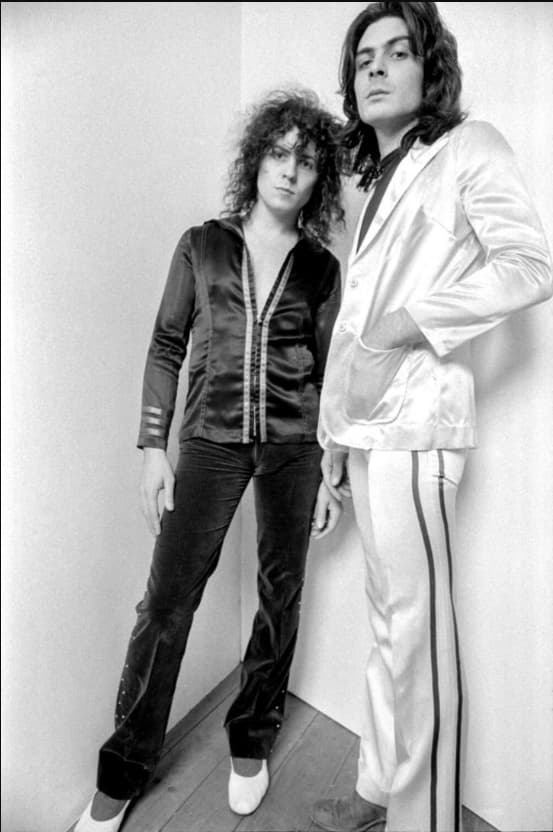
In the broader narrative of early 1970s rock, “Jeepster” represents liberation. It was an era when gender lines blurred, fashion glittered, and performance became as important as melody. Bolan’s feather boas, satin trousers, and glitter-dusted cheeks were not mere costume—they were declarations. In “Jeepster,” the romantic persona is fluid, confident, unashamed of its sensuality. The song’s lightness masks a quiet revolution: the permission to be theatrical, to be extravagant, to love boldly.
Even decades later, when the opening riff drifts from a vintage radio or spins softly on vinyl, “Jeepster” carries with it the warmth of another time. It recalls record shops with posters in the windows, crackling transistor radios, and the thrill of discovering something that felt daring yet comforting. Unlike heavier rock anthems that age into bombast, “Jeepster” remains agile and inviting. It does not overwhelm; it charms.
And perhaps that is its enduring meaning. At its heart, “Jeepster” is about devotion wrapped in playful bravado. It reminds us that romance can sparkle without losing sincerity, that music can wink and still speak truth. In the golden shimmer of early ’70s Britain, amid platform boots and electric dreams, Marc Bolan offered a song that felt both fleeting and eternal—a sly smile preserved in sound.