
A Gentle Voice Telling a Dark Old Story — Love, Guilt, and Fate Beneath the Willow Tree
Few recordings illustrate the quiet power of American folk tradition as starkly as “Down in the Willow Garden” by The Everly Brothers. Released in 1958 on Cadence Records, the song did not enter the charts as a standalone single. Instead, it appeared as the B-side to the No. 1 hit “Wake Up Little Susie,” which topped the Billboard Hot 100 in early 1958. That pairing alone tells us something important: while radio embraced the Everlys for their bright harmonies and youthful energy, this song belonged to a deeper, older current—one that flowed beneath commercial expectations.
Shortly afterward, the brothers included the song on their remarkable album Songs Our Daddy Taught Us (1958), a record devoted entirely to traditional folk and Appalachian material learned from their father, Ike Everly. It is within this context that “Down in the Willow Garden” finds its true home not as a pop artifact, but as an heirloom.
The song itself is a traditional Appalachian murder ballad, sometimes traced back to 19th-century British and Irish roots under alternate titles such as “Rose Connelly.” Like many ballads carried across generations, it survives because it speaks plainly and without adornment about irreversible choices. The narrator tells his story from the shadow of the gallows, confessing how he poisoned his lover with wine, stabbed her, and threw her body into a river. There is no attempt at justification, no plea for mercy—only the cold clarity of a man who understands that the end has already arrived.
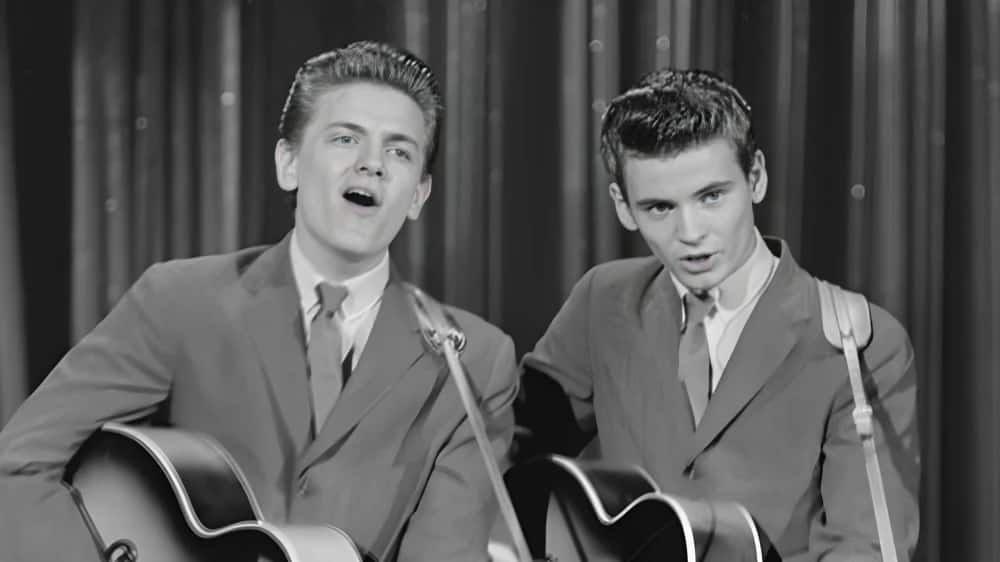
What makes the Everly Brothers’ version so enduring is not sensationalism, but restraint. Don and Phil Everly sing in close harmony, their voices calm, almost tender, even as the lyrics describe betrayal and death. This emotional contradiction is essential. The song does not shout its horror; it whispers it. In doing so, it reflects the moral landscape of old folk music, where tragedy is presented as a fact of life rather than a spectacle.
Musically, the arrangement is spare and reverent. Acoustic guitar carries the melody, allowing the harmonies to do the emotional work. There is no dramatic crescendo, no theatrical emphasis. The stillness feels intentional, as if the brothers understood that this song had already lived many lives before them. Their role was simply to listen carefully and pass it on intact.
The significance of “Down in the Willow Garden” within the Everly Brothers’ catalog cannot be overstated. At a time when they were dominating the charts with songs about young love and heartbreak, this recording revealed another side of their artistry: a deep respect for American roots music. Songs Our Daddy Taught Us would later be recognized as one of the most important folk albums ever recorded by mainstream artists, influencing generations of musicians across folk, country, and Americana.
The song’s meaning lingers long after the final line. It is not merely about murder; it is about the weight of memory, the finality of actions taken in a moment of darkness, and the inescapable reckoning that follows. The willow tree itself a recurring symbol in folk tradition stands as a witness, bending but unbroken, as human lives are undone beneath its branches.
In the Everly Brothers’ hands, “Down in the Willow Garden” becomes something quietly devastating. It reminds us that long before charts and categories, music served another purpose: to carry stories too heavy to forget. And sometimes, the most haunting songs are not the ones that climb the rankings, but the ones that stay with us spoken softly, remembered forever.