
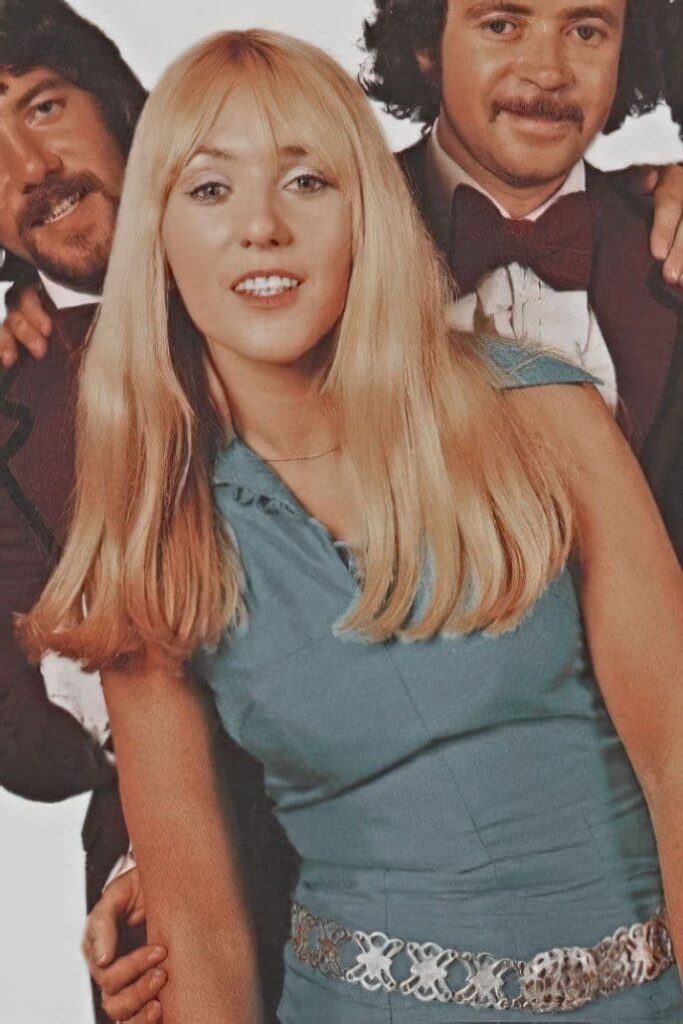
From a Scottish Village to Global Pop Stardom: The Enduring Voice of Sally Carr
As someone who has spent decades studying and documenting the popular music of the 1960s through the 1980s, I often return to artists whose voices defined an era. One such voice belongs to Sally Carr, the Scottish singer whose bright and distinctive tone helped propel the group Middle of the Road to international success in the early 1970s. Her story is not only about chart hits, but also about perseverance, transformation, and the lasting charm of classic pop music.
Sally Carr was born Sarah Cecilia Carr on March 28, 1945, in the small village of Muirhead in North Lanarkshire, Scotland, near Glasgow. She grew up in a working-class family as the only daughter among five children. Her father worked as a coal miner, while her mother, Cecilia, spent much of Sally’s childhood bedridden. Despite these challenges, music was always present in the household. Informal singing around the family piano played a major role in shaping Sally’s natural vocal ability. Notably, she developed her voice without any formal vocal training, relying instead on instinct and enthusiasm.
As a teenager, Carr became involved in the local Glasgow music scene, performing in clubs and small venues throughout the region. By the mid-1960s she had gained valuable stage experience and was already developing the confident stage presence that would later captivate international audiences.
Her first significant professional step came when she joined a Glasgow-based group that included Ken Andrew and brothers Ian and Eric McCredie. In 1967, Carr initially joined the group as a temporary replacement singer. However, her chemistry with the musicians proved undeniable, and the arrangement quickly became permanent. The band reorganized as a four-member vocal group centered on harmony singing.
During this early phase the group performed under different names, including Part Four and later Los Caracas, performing Latin-influenced pop in clubs and restaurants across the United Kingdom. They also appeared on the popular ITV talent program Opportunity Knocks, which helped expand their visibility.
A major turning point came in 1970, when the band traveled abroad seeking new opportunities. While passing through Italy, they performed at a club in Forte dei Marmi and caught the attention of representatives connected with RCA Italiana. Soon afterward they relocated to Rome, where they began recording sessions and working as backing vocalists for Italian artists and film soundtracks.
During this Italian period the group adopted the name Middle of the Road, working with producer Giacomo Tosti. Their breakthrough arrived in 1971 with the release of “Chirpy Chirpy Cheep Cheep.” Written by Lally Stott, the song became a worldwide phenomenon. In the United Kingdom it reached number one on the UK Singles Chart, firmly establishing the band as a major pop act.
A string of successful singles soon followed. “Tweedle Dee Tweedle Dum” reached number two in the UK, while “Soley Soley” and “Sacramento” became major hits across Europe and beyond. Carr’s clear, cheerful vocal style became the defining sound of these recordings. During the early 1970s the band toured extensively throughout Europe, Australia, and New Zealand, appearing on television and performing to enthusiastic crowds.
By 1977, however, Carr decided to leave the group. In the following years she focused more on family life after marrying Scottish sports journalist Chick Young, with whom she had a son, Keith.
Life brought both joy and hardship. In 2001, Carr experienced a profound personal tragedy when her son was killed in a motorcycle accident. She withdrew from public life for some time afterward. Later, serious health issues—including a brain hemorrhage and stroke in the early 2010s—temporarily halted her performing career.
Remarkably, Carr eventually returned to the stage. By 2017 she resumed performing with Middle of the Road at concerts and festivals across Europe, demonstrating the resilience that had characterized her entire career.
Today, Sally Carr has largely retired from public performance. Yet her legacy remains secure. The unmistakable voice behind “Chirpy Chirpy Cheep Cheep” continues to evoke the joyful spirit of early-1970s pop music, reminding listeners around the world of a golden age when melody, harmony, and simple optimism ruled the airwaves.