
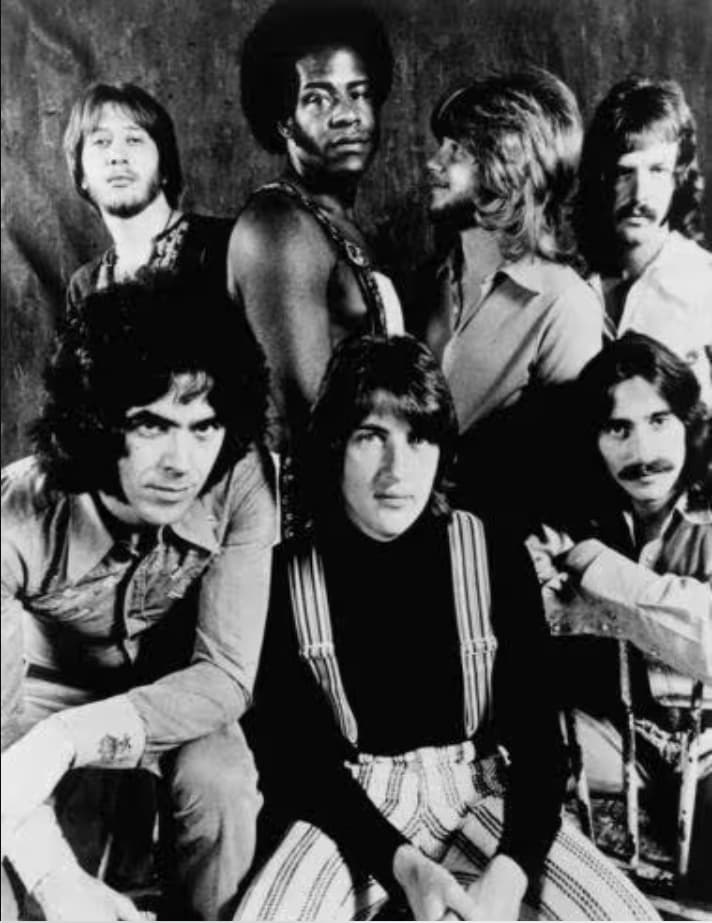
A solitary cry in a crowded world — “One” turns loneliness into a universal anthem of the human heart.
When Three Dog Night released “One” in early 1969, they could hardly have imagined that this stark, emotionally charged song would become one of the defining statements of their career. Issued as a single from their self-titled debut album, Three Dog Night (1968), the track climbed to No. 5 on the Billboard Hot 100 in the United States. In Canada, it reached No. 4, confirming that this was no fleeting radio curiosity but a song that resonated deeply across North America.
What makes the success of “One” particularly fascinating is that it was not written by a member of the band. The song was composed by Harry Nilsson, then a relatively unknown songwriter who had recorded his own haunting version in 1968. Nilsson’s rendition was introspective, almost ghostly, built around celeste and sparse orchestration. But when Three Dog Night — particularly lead vocalist Chuck Negron — took hold of it, the song transformed. It became less a fragile confession and more a dramatic, soulful lament, driven by steady rhythm and a swelling arrangement that gave the loneliness weight and gravity.
The opening line — “One is the loneliest number that you’ll ever do” — is deceptively simple. Yet in those few words lies a universal truth. The song speaks not only of romantic separation but of isolation in its broader, more existential sense. There is something quietly devastating about the idea that “two can be as bad as one” — suggesting that even companionship can fail, that closeness does not always protect us from solitude. In the turbulent cultural climate of the late 1960s, when society seemed divided and uncertain, that sentiment struck a nerve.
Musically, Three Dog Night had a rare gift for selecting outside material and making it unmistakably their own. Unlike many rock bands who focused primarily on self-written songs, they curated compositions by gifted songwriters — from Randy Newman to Paul Williams — and elevated them through powerful vocal performances and tight ensemble work. With “One,” Chuck Negron’s voice carries a tremor of vulnerability, yet it soars with conviction. There is restraint in the verses and controlled anguish in the chorus, a dynamic contrast that mirrors the emotional push and pull of heartbreak.
Behind the scenes, the band was just beginning to establish its identity. Formed in 1967, Three Dog Night featured three lead vocalists — Chuck Negron, Cory Wells, and Danny Hutton — a configuration that allowed them to explore a wide range of styles. “One” became an early proof of concept: this was not a one-dimensional rock act, but a group capable of soulful introspection and radio-friendly power in equal measure.
Over the decades, “One” has endured not merely as a nostalgic hit but as a cultural touchstone. It has appeared in films, television, and retrospectives of the era. Its message remains painfully relevant: the ache of standing alone, the quiet despair of love lost, the realization that sometimes silence speaks louder than words. And yet, paradoxically, the song itself has never been lonely. It has accompanied countless listeners through private sorrows and reflective evenings, offering companionship in the very act of describing isolation.
Listening to “One” today, there is a particular poignancy in the production — that late-1960s blend of pop structure and emerging rock boldness. The arrangement builds without overwhelming, allowing the lyric’s stark simplicity to shine through. It is a reminder of a time when a three-minute single could hold profound emotional depth without elaborate studio excess.
In retrospect, Three Dog Night’s interpretation of Harry Nilsson’s composition stands as one of the great examples of interpretive artistry in popular music. It is a song about loneliness that brought millions together. And perhaps that is its quiet miracle: in declaring that “one is the loneliest number,” it became a shared anthem — proof that none of us are ever truly alone when a melody like this is playing.
 Oldies Songs