
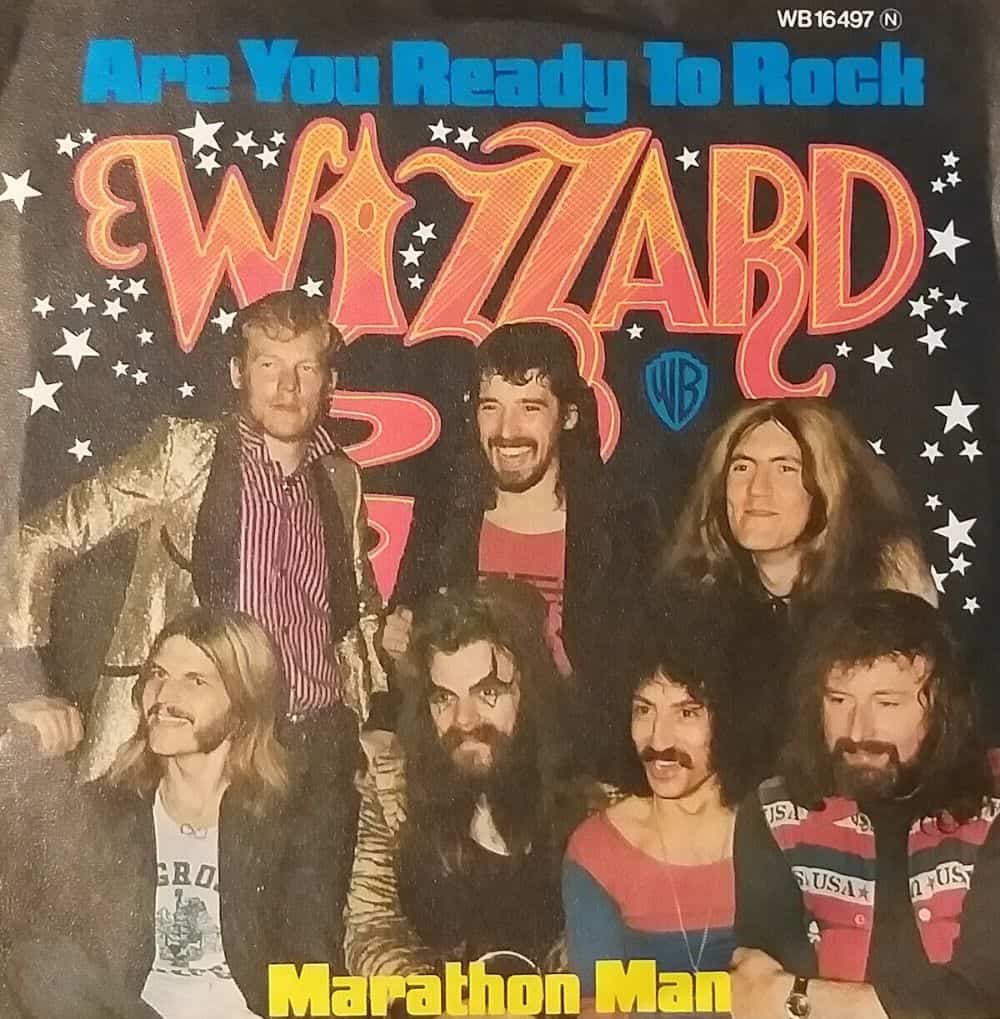
A thunderous celebration of raw material and human will, where rock ’n’ roll becomes a forge for memory, noise, and working-class pride
When talking about Wizzard, the conversation often drifts quickly toward the glittering triumphs of “See My Baby Jive” or the festive chaos of “I Wish It Could Be Christmas Everyday.” Yet tucked deeper in the band’s short but astonishing catalogue lies “Iron, Steel, Metal,” a track that reveals another, heavier face of Roy Wood’s musical imagination—one that is loud, stubborn, industrial, and deeply rooted in the physical world.
Released in 1973, “Iron, Steel, Metal” appeared as a B-side rather than a headline single, and as such it did not enter the UK Singles Chart at the time of its release. But to judge its importance purely by chart position would be to misunderstand both the song and the era that produced it. In the early 1970s, British rock was splitting in many directions: glam was dazzling the charts, progressive rock was growing increasingly cerebral, and heavy rock was rediscovering brute force. Wizzard, under Wood’s restless leadership, refused to choose just one path—and “Iron, Steel, Metal” stands as proof.
Musically, the song is built like its title suggests. Thick, overdriven guitars grind forward with a sense of mechanical repetition. The rhythm section pounds rather than grooves, evoking factory floors more than dance halls. There is little polish here, little concession to pop sweetness. Instead, Wood leans into noise as texture, treating distortion and volume as expressive tools. This approach places the track closer in spirit to early hard rock and proto-metal than to the chart-friendly glam hits that made Wizzard famous.
Lyrically, “Iron, Steel, Metal” is deceptively simple. The repeated invocation of industrial materials—iron, steel, metal—works less as literal description and more as metaphor. These are substances shaped by fire, pressure, and time. In that sense, the song becomes a meditation on endurance: of labor, of identity, of human resilience in an increasingly mechanized world. Wood does not romanticize the factory; he embraces its weight, its noise, its inevitability. The result feels honest rather than sentimental.
This theme resonates strongly when viewed against Britain’s social backdrop in the early 1970s. Heavy industry still defined entire communities, even as its future was beginning to look uncertain. “Iron, Steel, Metal” captures that moment of tension—pride mixed with fatigue, strength shadowed by anxiety. It is rock music that understands where it comes from: not from fantasy, but from work, repetition, and survival.
Within Wizzard’s broader body of work, the song also highlights Roy Wood’s refusal to be boxed in. Having already conquered the charts with The Move and Electric Light Orchestra, Wood could easily have settled into formula. Instead, he used Wizzard as a laboratory, jumping from doo-wop pastiche to orchestral pop to abrasive hard rock. “Iron, Steel, Metal” feels like a statement of freedom—music made because it needed to exist, not because it was guaranteed to sell.
Over time, the song has gained a quiet cult appreciation among listeners who value texture, weight, and historical context over immediate hooks. For those who lived through the era, its sound can trigger memories of a Britain where industry still roared, radios still crackled with guitars, and music was allowed to be rough around the edges. For later listeners, it offers a sonic document—an aural photograph of a moment when rock music still believed in the power of volume and physicality.
In the end, “Iron, Steel, Metal” may never have climbed the charts, but it stands tall as a reminder that not all meaningful songs arrive wrapped in gold records. Some are forged in noise, shaped by pressure, and left to endure—much like the materials they so proudly name.