
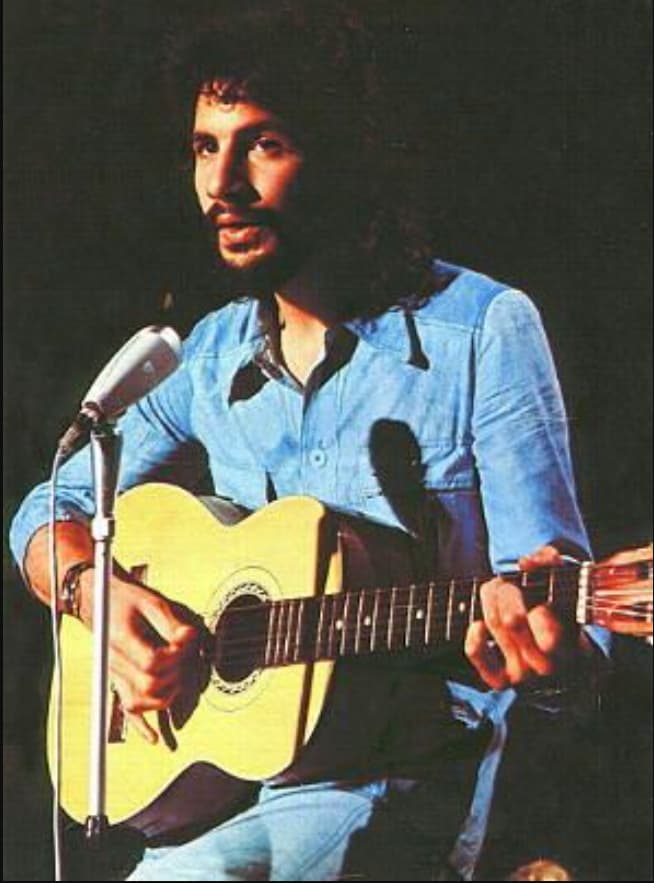
A Tender Dialogue Between Generations, Where Love Speaks Through Silence and Separation
Few songs in the canon of modern folk music carry the quiet emotional weight of “Father & Son” as profoundly as this timeless composition by Yusuf / Cat Stevens. Released in 1970 on the landmark album Tea for the Tillerman, the song did not storm the charts in the United States as a conventional hit single. Instead, it found its place more slowly—more deeply—embedding itself in the hearts of listeners. In the United Kingdom, it reached No. 4 on the UK Singles Chart when reissued in 1972, and over the decades it has become one of the most enduring pieces in Stevens’ repertoire, often cited as his signature song.
At the time of its release, Tea for the Tillerman was a critical and commercial triumph, reaching No. 20 on the Billboard 200 and No. 7 in the UK Albums Chart. The album itself stands as a pillar of early 1970s singer-songwriter introspection. Yet among its luminous tracks—“Wild World”, “Where Do the Children Play?”, and “Hard Headed Woman”—it is “Father & Son” that resonates with a universal ache that transcends era and circumstance.
The origin of the song is both theatrical and personal. Stevens originally wrote it for a musical project titled Revolussia, an ambitious concept album about a young man caught between revolutionary fervor and established authority. Although the musical was never fully realized, the emotional core of that abandoned work found a permanent home in this composition. What makes “Father & Son” so extraordinary is its structure: two voices in one body. Stevens performs the father’s verses in a lower, steady tone—measured, patient, restrained. When he shifts to the son’s perspective, the vocal timbre lifts, trembles, and strains toward urgency. It is not merely a lyrical conversation; it is an emotional dialogue rendered through pitch and phrasing.
The late 1960s and early 1970s were years of generational friction. Across Europe and America, youth movements were challenging political systems, social conventions, and inherited values. In that climate, “Father & Son” became something of an anthem—not in a loud, defiant sense, but in a reflective one. The father’s advice—“It’s not time to make a change, just relax, take it easy”—is not portrayed as tyranny. It is offered with concern, with a desire for stability. Meanwhile, the son’s response—“I know I have to go”—is not rebellious for rebellion’s sake. It carries the trembling certainty of someone who feels called to find his own road, even if it leads away from home.
That dual empathy is perhaps the song’s greatest achievement. Yusuf / Cat Stevens does not villainize either side. He understands both. And in that understanding lies the heartbreak: love does not always mean agreement. Sometimes love means allowing departure.
Musically, the arrangement is deceptively simple. Gentle acoustic guitar lines form the backbone, with subtle string arrangements that swell almost imperceptibly, supporting the emotional crescendo without overwhelming it. The production—handled by Paul Samwell-Smith—retains an intimate warmth, as if the conversation were taking place in the next room. There is no bombast, no dramatic orchestral flourish. The power resides in restraint.
Over the decades, “Father & Son” has taken on new layers of meaning. It has been used in films, most notably in Guardians of the Galaxy Vol. 2 (2017), introducing the song to younger generations while reminding longtime listeners of its enduring resonance. It has been covered by numerous artists, including a successful 2004 duet version featuring Ronan Keating alongside Stevens’ original vocals, which again reached No. 2 in the UK charts. Yet no reinterpretation quite captures the fragile sincerity of the original recording.
There is something quietly devastating about the song’s final repetition. The son’s voice grows more insistent, almost desperate, as if aware that understanding may never come in time. And yet, beneath the tension, there is unmistakable affection. It is the sound of two people who love each other deeply, separated not by hatred but by experience.
More than half a century later, “Father & Son” remains a mirror in which many listeners see their own unspoken conversations—words said too late, or not at all. In its gentle chords and trembling vocal shifts, it preserves a universal truth: that growing up often means walking away, and loving someone sometimes means letting them go.
In the quiet after the final note fades, one is left with a sense of gratitude—for a song that understands the delicate balance between guidance and freedom, and for an artist who had the courage to give both voices equal dignity.