
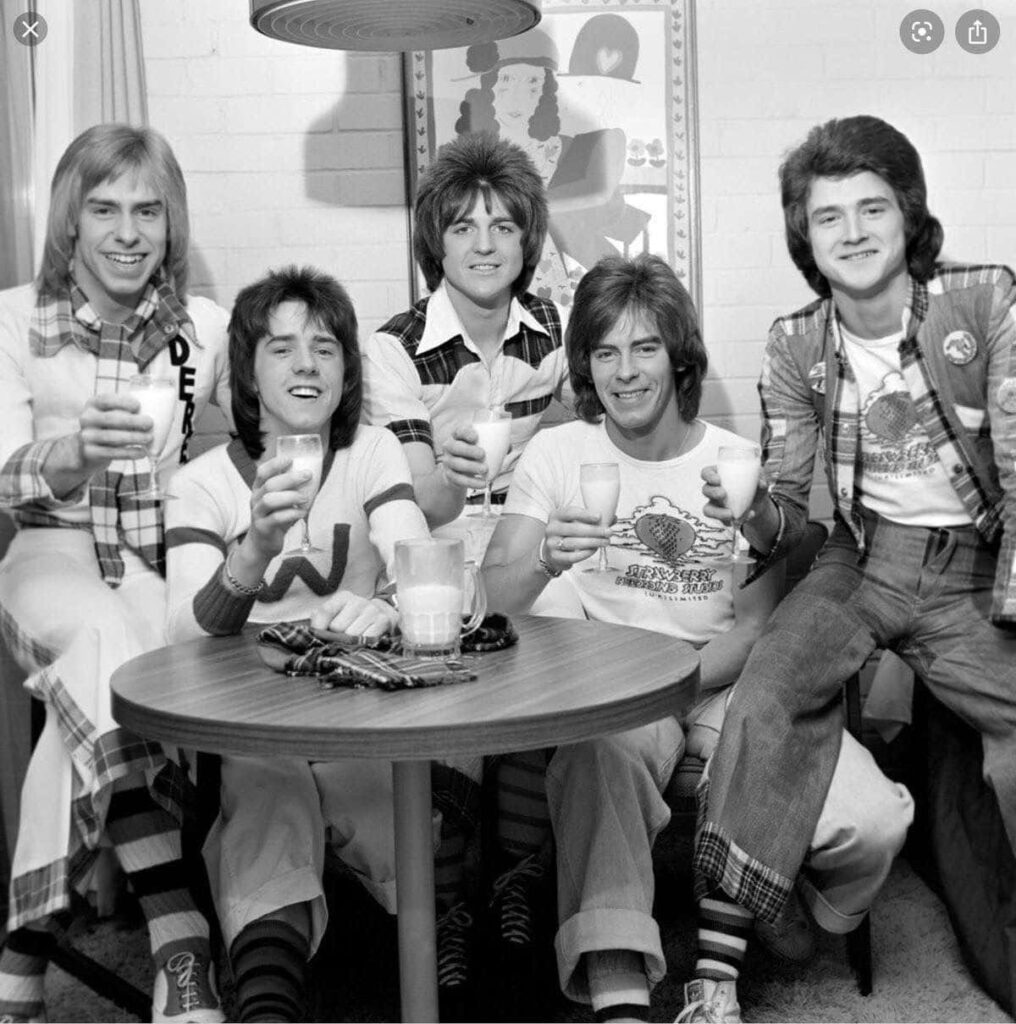
A buoyant declaration of young love, wrapped in bright harmonies and the innocent urgency of the mid-1970s pop revival
When “I Only Wanna Be With You” was released by Bay City Rollers in 1976, it arrived not merely as a cover of an already beloved tune, but as a spirited reaffirmation of youthful devotion during the height of the band’s glittering fame. Issued as a single in the UK in early 1976, the song climbed to No. 4 on the UK Singles Chart, becoming one of the group’s major hits during their commercial peak. It later appeared on the album Dedication (1976), a record that captured the Rollers at a moment when “Rollermania” was sweeping across Britain, Europe, and even reaching American shores.
It is important to remember that the song itself was not new. Written by Mike Hawker and Ivor Raymonde, it was first recorded in 1963 by Dusty Springfield, whose version reached No. 4 on the UK chart and No. 12 on the Billboard Hot 100 in the United States. Springfield’s original carried the breathless charm of early 1960s pop-soul, brimming with girlish excitement and romantic confusion. When the Bay City Rollers revisited it more than a decade later, they did not merely replicate that sweetness; they infused it with the crisp, guitar-driven sheen of mid-’70s pop-rock, adding their unmistakable vocal harmonies and a rhythmic bounce that felt both nostalgic and contemporary.
By 1976, the Rollers were already household names. Songs like “Bye Bye Baby” and “Shang-A-Lang” had cemented their reputation as the smiling standard-bearers of British teen pop. But “I Only Wanna Be With You” offered something subtly different. Beneath its effervescent surface lies a story of emotional surrender—of being so taken by someone that reason dissolves into pure feeling. “I don’t know what it is that makes me love you so…” the lyric confesses. It is not an analytical love song; it is instinctive, almost helpless. That vulnerability, carried by Les McKeown’s bright and earnest lead vocal, gives the track an enduring sincerity.
The mid-1970s were an interesting crossroads in popular music. Glam rock was fading, disco was rising, and harder-edged sounds were waiting in the wings. Amid that shifting landscape, the Bay City Rollers stood for uncomplicated joy. Their version of “I Only Wanna Be With You” felt like a reassuring reminder of simpler emotions—of handwritten letters, transistor radios, and the thrill of hearing a favorite song crackle to life on the airwaves. Its chiming guitars and buoyant tempo gave it a celebratory tone, but listen closely and there is also a wistfulness embedded in its melody. The song captures that fragile space between infatuation and devotion—the moment when love feels both exhilarating and slightly bewildering.
Commercially, the single reinforced the Rollers’ remarkable run of success. Reaching the UK Top 5 in 1976, it demonstrated that the band could reinterpret earlier classics and still make them feel immediate. In the United States, the track also helped sustain their growing popularity during a period when British acts were competing fiercely for American attention. Though they would soon face the inevitable cooling of pop hysteria, this recording remains one of the brightest jewels in their catalogue.
Looking back, what makes “I Only Wanna Be With You” endure is not just its chart position or its catchy refrain. It is the atmosphere it evokes. For many listeners, the song is a time capsule—transporting them to dance halls decorated with tartan scarves, to youthful afternoons spent humming along without a care for tomorrow. The Rollers’ rendition carries a sense of optimism that feels almost rare in retrospect. There is no irony here, no guarded distance—only the wholehearted declaration that being close to someone you love is reason enough for joy.
In revisiting this song, one cannot help but feel that it embodies a particular era of pop music when melody reigned supreme and sincerity was not something to hide. The Bay City Rollers, in their spirited revival of a Dusty Springfield classic, managed to capture lightning in a bottle once more—reminding us that sometimes, the simplest words can hold the deepest truth: wanting to be with someone, and nothing more.
 Oldies Songs