
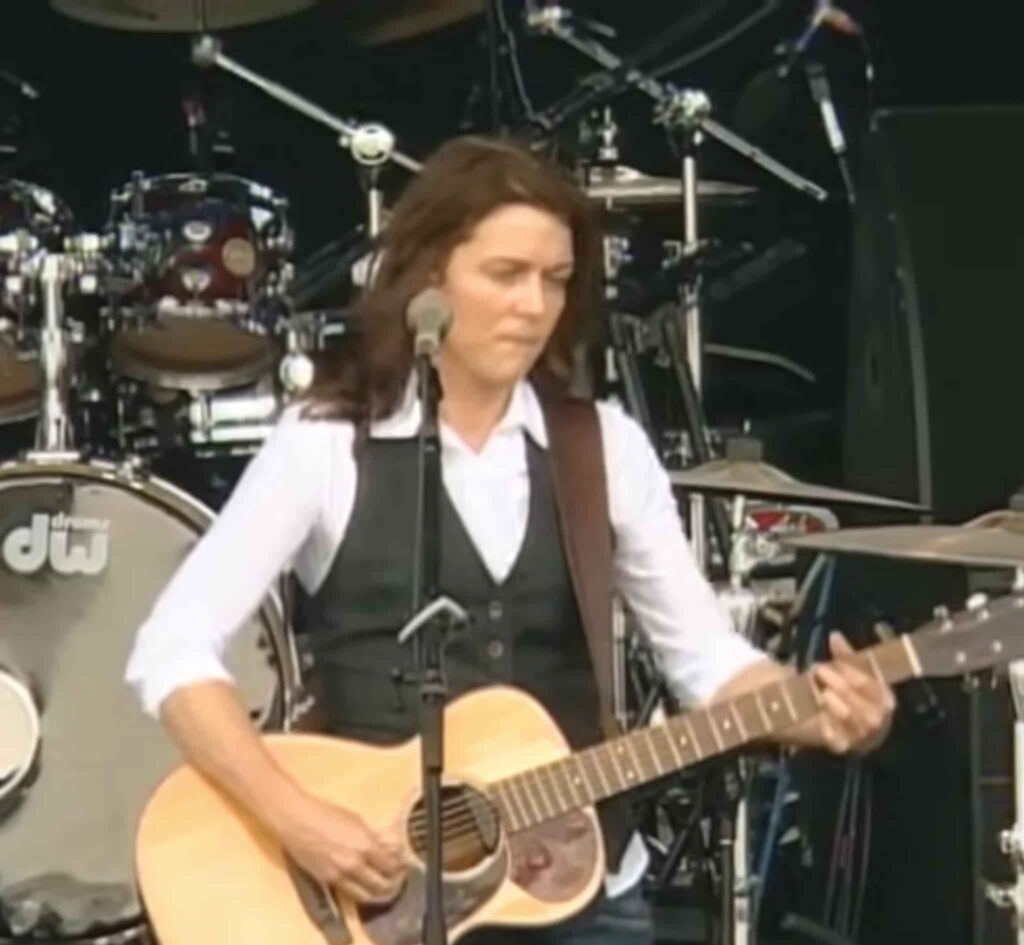
A Voice That Turns “Hallelujah” Into a Quiet Prayer — Brandi Carlile’s Unforgettable Moment at Newport
When Brandi Carlile stepped onto the stage at the Newport Folk Festival in 2008 and began singing Hallelujah, the audience heard something more than a cover. It was a moment where generations of folk tradition seemed to gather in one place — a modern voice carrying the weight of an old song whose journey through history had been long, complicated, and deeply emotional.
The song itself was originally written by Leonard Cohen and released in 1984 on his album Various Positions. Curiously, despite its towering reputation today, the track did not become a commercial success at the time of its release. The album was even rejected by Cohen’s American label, leaving the song largely unnoticed in the United States for several years. It was not a chart hit in its original form. In fact, its true recognition came much later, largely through reinterpretations.
One of the most influential revivals came from Jeff Buckley, whose haunting 1994 recording on the album Grace transformed the song into a spiritual and emotional centerpiece of modern music. Buckley’s version eventually reached No. 2 on the UK Singles Chart in 2008 after his tragic death had already cemented his legend. By then, “Hallelujah” had already begun its remarkable evolution into one of the most covered songs in contemporary music history.
By the time Brandi Carlile performed it at Newport in 2008, the song had become something almost sacred among songwriters and folk musicians.
And Newport was exactly the right place for such a moment.
Since its founding in 1959, the Newport Folk Festival has been a gathering ground for artists who believe in the power of storytelling through music. Legends such as Bob Dylan, Joan Baez, and Johnny Cash had already shaped the festival’s legacy decades earlier. Performing there means stepping into a living history.
Carlile was still early in her career then, having recently gained attention through her 2007 breakthrough album The Story. That record introduced her powerful voice — a voice capable of moving from quiet vulnerability to soaring emotional peaks in a single breath. It made her one of the most promising new voices in Americana and folk music.
Yet at Newport, rather than showcasing her own material, she chose to interpret a song already filled with layers of meaning.
That decision revealed something important about Carlile as an artist: she treats songs as living stories, not simply performances.
Her interpretation of “Hallelujah” leaned into the song’s spiritual ambiguity — a hallmark of Cohen’s writing. The lyrics famously weave together biblical imagery and human longing: King David’s harp, Samson and Delilah, broken love, and fragile faith. Cohen once wrote nearly eighty verses while crafting the song, constantly refining its balance between sacred reverence and earthly sorrow.
Carlile approached those words with restraint and respect.
Her performance avoided theatrical excess. Instead, it felt intimate, almost reflective — as though she were singing to the song itself rather than to the crowd. That quality gave the moment a quiet gravity. Listeners could feel the lineage of the song moving through time: from Cohen’s poetic solitude to Buckley’s haunting fragility and now into Carlile’s soulful warmth.
What makes this performance memorable is not technical perfection, but emotional honesty.
There is a certain maturity in the way Carlile allows the melody to breathe. She does not rush the phrases. She lingers where the song aches the most. And when the word “Hallelujah” arrives — repeated like a gentle confession — it carries the feeling that Cohen always intended: not a triumphant shout, but a humble acknowledgment of life’s contradictions.
A broken hallelujah.
By 2008, the song had already traveled across decades, continents, and countless interpretations. Yet in that moment at Newport, Carlile reminded listeners why songs endure: because every generation finds a new truth inside them.
And for those who heard her sing that evening by the Rhode Island shoreline, it felt as if time itself had paused — just long enough for one beautiful, aching word to echo again.
 Oldies Songs