
The Night a Simple Song Became a Cultural Shockwave: Roy Orbison and “Oh, Pretty Woman” in 1964
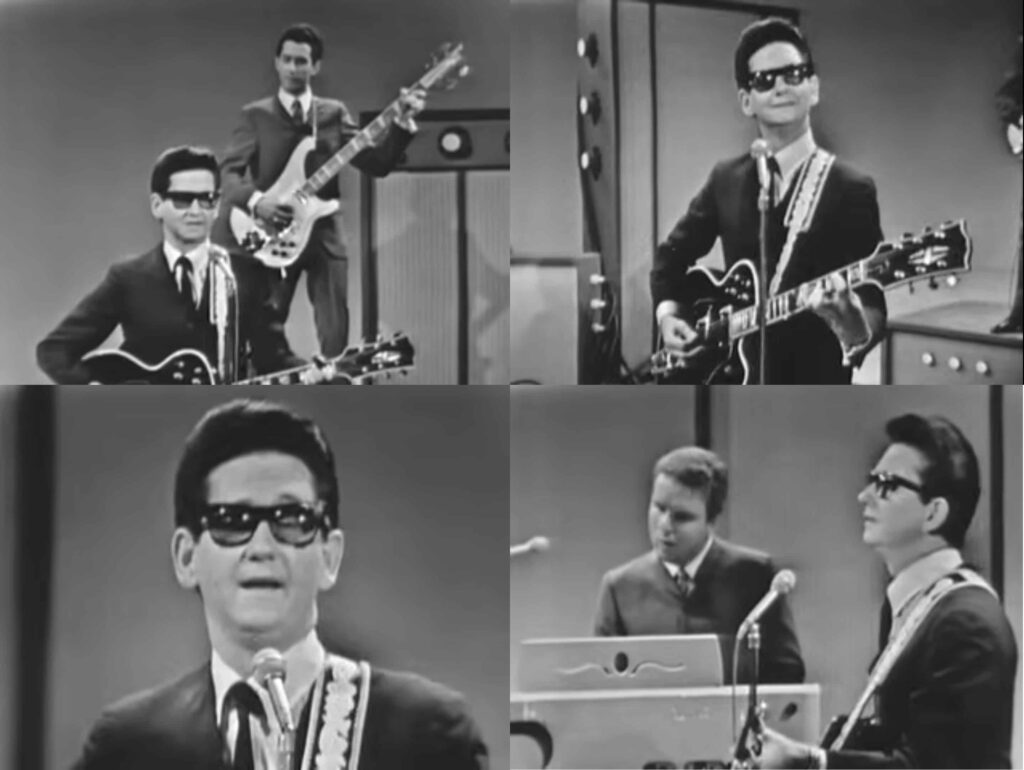
On October 11, 1964, the stage of The Ed Sullivan Show welcomed a man whose quiet presence contrasted sharply with the storm he had created on the charts. Introduced as the number one sensation on both sides of the Atlantic, Roy Orbison stepped forward to perform “Oh, Pretty Woman”, a song that had already begun reshaping the sound of popular music.
From the first line, the impact was immediate. There was no elaborate staging, no theatrical movement. Orbison stood almost still, dressed in black, his dark glasses reflecting the studio lights. Yet the voice carried everything. Rich, soaring, and unmistakably his, it turned a seemingly simple street encounter into something cinematic.
“Oh, Pretty Woman” was more than a catchy melody. Built on a driving rhythm and punctuated by that now iconic guitar riff, the song captured a fleeting moment of desire and uncertainty. When Orbison sang “I don’t believe you, you’re not the truth,” it felt less like flirtation and more like disbelief at beauty itself. That emotional layering, so characteristic of his work, elevated the song beyond its surface charm.
The performance unfolded with a natural tension. As the lyrics moved from confidence to doubt, from invitation to resignation, the audience followed every turn. Then came the twist. Just as the narrator accepts rejection and prepares to walk away, the story shifts. “What do I see?” Orbison sings, and suddenly hope returns. It is a small narrative arc, but in his hands, it felt profound.
What made that night enduring was not just the song’s popularity, but the way Roy Orbison delivered it. At a time when rock and roll was increasingly defined by energy and rebellion, he offered restraint. He did not chase attention. He commanded it quietly.
Looking back, this appearance stands as a defining television moment of the 1960s. “Oh, Pretty Woman” would go on to become one of the most recognizable songs in music history, but on that stage, it was still fresh, still unfolding. And in those few minutes, Roy Orbison proved that sometimes the most powerful performances are the ones that do not need to shout to be heard.
 Oldies Songs