
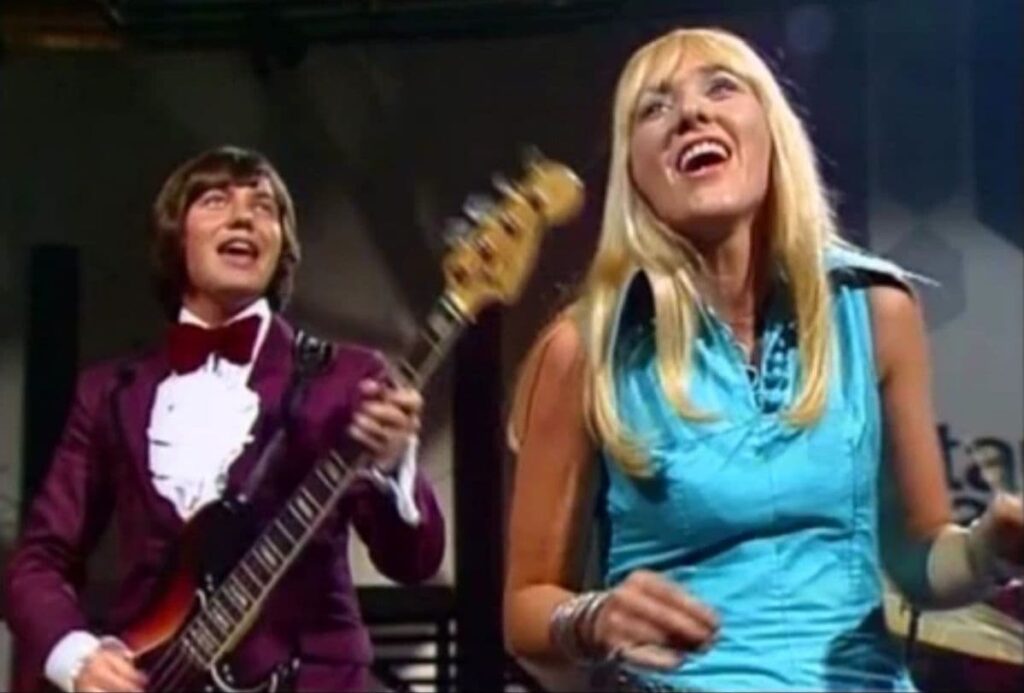
A Bright Pop Anthem About Dreams, Youth, and the Charm of an Imagined American City
When “Sacramento (A Wonderful Town)” by Middle Of The Road burst onto the airwaves in early 1972, it carried with it a feeling that was both lighthearted and strangely wistful. At first glance, the song seemed like a cheerful postcard from a distant city in the American West. Yet behind its upbeat melody and catchy chorus lay something deeper—a European band dreaming about America, about opportunity, and about the kind of place where life might feel just a little brighter.
Released in February 1972 as a single from the album “Acceleration”, the song quickly became one of the most recognizable hits of Middle Of The Road, the Scottish pop group fronted by the warm and distinctive voice of Sally Carr. Commercially, it was an undeniable success across continental Europe. The record climbed to No. 1 in West Germany, No. 1 in Switzerland, and reached No. 2 in Austria and No. 2 in Norway, while also performing strongly in several other European markets. Although it did not chart significantly in the United Kingdom or the United States, its popularity across Europe made it one of the band’s signature songs and a staple of early-1970s radio.
The story behind “Sacramento (A Wonderful Town)” begins with the songwriting and production team Giorgio Moroder and Pete Bellotte, who at the time were working extensively with Middle Of The Road in Munich. Long before Moroder became famous as the pioneering force behind electronic disco in the late 1970s, he was already crafting polished pop songs that blended European sensibilities with American imagery.
The idea of writing about Sacramento, the capital city of California, was not necessarily about the real place itself. Instead, the city functioned almost like a symbol—an imagined destination representing sunshine, freedom, and the promise of a new life. For European listeners in the early 1970s, America still held a powerful mystique. Cities like San Francisco, Los Angeles, and Sacramento felt like distant stages where dreams could unfold.
Musically, the song reflects the polished pop production typical of Moroder’s early work. Its arrangement is bright and efficient: crisp drums, buoyant guitar lines, and a melody that moves with effortless optimism. The chorus, with its repeating declaration—“Sacramento, a wonderful town”—is instantly memorable, designed to linger in the listener’s mind long after the record stops spinning.
But what gives the song its lasting charm is the voice at the center of it all. Sally Carr, whose clear and energetic vocal style defined the sound of Middle Of The Road, delivers the lyrics with an infectious enthusiasm. She sings not with irony, but with genuine delight, as if the city she describes truly exists somewhere just beyond the horizon.
In many ways, “Sacramento (A Wonderful Town)” belongs to a particular moment in pop history. The early 1970s were still close enough to the optimism of the 1960s that pop music often celebrated simple pleasures—places, memories, and the idea that happiness might be waiting somewhere else. Songs like this did not need complex messages. Their power came from melody, atmosphere, and the feeling they left behind.
Over the decades, the song has continued to evoke that gentle sense of nostalgia. For those who remember hearing it on radio stations or jukeboxes in the early seventies, it recalls a time when pop music carried a certain innocence—when a three-minute song could paint a picture of a faraway city and make it feel welcoming.
Today, “Sacramento (A Wonderful Town)” remains one of the defining recordings of Middle Of The Road, standing alongside hits like “Chirpy Chirpy Cheep Cheep” and “Soley Soley.” While trends in music have shifted countless times since its release, the song’s bright melody and hopeful spirit still resonate.
It reminds us that sometimes the most enduring songs are not the ones that try to say everything—but the ones that capture a feeling. In this case, the simple joy of imagining a wonderful town somewhere out there, waiting to be discovered.
 Oldies Songs